Expressvpn Glossary
Cloud networking
What is cloud networking?
Cloud networking is an IT infrastructure model in which network resources are delivered through cloud-based services rather than physical, on-premises hardware. These resources can include virtual routers, firewalls, load balancers, and network management tools, all made available through an internet connection.
The goal of cloud networking is to simplify network operations and improve scalability while reducing reliance on dedicated hardware.
Unlike traditional networks, which require organizations to purchase, deploy, and maintain physical equipment, cloud networking allows components to be provisioned, adjusted, or removed as needed.
How cloud networking works
Cloud networking delivers network infrastructure and management through cloud-based platforms instead of physical hardware. This is made possible through virtualization, a technology that allows multiple virtual resources to run on shared physical infrastructure. Using software, cloud providers create virtual versions of networking components, including routers, switches, and firewalls.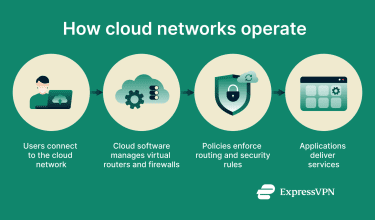
Cloud networks are typically managed through a centralized controller that provides visibility into network configuration and performance. This management layer is usually accessed through a web-based interface, allowing teams to configure policies, monitor traffic, and adjust resources from a single dashboard. Application programming interfaces (APIs) also play a role by enabling automated communication between cloud services, applications, and network components.
Benefits of cloud networking
Cloud networking can reduce upfront infrastructure costs by removing the need to purchase and maintain on-premises networking hardware.
Cloud networking also improves scalability and flexibility. Network resources can be scaled up or down quickly to match demand, and many cloud platforms support automated scaling that adjusts capacity based on traffic or workload conditions.
Security capabilities can also improve when networking is centralized in the cloud. Cloud providers offer built-in visibility tools, logging, and monitoring that help teams assess network activity and detect issues more efficiently. Cloud networking commonly integrates with identity and access management (IAM) systems when users or devices attempt to connect, allowing organizations to control who can access specific network resources and services.
Common uses of cloud networking
One common use of cloud networking is enabling remote access to corporate resources. In these cases, organizations often rely on cloud-based virtual private networks (VPNs) to provide employees with secure, encrypted connections to internal applications and systems.
Another common use is centralized network security enforcement. Cloud-hosted firewalls, often referred to as Firewall-as-a-Service (FWaaS), allow organizations to apply and manage security policies consistently across users, devices, and locations without relying on on-site firewall hardware.
Cloud networking is also commonly used to manage wireless networks at scale. With cloud-managed Wi-Fi, organizations deploy physical access points locally while using cloud-based platforms to configure, monitor, and update wireless networks centrally across multiple sites.
Cloud networking vs. traditional networking
Cloud networking and traditional networking differ primarily in how network infrastructure is deployed, managed, and scaled.
Cloud networks are managed through cloud-based platforms and configured remotely using software interfaces rather than direct physical access to equipment. Network capacity can typically be scaled up or down quickly without installing new hardware. Cloud networking also makes it easier to deploy and manage networks across multiple geographic regions from a single control plane.
Traditional networks rely on on-site physical hardware, such as routers, switches, and firewalls, deployed at each location. Organizations are responsible for purchasing, installing, and maintaining this equipment. Scaling a traditional network usually requires additional hardware and manual configuration. Network reach is generally constrained by the locations where infrastructure has been physically deployed.
Security considerations in cloud networking
Cloud networking introduces security requirements that organizations must actively manage. One core consideration is identity and access control, which helps ensure that only authenticated and authorized users can access network resources.
Data encryption is also essential. Information should be protected both in transit and at rest to reduce the exposure risk if systems are compromised.
Secure configuration is another important area. Cloud environments are highly configurable, and misconfigurations can unintentionally expose data.
Further reading
- How data leaks are fueling the surge in identity theft cases
- Why your old email is a goldmine for hackers
- Protect your privacy: A guide to data removal services
- Protect your personal data with Identity Defender
FAQ
Is cloud networking secure?
What is the difference between cloud networking and cloud computing?
Do home users rely on cloud networking?
Is cloud networking used for VPN services?
Can cloud networking replace all traditional hardware?
However, some physical infrastructure is still required. Devices such as user endpoints, local network equipment, and edge connections are needed to connect users and locations to cloud services. As a result, cloud networking typically reduces, rather than fully eliminates, the need for traditional hardware.