Expressvpn Glossary
Cellular network
What is a cellular network?
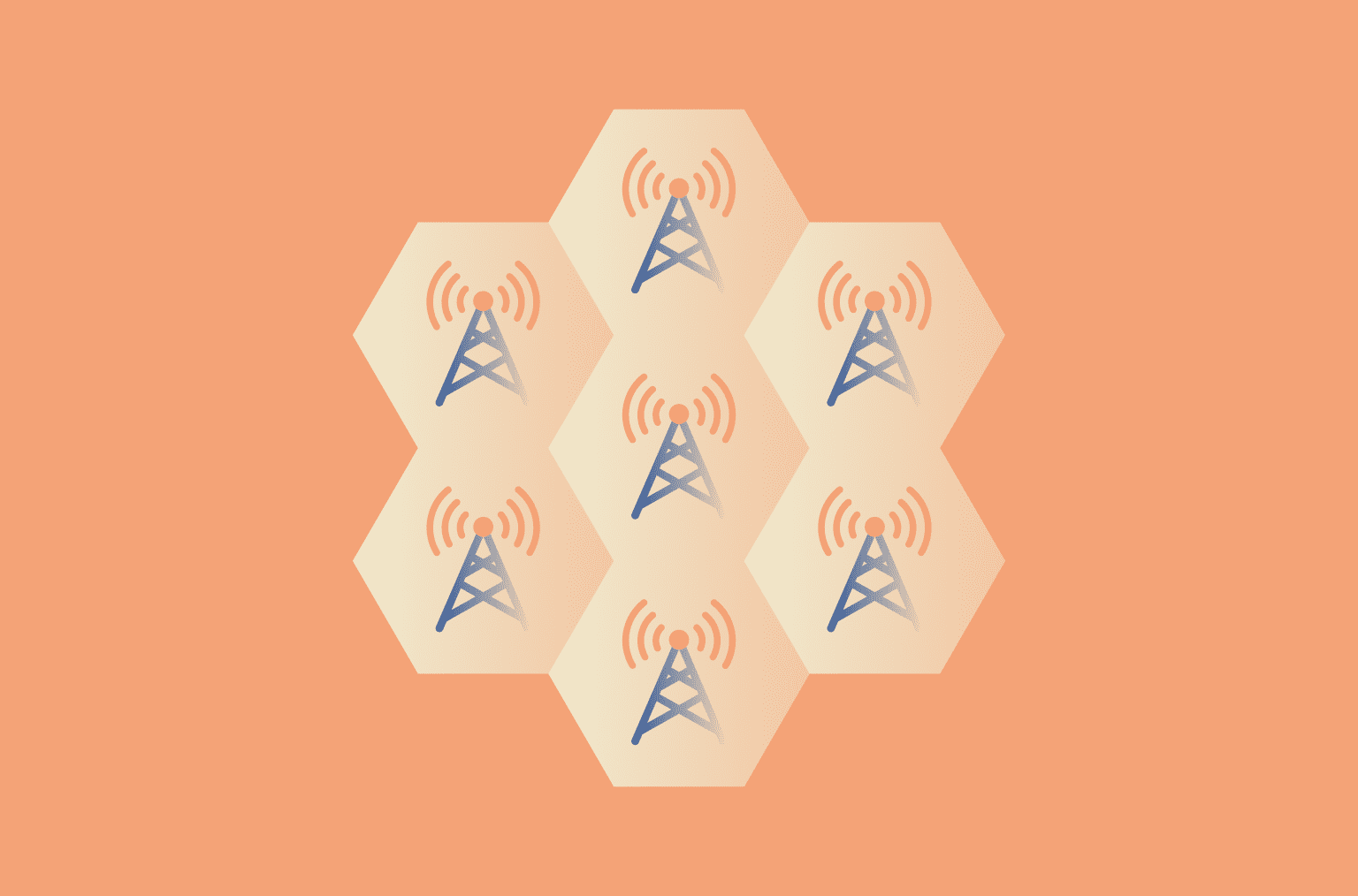
A cellular network is a wireless communication system that connects mobile devices to nearby cell towers (many people use this term, though the technical terms are "cell site" or "base station"). Each site provides coverage for a specific geographic area called a cell.
The network divides coverage into cells (which may overlap at the edges) to support large numbers of users and maintain connections as devices move. This infrastructure enables voice calls, text messaging, and mobile data.
How does a cellular network work?
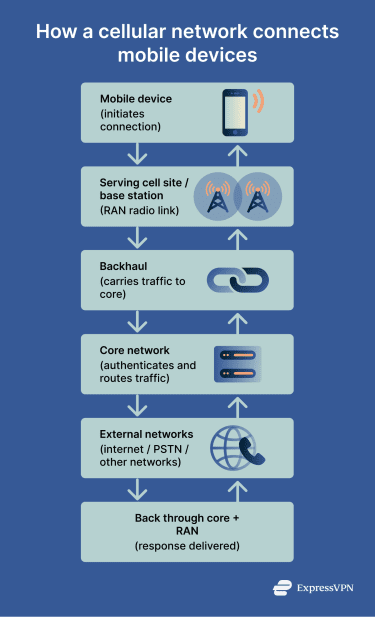 A cellular network connects mobile devices to a serving cell site using radio signals. When a phone makes a call, sends a message, or uses mobile data, it transmits wirelessly to the serving cell site, which acts as the entry point into the network.
From there, traffic is carried over backhaul links into the operator’s core network, which handles functions such as authentication and routing to deliver calls, messages, and data to their destinations. As the device moves, the network can hand over the connection to another cell to maintain service.
Key components of a cellular network
A cellular network relies on several core components:
- User equipment: Devices such as smartphones, tablets, and Internet of Things (IoT) sensors that send and receive data over cellular networks.
- Radio access network (RAN): Base stations (cell sites) and radio infrastructure that connect user equipment to the core network.
- Backhaul infrastructure: High-capacity connections (fiber optic, microwave, or satellite links) that carry traffic between the cell sites and the core network.
- Core network: Central systems that manage authentication, routing, and connectivity, directing calls, messages, and data between devices and external networks.
Benefits of cellular networks
Cellular networks offer several key benefits:
- Wide-area coverage: Supports connectivity across cities, rural regions, and national networks.
- Mobility: Maintains connections as devices move by switching between cells/cell sites.
- High-speed data transfer: Modern standards like 4G and 5G enable faster data transfer speeds and higher network capacity.
- IoT support: Connects large numbers of devices, including sensors and smart systems, across wide areas.
- Built-in authentication: Uses SIM-based authentication to control network access more effectively than open wireless networks.
Limitations and security considerations of cellular networks
While cellular networks offer broad coverage and mobility, they also have limitations and security risks to consider:
- Cell-site spoofing: Fake base stations can capture the International Mobile Subscriber Identity (IMSI) and other identifiers and may enable interception in some scenarios.
- Metadata tracking: Operators can generate logs (e.g., for operations/billing/compliance) that may include device identifiers, connection times, and location-related data.
- Signal congestion: High device density can reduce connection quality and speed in crowded areas.
- Coverage gaps: Cellular service depends on physical infrastructure, which may be limited or unavailable in rural areas.
- Weak encryption on legacy networks: Older standards like 2G use weaker mechanisms (including a lack of mutual authentication), making traffic and identifiers easier to target.
Types of cellular networks
Cellular networks can be categorized by generation, deployment model, and technology.
Network generations
- 1G: Early cellular technologies were designed primarily for voice communication, with minimal security.
- 2G: Digital cellular technology designed primarily for voice and texting, with known security limitations (and later enhancements for mobile data in some deployments).
- 3G–4G: Expanded mobile broadband data services and capacity, enabling richer web access, apps, and multimedia communication.
- 5G: Delivers higher speeds, lower latency, and greater capacity, with support for IoT use cases at scale.
Public vs. private networks
Public cellular networks are operated by mobile carriers and available to subscribers. Meanwhile, private cellular networks are deployed by organizations for internal use, such as in factories or campuses, for controlled access and specific connectivity needs.
Cellular networks vs. Wi-Fi
Cellular networks and Wi-Fi both provide wireless connectivity but serve different purposes. Cellular networks prioritize wide-area coverage and mobility, while Wi-Fi provides high-speed local connectivity within a limited range.
| Cellular networks | Wi-Fi | |
| Coverage | Wide-area coverage via cell sites | Limited to the range of a local access point |
| Mobility | Designed for hand-off between cells/cell sites | Best suited for stationary or local use |
| Authentication | SIM-based authentication managed by carriers | Network-based authentication (passphrases or enterprise login; sometimes captive portals) |
| Security | Standardized authentication and over-the-air encryption (varies by generation; not end-to-end by default) | Security depends on configuration and encryption standards |
| Typical use | Mobile access across cities or regions | Home, office, or public hotspots |