
Expressvpn Glossary
Biometric security
What is biometric security?
Biometric security refers to the use of biometric technology to control access, monitor environments, prevent threats, and protect people and property. Biometric security systems use traits that are unique to each individual and difficult to replicate.
How does biometric security work?
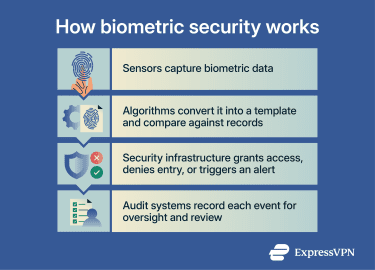
Most biometric security systems share a common architecture, regardless of their specific application:
- Sensors capture biometric data using devices such as cameras, fingerprint readers, microphones, or infrared scanners.
- Processing algorithms then convert the captured data into a digital template. The system extracts key features from the data and evaluates the template against defined criteria.
- Security infrastructure responds to the result of the comparison, for example, granting access, flagging activity, or triggering alerts.
- Audit and monitoring systems record each event and track system activity. This allows organizations to review access attempts, detect unusual behavior, and maintain oversight of the biometric system.
Applications of biometric security systems
Biometric security systems are used in different environments to verify identity and control access using unique biological or behavioral characteristics.
- Physical access control: Biometrics can be used to control entry to buildings or restricted areas by verifying a person’s identity before granting access.
- Device authentication: Biometric verification is commonly used to unlock devices such as smartphones or computers.
- Identity verification: Biometric data can be used to confirm a person’s identity during login, registration, or security checks.
- Surveillance and monitoring: Some systems use biometrics to identify individuals in real time in monitored environments.
- Workforce management: Organizations may use biometric systems to track employee attendance and control workplace access.
Advantages of biometric security systems
Biometric security systems allow organizations to control access to physical and digital environments at scale, for example, at large facilities, border checkpoints, or corporate networks. They also create a digital record, which can help with incident investigation and compliance reporting.
Risks and privacy concerns
Biometric security systems introduce risks that extend beyond the technology itself.
- Regulatory inconsistency: Legal protections for biometric data vary significantly by jurisdiction, which can affect how data is collected, stored, and used.
- Data breach implications: If biometric data or templates are exposed, they may be difficult to replace or revoke compared to passwords or tokens, increasing the long-term impact of a breach.
- False positives and false negatives: Systems may incorrectly match an individual to another person or fail to recognize a legitimate user, which can lead to unauthorized access or denied entry.
- Accuracy variation: System performance can vary depending on factors such as sensor quality, environmental conditions, and how the system was trained or configured.
Further reading
- What is biometrics? A complete guide to modern identity technology
- Biometric data collection around the world
- 2FA vs MFA: Key differences and how to choose the right one
- To log in, just type. How typing biometrics makes life easier
- How hackers can use your fingerprints to frame you