Expressvpn Glossary
Biometric data

What is biometric data?
Biometric data refers to measurable physical or behavioral characteristics that can be used to identify or authenticate an individual. Common examples include fingerprints, facial features, iris patterns, or voice.
How is biometric data collected and processed?
Biometric data is collected through sensors that capture a specific physical or behavioral trait. This can include a camera for facial recognition or a microphone for voice analysis. The captured data is converted into a digital template that stores only the essential features, so the system only keeps the key points needed to distinguish one individual from another.
The template is encrypted and stored either on the device or within a secure authentication system. During verification, the system captures a new sample and compares it with the stored template to determine whether they match.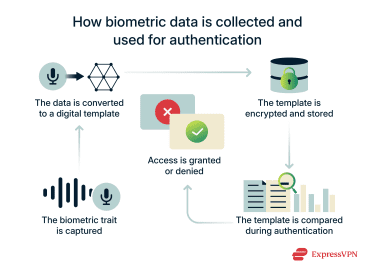
Types of biometric data
Biometric data is often grouped into categories based on how the identifying trait is measured:
- Physiological biometrics: Physical characteristics such as fingerprints, facial features, iris or retina patterns, vein patterns, or hand geometry.
- Behavioral biometrics: Patterns in how a person acts, including typing rhythm, walking gait, touchscreen gestures, or speaking characteristics.
- Multimodal biometrics: Systems that combine two or more biometric traits, such as face and voice, to increase accuracy and reduce false matches.
Common use cases
Biometric data is used across a range of systems that require accurate and convenient identity verification. Common examples include:
- Smartphone and device unlocking: Fingerprint sensors and facial recognition systems provide quick access without passwords or passcodes.
- Workplace and facility access: Organizations use biometric scanners to control entry to secure areas.
- Financial verification: Banks and payment services use biometrics to confirm identity during transactions or account sign-ins.
- Medical identification: Medical facilities use biometrics to match patients with records and support secure access to clinical systems.
Why is biometric data important?
Biometric data is important because it enables strong identity verification using traits that are difficult to replicate. This makes authentication both more secure and more convenient. Biometrics also support zero-trust and identity-based access models by ensuring that access decisions are tied to a verified individual rather than to shared or easily transferable credentials.
Security and privacy considerations
Handling biometric data requires careful attention because it involves sensitive, long-lasting identifiers. Key considerations include:
- Biometric data is highly sensitive: Unlike passwords, biometric traits can’t be changed if exposed. A compromised fingerprint or facial template creates long-term security risks.
- Breaches have a lasting impact: If stored biometric templates are accessed without authorization, attackers could misuse them to impersonate individuals or bypass weak identity checks.
- Protection depends on secure storage: Strong encryption, limited retention, and storing templates locally (rather than on remote servers) can help reduce exposure.
- Regulations govern its use: Laws such as the General Data Protection Regulation (GDPR) and California Consumer Privacy Act (CCPA) classify biometric data as sensitive information, requiring explicit consent, secure handling, and strict access controls.
Further reading
- What are biometrics?
- Biometric data collection around the world
- How typing biometrics could make life easier
FAQ
What are examples of biometric data?
Examples of biometric data include fingerprints, facial features, iris or retina patterns, voice characteristics, typing rhythms, and walking gait.
Is biometric data secure?
Biometric data can be secure when stored and protected properly. Strong encryption, local storage, and strict access controls can help reduce risks.
Is biometric data covered under the General Data Protection Regulation (GDPR)?
Yes. Under the GDPR, biometric data is classified as “special category” data, meaning it’s subject to stricter rules on consent, processing, storage, and access. Organizations must justify why they collect it, limit how long it is kept, and apply appropriate security measures, especially when it is used for uniquely identifying an individual.
Can biometric data be anonymized?
Modern biometric authentication systems convert biometric traits into templates that remove unnecessary details. However, complete anonymization is difficult because the data still represents a unique individual.