Expressvpn Glossary
Application performance monitoring (APM)

What is application performance monitoring (APM)?
Application performance monitoring (APM) is the process of tracking how well an application is running. It uses various software tools and telemetry data to help users verify that apps are running correctly and efficiently. It also helps detect and diagnose any issues that may arise.
How APM tools work
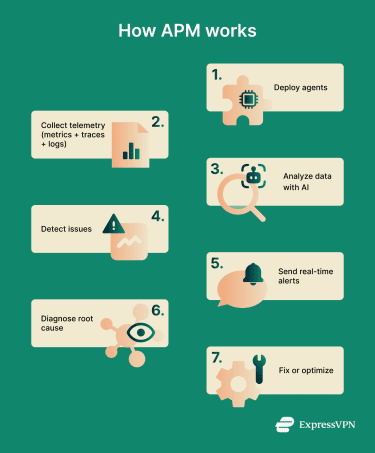 APM tools monitor running apps and collect telemetry on their performance, including response times, CPU usage, and more. The performance data is then analyzed and compared against expected benchmarks to determine how efficiently an application is working.
Real-time monitoring dashboards let users see the results of these monitoring and analytical processes. APM tools can also be configured to send automated alerts for sudden performance dips or technical issues as they occur.
APM tools can track the following performance metrics:
- Throughput (requests or transactions per second).
- Response times and loading speeds.
- Backend and server performance.
- CPU, memory, and network usage statistics.
- Errors and failed requests.
- Database call times.
- User experience and satisfaction metrics.
Why APM matters
APM provides:
- Detection of performance-related problems.
- Data to improve app design, user experiences, and overall reliability.
- Troubleshooting and incident responses.
- Less downtime and fewer service interruptions.
- Resource usage and infrastructure scaling for more efficient functionality.
- Improved security visibility with anomaly detection and insights into potential vulnerabilities.
Security and privacy considerations
APM can introduce security and privacy risks if the monitoring tools or dashboards used aren't properly secured.
Any exposed dashboards could lead to leaks of sensitive application data, such as performance metrics or infrastructure details. APM could also introduce privacy risks, as accumulated app data becomes more difficult to store and manage securely.
Common use cases
APM can be used with most apps, from small mobile apps to established web apps. It helps track performance across various microservice architectures, detecting slowdowns and other issues, and observing cloud-based or containerized environments.
It can also help developers, engineering teams, and other IT professionals fine-tune app designs and optimize resources.
Further reading
- PaaS services explained: Overview, types, and use cases
- What is DevSecOps? Securing software development from the start
- What is OAuth 2.0, and how does it work