Expressvpn Glossary
Simple Network Management Protocol (SNMP)

What is the Simple Network Management Protocol?
The Simple Network Management Protocol (SNMP) is used to collect operational data from devices connected to an IP network. It enables monitoring platforms to track device status, performance, and network conditions across distributed infrastructure.
SNMP provides centralized visibility into networked systems such as routers, switches, servers, and printers. Widely deployed across enterprise networks, data centers, and service provider environments, SNMP gives admins an easy way to monitor the health and status of networked devices.
How does the Simple Network Management Protocol work?
SNMP operates through a monitoring architecture built around managers, device agents, and structured data definitions. A central monitoring platform, often part of a network management system (NMS), communicates with software agents running on devices to retrieve structured management data defined in management information bases (MIBs).
In a typical deployment, the SNMP manager sends requests to agents to retrieve specific data points. Devices can also generate traps, automatic alerts sent out when predefined events (such as link failures or resource thresholds) occur.
Within MIB structures, each object is identified by an object identifier (OID). This allows managers to request specific metrics from a device. In addition to retrieving data, SNMP managers can also use SET operations to modify device configuration parameters on supported agents.
SNMP messages are commonly transmitted using the User Datagram Protocol (UDP), which supports lightweight communication and frequent polling across large networks. SNMP typically uses UDP ports 161 for queries and 162 for traps, though other transport mappings are also used.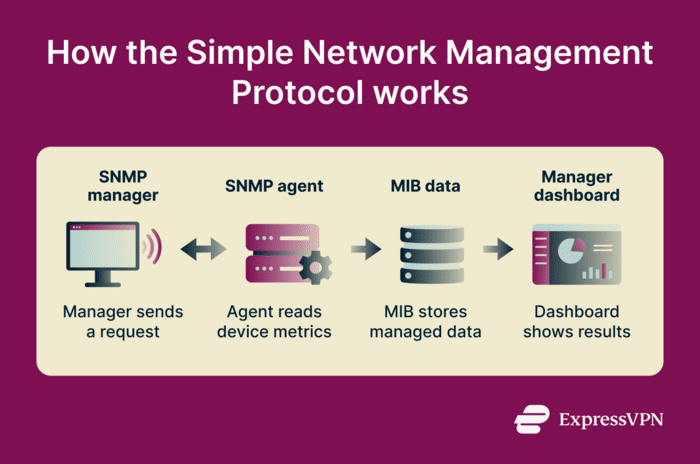
Types of Simple Network Management Protocols
Several versions of SNMP exist, each bringing improvements in performance and security:
- SNMPv1: The original version that introduced the basic protocol structure while providing limited security features.
- SNMPv2c: A community-based version that improved protocol operations, error handling, and bulk data retrieval, making monitoring more efficient, especially on larger networks.
- SNMPv3: A security-focused version that added authentication and optional encryption to protect traffic.
Because it relies on plaintext community strings for access control, SNMPv2c is considered less secure than SNMPv3. Even so, it's still used in some environments for compatibility or operational simplicity, especially where additional network controls are in place.
Why is the Simple Network Management Protocol important?
SNMP helps maintain network reliability and provides admins with operational visibility. Monitoring systems use SNMP data to detect outages, unreachable devices, and performance degradation. Dashboards can track device health indicators such as CPU usage, memory consumption, interface status, and traffic counters.
The collected data supports troubleshooting and capacity planning by providing historical performance metrics. SNMP data can also support broader monitoring and alerting workflows, including some security monitoring use cases.
Many monitoring tools use SNMP for device discovery, inventory, health monitoring, and topology mapping. Some environments also use SNMP SET operations for limited remote configuration on supported devices.
Where is it used?
SNMP is widely supported by networked hardware and software across enterprise and service provider environments.
Common deployments include:
- Routers and switches: Monitor interface status, traffic levels, and hardware health.
- Firewalls and virtual private network (VPN) gateways: Track appliance health, interface activity, and resource or session statistics, depending on the platform.
- Servers and workstations: Collect system metrics, including CPU, memory, and disk usage.
- Printers and Internet of Things (IoT) devices: Report device status, availability, and operational alerts.
- Data centers and enterprise infrastructure: Provide centralized monitoring across large networks.
Because SNMP works across heterogeneous devices and vendors, it remains one of the most widely adopted monitoring mechanisms in IP networks.
Risks and privacy concerns
While SNMP enables effective monitoring, incorrect configuration can introduce security and privacy risks. Several factors can contribute to increased exposure:
- Older versions lack strong security: SNMPv1 and SNMPv2c rely on plaintext community strings rather than robust security mechanisms.
- Community strings can be exposed: Default, weak, or sniffed strings may allow unauthorized access to device information.
- Write access can be abused: Unauthorized reconfiguration may disrupt network operations or weaken security controls.
- Misconfigurations can leak device data: Incorrect settings may expose interface details, routing information, and other system metrics.
- Attackers may map internal networks: SNMP responses can reveal network topology and device structure useful for reconnaissance.
- SNMPv3 reduces major security risks: Authentication, optional encryption, and stronger access controls provide better protection when properly configured.
SNMP has also been exploited in reflection and amplification attacks. Internet-accessible devices can respond to spoofed requests, which can contribute to distributed denial-of-service (DoS) attacks.
Further reading
- What are network protocols? A complete guide
- TCP vs. UDP: Understanding the key differences and best use cases
- Network configuration management for secure networks
- What is network discovery? How to enable it safely
- What is network mapping? Complete guide