
Expressvpn Glossary
Security through obscurity

What is security through obscurity?
Security through obscurity is the practice of hiding system details, such as URLs, configurations, or internal logic, in the hope that attackers won’t find them.
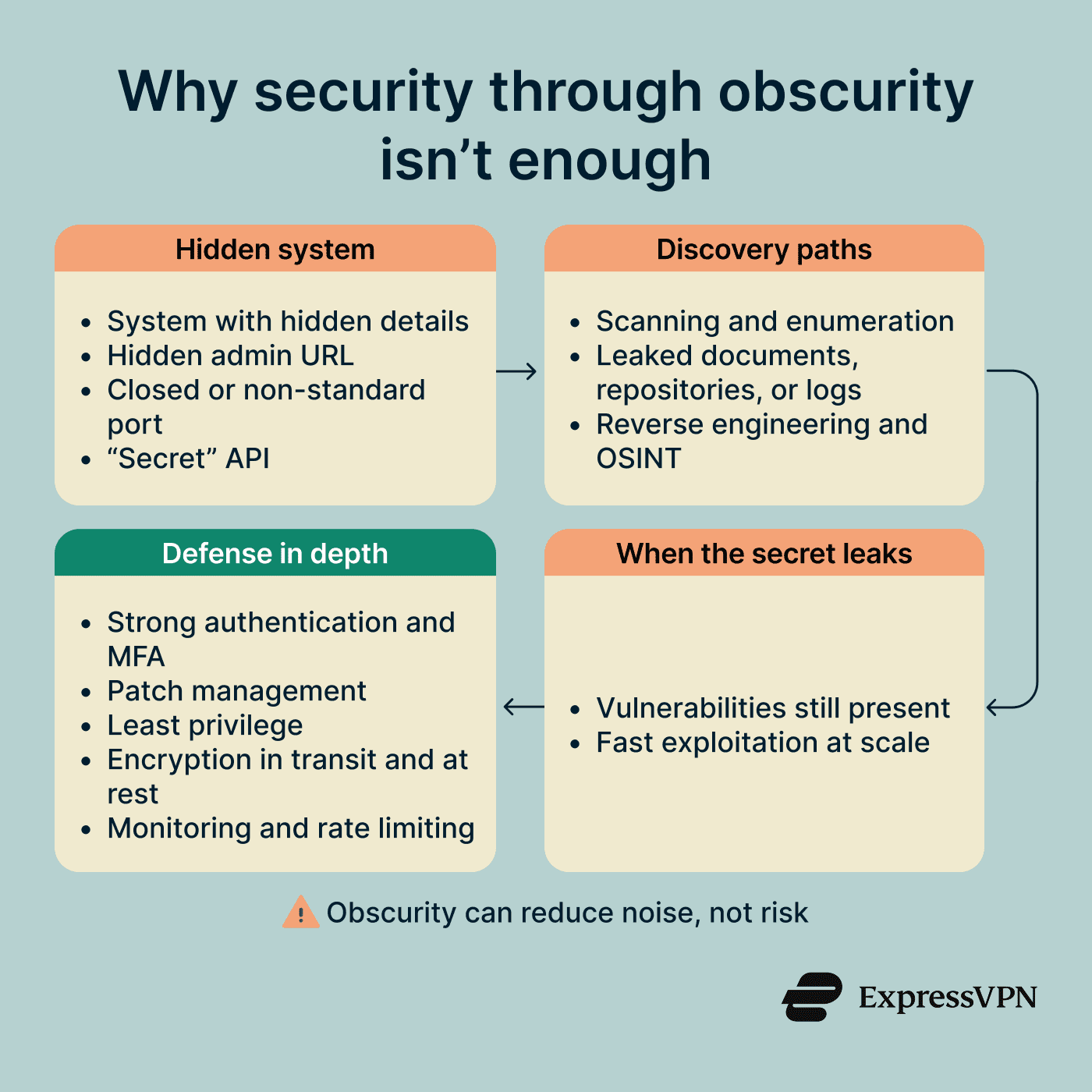
Security through obscurity is not considered a reliable security strategy on its own. At best, obscurity adds a small amount of friction. It does not fix underlying vulnerabilities, and it fails as soon as hidden details are discovered.
Modern security approaches, like defense-in-depth and secure-by-design, assume attackers can see how a system works. They rely on strong controls like authentication, encryption, and access restrictions that remain effective even when system details are known.
How does security through obscurity work?
Security through obscurity reduces visibility rather than strengthening defenses. Common tactics include:
- Hiding admin interfaces behind unguessable URLs.
- Using non-standard ports.
- Keeping APIs undocumented.
- Avoiding public documentation of system behavior.
This approach assumes attackers won’t discover these hidden elements. In practice, however, attackers can use:
- Automated scanners and crawlers.
- Leaked credentials or code.
- Misconfigured cloud resources.
- Public logs or metadata.
If a hidden component is discovered, any underlying weakness remains fully exploitable.
Risks and privacy concerns of security through obscurity
Relying on obscurity can introduce the following risks:
- False sense of security: Teams may skip essential controls (like multi-factor authentication (MFA) or encryption) because systems are "hidden."
- Rapid discovery: Automated scanning tools can quickly map large attack surfaces, including non-standard endpoints.
- Weaker incident response: Undocumented or hidden components make systems harder to audit, monitor, and secure.
Further reading
- What is an open port? A guide to network vulnerabilities
- How to encrypt your internet traffic and protect your privacy
- Zero trust network access (ZTNA) explained
- 2FA vs MFA: Key differences and how to choose the right one
- Cybersecurity vulnerabilities explained