
Expressvpn Glossary
Secure connection
What is a secure connection?
A secure connection is an encrypted link between devices or systems. It protects data in transit by converting it from plaintext into a scrambled format that only authorized parties can read. This helps ensure that sensitive information, such as passwords, messages, or payment details, remains private during transmission.
How does a secure connection work?
When a device connects to a website or service, it establishes a secure connection before any data is exchanged. The exact process depends on the protocol being used.
In Transport Layer Security (TLS), the most common security protocol for web traffic, the device and server begin with a TLS handshake. The device first sends a list of supported encryption methods, and the server selects one that both sides can use.
The server then presents a digital certificate, issued through public-key infrastructure (PKI), to prove its identity and allow the device to verify that it’s legitimate.
Once verified, both parties generate a shared session key. This key is used to encrypt data for that session.
After the connection is established, all data transmitted between the device and server is encrypted in real time, protecting it as it travels across networks.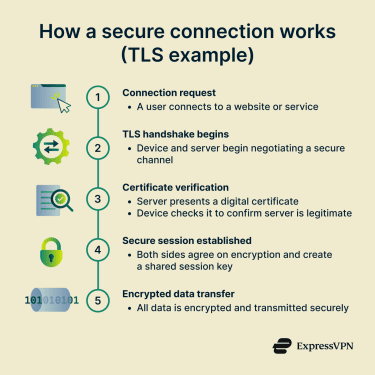
Why is a secure connection important?
Without a secure connection, data traveling across a network can be read by attackers if intercepted.
On public Wi-Fi networks attackers on the same network can potentially monitor unencrypted traffic through packet sniffing and man-in-the-middle (MITM) attacks. A secure connection makes that data unreadable.
Secure connections also help verify that information arrives at its destination without being altered along the way. This is especially important for sensitive transactions like online banking, shopping, messaging, and accessing work systems remotely.
Additionally, secure connections help build trust in digital services by giving users more confidence that their data is protected.
Where is it used?
Secure connections are used across many everyday online services to protect data in transit. Common use cases include:
- HTTPS websites and web apps: When “https://” appears in a browser’s address bar, a secure connection is active, protecting data exchanged between the device and the website.
- Virtual private network (VPN) tunnels and remote access: A VPN creates an encrypted tunnel between a device and a VPN server, securing all traffic that passes through it.
- Messaging and email services: Secure connections protect the contents of communications as they travel between sender and recipient.
- Online banking and payments: Financial platforms use secure connections to safeguard account and transaction data.
- Cloud platforms and APIs: When apps communicate with remote servers or exchange data in the background, secure connections help keep that information protected throughout the process.
Risks and privacy concerns
While a secure connection helps protect data in transit, its effectiveness depends on how it’s implemented. Misconfigured encryption settings or outdated protocols can weaken protection, which can increase the risk of attackers exploiting vulnerabilities.
Another risk involves fraudulent or compromised digital certificates. If an attacker obtains a fraudulent certificate, they may be able to impersonate a legitimate server and intercept traffic.
Secure connections don’t make online activity completely private, either. Certain metadata, such as visited domains, IP addresses, connection timing, and the amount of data transferred, may still be visible to internet service providers (ISPs) or network operators.
User behavior can also weaken the benefits of a secure connection. Ignoring browser warnings and connecting to untrusted networks can expose users to risks that encryption alone can’t prevent.
Further reading
- HTTPS vs. VPN: What’s the difference, and do you need both?
- What is TLS encryption, and how does it protect your data?
- How to encrypt your internet traffic and protect your privacy
- HTTP vs. HTTPS: How to choose the secure option for your site
- SSL vs. TLS: Key differences and why TLS is better
- HTTPS Everywhere: What is it, and can you use it today?