Expressvpn Glossary
Rotating proxy
What is a rotating proxy?
A rotating proxy is a proxy service that automatically changes the IP address used for outgoing traffic. This may happen at set intervals, with each new connection, or after a certain number of requests. By cycling through different IPs, rotating proxy users can reduce repeated traffic from a single IP and make IP-based tracking, rate limiting, or blocking harder.
How does a rotating proxy work?
All proxies route user traffic through an intermediary server before forwarding it on to the destination. The requested data then passes back through the proxy before reaching the client device. This changes the IP address that the destination server sees.
With a rotating proxy, users often connect to a single proxy gateway or endpoint, while the provider assigns different exit IP addresses from a pool. Depending on the service, these IPs may come from data centers, internet service providers (ISPs), residential, or mobile proxy networks.
Depending on the service, users may have the option to enable either interval- or request-based IP rotation. Interval-based rotation changes the IP after a set period, such as every 5 or 10 minutes. Request-based rotation changes the IP after each request or after a set number of requests.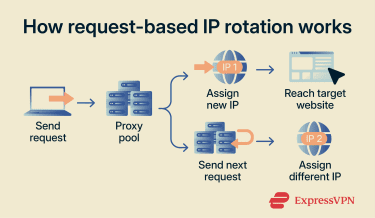
Why is a rotating proxy important?
The main benefits of using a rotating proxy are masking the original IP address and reducing repeated requests from a single IP.
Conventional proxies mask the user’s real IP address with the proxy server's IP address. But if the same proxy IP is used for long enough, websites and online services may still be able to link activity through IP-based patterns. A rotating proxy can make IP-based tracking harder, but it doesn't prevent other forms of tracking, such as cookies, account logins, or browser fingerprinting.
When websites or online services receive too many requests from the same IP address within a set period, they may temporarily block or limit requests from that IP. This helps protect servers and users from abuse.
Rate limiting is a legitimate security measure used to reduce malicious or excessive activity, including brute-force attacks, denial-of-service (DoS) attempts, and excessive API calls. However, it may also affect legitimate high-volume activities. For example, web scraping, ad verification, price monitoring, and large-scale testing may rely on proxies, provided they're used lawfully and in line with the target service’s terms.
Where is it used?
Rotating proxies are often used for the same broad purposes as other proxies, especially when traffic needs to appear from different IP addresses or locations. Common legitimate use cases include:
- Web data collection: Gathering publicly available information from websites and search engines at scale.
- Ad verification: Checking whether ads perform or display correctly across different locations, devices, or networks.
- Price monitoring: Tracking competitor pricing, product availability, or market changes across sites and regions.
- Cybersecurity research: Supporting threat intelligence, fraud detection, and authorized security testing across different network locations.
- Account management and testing: Managing authorized accounts, testing regional experiences, or separating business workflows with distinct IPs.
Risks and privacy concerns
Despite some privacy benefits, there are still potential risks attached to using rotating proxies, including:
- Proxy operators may monitor, track, or log traffic metadata and unencrypted activity that passes through their servers.
- Free or disreputable proxies may collect user data, inject unwanted ads, or redirect users to malicious sites.
- Overuse or misuse of rotating proxies may still trigger abuse detection, account checks, or IP/device restrictions.
- Not all residential IPs are sourced with clear user consent, raising ethical, reliability, and security concerns.
- Proxies generally provide less comprehensive traffic protection than virtual private networks (VPNs); they may not encrypt all device traffic, though HTTPS can still protect content sent between the browser and the destination website.
Further reading
- What is IP rotation, and how does it work?
- What is a proxy server?
- What are anonymous proxies, and how do they work?
- What is a transparent proxy? A complete guide
- What is a VPN proxy, and why do I need one?