Expressvpn Glossary
Point-to-Point Protocol (PPP)
What is the Point-to-Point Protocol?
Point-to-Point Protocol (PPP) is a network protocol used to establish a direct connection between two devices over a point-to-point link. It manages the connection so that devices can start a session, exchange data, and end it properly.
PPP can run over serial links and older dial-up phone lines, and it's also used over some broadband access technologies. It matters because it provides a standard way for two devices to communicate reliably over a direct connection.
How does Point-to-Point Protocol work?
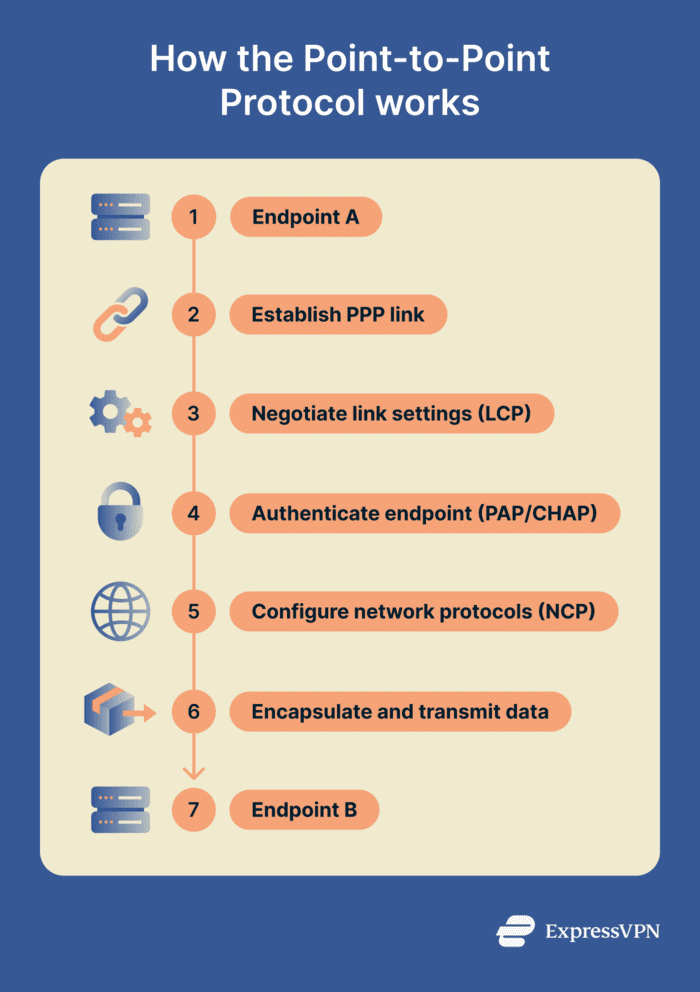
A PPP connection follows several stages:
- Establishing the link: PPP operates at the data link layer of the Open Systems Interconnection (OSI) model and manages communication before network traffic begins. The two endpoint devices open the connection and confirm the link is active.
- Negotiating the connection: Link Control Protocol (LCP) determines how the connection will operate, including link settings, packet size limits, link testing, and authentication requirements.
- Authenticating endpoints: If authentication is enabled, PPP verifies the identity of the connecting device. This often uses Password Authentication Protocol (PAP) or Challenge-Handshake Authentication Protocol (CHAP).
- Configuring the network: Network Control Protocol (NCP) sets the network configuration needed to carry traffic across the link. Different NCPs are used for different network-layer protocols.
- Transmitting data: PPP encapsulates data packets and sends them over the connection.
- Terminating the connection: When the session ends, the devices close the PPP connection.
Why is the Point-to-Point Protocol important?
Earlier point-to-point connection methods could carry data, but PPP introduced a common framework for multiprotocol transport, link establishment and testing, authentication, and network-layer configuration.
This gave network equipment vendors and internet service providers (ISPs) a standard they could implement across different systems. This improved compatibility by allowing devices from different manufacturers to communicate using the same rules.
PPP also supported different types of point-to-point links and features such as Multilink PPP, which bundles multiple physical links into a single logical connection to increase aggregate throughput.
This protocol provided network operators with a structured way to control sessions, making direct links easier to manage, monitor, and troubleshoot.
Where is the Point-to-Point Protocol used?
PPP is still used in some network connections, although it is less common than it was in earlier internet and wide area network (WAN) deployments.
- Dial-up internet: PPP was used in modem-based internet connections, where a computer connected to an ISP server over a telephone line.
- Digital Subscriber Line (DSL) broadband connections: PPP is used in many DSL services through PPP over Ethernet (PPPoE), which allows a router to authenticate with an ISP using account credentials.
- Virtual private network (VPN) tunneling: Protocols such as Point-to-Point Tunneling Protocol (PPTP) and Layer 2 Tunneling Protocol (L2TP) use PPP to carry traffic and support authentication. PPTP is now widely considered obsolete due to known security weaknesses and has been deprecated by major operating system vendors, while L2TP is often combined with Internet Protocol Security (IPsec) for encryption.
- Router-to-router WAN links: PPP is used on leased lines and other direct connections between routers in branch and central office networks.
- Legacy remote access systems: PPP was used on dial-in access servers, allowing employees to connect to corporate networks before modern VPNs became common.
Risks and privacy concerns
PPP can be used securely in some environments, but it has important limitations. It doesn't provide encryption by default, so its security depends on how the connection is configured and what additional protections are used. In some older PPP-based deployments, the added encryption methods are also considered weak by modern standards.
One risk is weak authentication. PAP sends credentials in plaintext, which can expose usernames and passwords if the link is not otherwise protected.
CHAP improves security by avoiding transmission of the shared secret during authentication, but it still relies on a reusable secret stored on both sides of the connection. Microsoft CHAP version 2 (MS-CHAPv2), a more commonly deployed variant in some legacy PPP environments, adds features beyond basic CHAP but has known cryptographic weaknesses that can allow offline credential cracking if captured traffic is analyzed.
Because of these limitations, PPP is not usually considered a secure protocol on its own. Its security depends on the surrounding technologies and configuration.
Further reading
- What is PPPoE? A complete guide
- PPPoE vs. DHCP: Which should you use?
- PPTP VPN: What it is and how it works
- PPTP vs. L2TP: What’s the difference?
- PPTP, L2TP, and a plethora of VPN protocols