
Expressvpn Glossary
Online data storage
What is online data storage?
Online data storage refers to storing data on remote servers, either self-hosted or managed by third-party providers, and accessing it over the internet.
Instead of relying on a local hard drive or external disk, data is uploaded to online infrastructure that can be accessed from any internet-connected device. Services like Google Drive, Dropbox, and iCloud are common examples used by both individuals and businesses.
How does online data storage work?
When a file is uploaded to an online data storage provider, it travels over an internet connection to a remote server in the data center. The provider’s infrastructure stores, manages, and makes that data available when needed.
To reduce the risk of hardware failure and maintain availability, providers typically store copies of data across multiple servers in different locations. Data can then be accessed through a browser or a dedicated app.
Data stored in online storage is typically protected using encryption standards like Advanced Encryption Standard (AES) to help keep it unreadable if systems are compromised. It’s also encrypted in transit using protocols like Transport Layer Security (TLS), which helps prevent interception during transfer.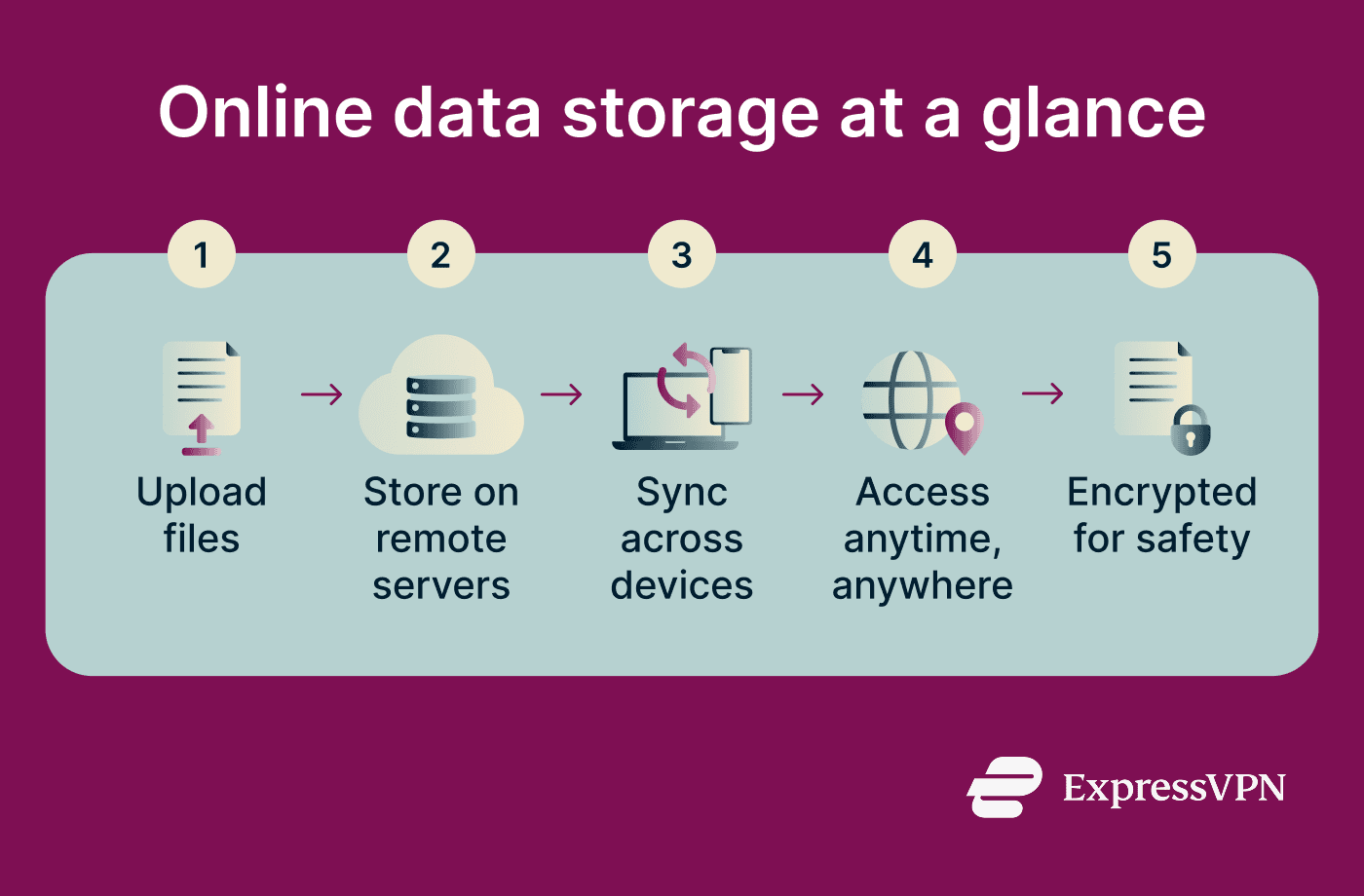
Types of online data storage
Online data storage comes in various types, each suited to different use cases.
- Cloud file storage: Stores files on remote servers managed by a provider, allowing users to access, sync, and share them over the internet.
- Cloud backup storage: Focuses on automatically backing up copies of data for recovery in case of loss or hardware failure and prioritizes restoration over real-time access.
- Object storage service: Stores data as discrete units called objects, each containing the data itself, metadata, and a unique identifier. Objects are stored in flat environments (often called buckets) and accessed via APIs, making object storage well-suited for scalable applications, backups, and large volumes of unstructured data.
- File and block storage: File storage is when data is organized into folders and stored online, while block storage splits files into blocks, assigns each block a unique identifier, and reassembles the complete file when needed. File storage provides simplicity and ease of access, while block storage is effective for working with large amounts of data.
Why is online data storage important?
Online data storage is important because it allows files to be accessed from any internet-connected device, removing the need for external drives or a single machine. It also supports collaboration by letting multiple users work on the same files from different locations at the same time. For example, tools like Google Docs and Google Sheets allow real-time editing and sharing.
It’s also scalable, meaning storage can be increased or reduced based on demand, so users typically only pay for what they use. This makes online data storage a practical option for both individuals and growing organizations.
Risks and privacy concerns
Online data storage can introduce risks if not properly secured. Issues include weak passwords and misconfigured permissions, as these can provide entry points into online data storage services for attackers.
End-to-end encryption (E2EE) and zero-knowledge architecture are critical to ensuring the safety of online data storage. With E2EE, data is encrypted on the user's device before upload, while zero-knowledge architecture ensures that not even the storage provider can access it.
Further reading
- Top cloud services to store photos online (free and paid)
- Apple iCloud alternatives? How about external drives