Expressvpn Glossary
Network ID
What is a network ID?
A network ID is the portion of an IP address that identifies the network a device belongs to. It’s determined by the subnet mask, which separates the network portion from the host portion of the address.
How is a network ID derived?
A network ID is derived by applying the subnet mask to an IP address via a bitwise logical AND operation. Routers and hosts perform this operation by comparing each bit of the IP address against the corresponding bit in the subnet mask; the mask keeps the network portion of the address and sets the host portion to zero.
For example, applying the subnet mask 255.255.255.0 to the IP address 192.168.1.72 zeroes out the final octet, producing the network ID 192.168.1.0.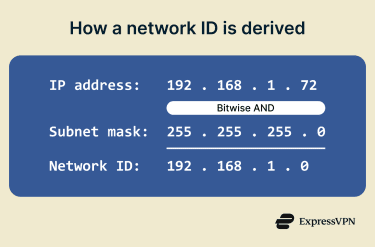
Why is a network ID important?
Network IDs are used in routing, addressing, and network organization.
- Enables accurate packet routing: Network IDs allow routers to deliver data packets to the correct destination using the best path.
- Supports subnetting and segmentation: Subnetting borrows bits from the host ID to extend the network ID and create smaller subnets.
- Prevents address allocation mistakes: Network IDs help avoid IP overlap or duplication.
- Helps organize internal networks: Segmentation based on network IDs helps separate departments and enforce access control.
- Improves network administration clarity: Network IDs help identify issues during troubleshooting to reduce downtime.
Network IDs in IPv6
IPv6 uses 128-bit addresses, divided into eight groups of four hexadecimal digits. For most IPv6 addresses, the first 64 bits represent the network prefix, while the remaining 64 bits represent the interface identifier (the host portion).
Unlike IPv4, IPv6 identifies the network prefix via Classless Inter-Domain Routing (CIDR) prefix lengths (e.g., /48, /64) rather than subnet masks. The prefix can then be further divided, allowing network administrators to create smaller subnets within a network.
Security and privacy concerns
Although network IDs make IP management easier, there are still some security risks to be aware of.
- Misconfigured subnets expose services: Incorrect subnet mask settings or misconfigurations can increase the risk of security breaches, resource exposure, and incorrect traffic flows.
- Flat networks increase attack spread: In flat networks, any two computers can communicate without restrictions, which may increase the attack surface and risk of compromise.
- Poor segmentation weakens containment: Over-segmentation can make management difficult, while under-segmentation increases security risk.
- Reveals internal network structure: If exposed, private IPs can reveal the internal network structure of an organization, allowing attackers to run in-depth reconnaissance.
Further reading
- What are IP address classes? Importance for VPNs and cybersecurity
- What is a subnet? A complete guide to subnetting
- Types of IP addresses explained: Complete guide
- What is my local IP address?
- How to set up a static IP address (step-by-step guide)
- What are non-routable IP addresses?