Expressvpn Glossary
Network database
What is a network database?
A network database is a data model that organizes information as records connected through links, forming a web-like structure. Each record can have multiple relationships with other records, allowing each record to have multiple parent and child records.
How does a network database work?
Data in a network database is stored as records, and relationships between records are represented as direct links called sets. A set defines a relationship between an owner record (parent) and one or more member records (children). Each record contains pointers that connect it to related records within its sets.
A network database navigates to data rather than searching for it. Before any data is entered, a blueprint called a schema is created that defines what types of records exist and exactly how they’re allowed to connect to each other. This creates a fixed map of relationships across the entire database. When data is needed, a program starts from a known record and follows the predefined links through the structure until it reaches its target.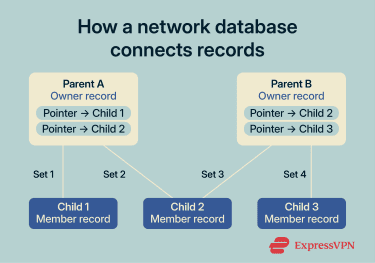
Where is it used?
Network databases are primarily found in legacy systems, as relational databases have become the current standard. Telecommunications, banking, and airline reservation systems are among the sectors that still run systems built on network database models. In these contexts, the cost and complexity of migrating to modern systems often outweigh the benefits, so the original architecture remains in production.
Further reading
- What is a data warehouse?
- What is the CVE database and how does it work?
- What is big data security and privacy?
- Data scraping: What it is and how it works
- What is network-attached storage (NAS)?