
Expressvpn Glossary
Network configuration management (NCM)

What is network configuration management?
Network configuration management (NCM) is the process of organizing, tracking, and controlling the settings and configuration files of network devices, including routers, switches, firewalls, load balancers, and wireless access points. It covers storing device configurations, recording changes, enforcing standards, and restoring previous states when needed.
The core purpose is to maintain network stability, security, and consistency across an infrastructure as it scales or changes over time.
How does network configuration management work?
NCM is usually implemented through a centralized platform or automation system that connects to network devices using standard management protocols and administrative access methods. Simple Network Management Protocol (SNMP) is commonly used for device discovery, inventory, and status polling, while actual configuration retrieval and deployment more often rely on Secure Shell (SSH) command-line access, Network Configuration Protocol (NETCONF), Representational State Transfer Configuration Protocol (RESTCONF), vendor APIs, or automation agents.
The platform authenticates with each device, retrieves the relevant configuration data, such as running, startup, or structured model-driven configuration, and stores it in a versioned repository
The system compares each device's active configuration against a defined baseline: approved standards reflecting security policies or compliance requirements. Deviations (configuration drift) are flagged for review or correction, and changes can be pushed to multiple devices through automated or approval-gated workflows. Each configuration version creates an audit trail and can help teams restore or redeploy a previous configuration if a change causes issues, depending on device support and the type of change.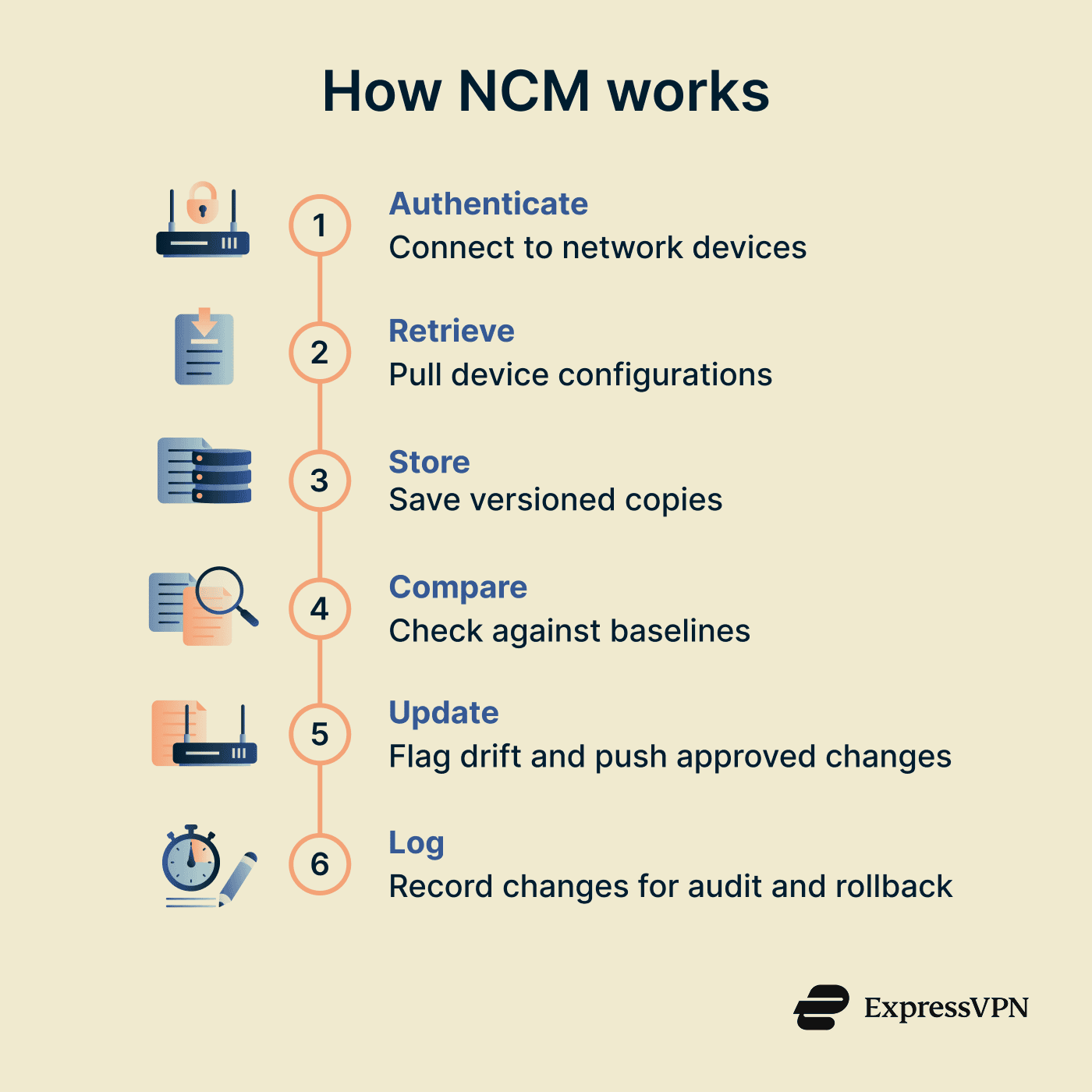
Why is network configuration management important?
NCM helps teams reduce human error by making configuration changes more controlled and consistent across devices. That matters in larger networks, where manual changes can quickly lead to mistakes and inconsistent settings.
It also improves security and supports compliance. Teams can spot unauthorized changes, weak settings, and outdated firmware more easily, while stored configurations and change logs create a useful record for audits and reporting.
NCM can also reduce downtime and improve consistency. Stored backups and version history can speed up recovery after a bad change, while standardized settings help devices perform more reliably across the network. An accurate device inventory supports that work.
Where is network configuration management used?
NCM is used in enterprise IT environments to manage routers, switches, firewalls, and wireless infrastructure across offices and campuses. Data centers and hybrid cloud environments use NCM, automation, or infrastructure-as-code (IaC) tools to keep settings consistent across physical, virtual, and cloud-based infrastructure.
Managed service providers (MSPs) use NCM to manage configurations for multiple clients from a central platform, and telecom and internet service providers (ISPs) use it to maintain large networks supporting customer connectivity.
Limitations of network configuration management
- Tools can be complex: Some platforms take time to set up, learn, and maintain, especially in large or mixed network environments. That’s also true of cloud-based tools, especially in hybrid environments with many device types and change workflows.
- Weak policies create gaps: If teams don’t follow clear rules for change control, approvals, and documentation, important changes can still be missed or mishandled.
- It's only as good as the data it tracks: Outdated inventories, missing backups, or incomplete records can reduce visibility and make recovery harder.
- It doesn't prevent every issue: Configuration management helps control changes, but it cannot fix poor network design, hardware failures, or every security problem on its own.
Further reading
- Network configuration management: A detailed guide
- Network architecture: Building secure and modern networks
- Network topology: Best practices for modern networks
- What is network mapping? Complete guide to tools and best practices
- What are network protocols? A complete guide