Expressvpn Glossary
Internet of Bodies (IoB)

What is the Internet of Bodies?
The Internet of Bodies (IoB) is a network of physical devices connected to, worn on, or implanted in the human body that collect, transmit, and analyze biological data.
How does the Internet of Bodies work?
IoB devices use sensors to continuously monitor biological signals. This data is transmitted wirelessly via Bluetooth, Wi-Fi, or cellular networks to cloud platforms, where it’s stored and processed. Algorithms analyze the data in real time and can trigger predefined actions when certain thresholds or patterns are detected.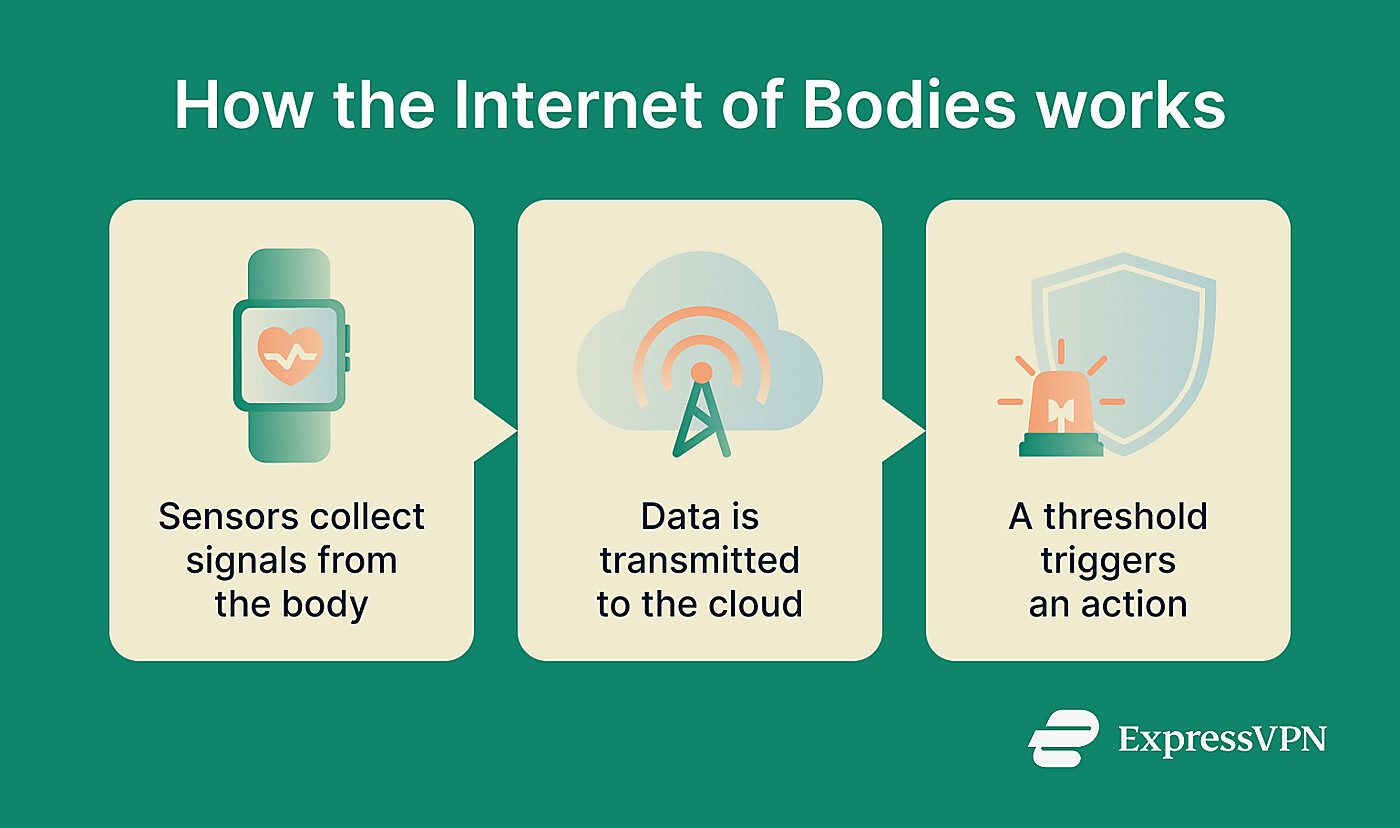
Types of Internet of Bodies
- Wearable devices: Worn outside the body and include smartwatches, fitness bands, patches, hearing devices, and other wearable computers.
- Implantable devices: Placed inside the body, often for medical purposes. Examples include pacemakers, glucose monitors, and neural implants.
- Ingestible devices: Swallowed and used for a limited period to gather internal data. Sensor-enabled capsules are one example.
Why is the Internet of Bodies important?
The IoB enables continuous, real-time health monitoring that was previously only possible in clinical settings. It supports early disease detection, personalized treatment, and remote patient care. Beyond healthcare, it has applications in workplace safety, athletic performance, and human-computer interaction.
Risks and privacy concerns
The IoB raises important questions about privacy, security, and individual rights.
- Data privacy: Continuous collection of intimate biological data can create risks of unauthorized access or misuse.
- Cybersecurity: Connected devices embedded in the body could be vulnerable to hacking, which may affect critical devices like pacemakers or insulin pumps.
- Consent and regulation: IoB data may fall outside of traditional healthcare privacy laws, depending on who handles it and in what context. As a result, consent may be obtained through general terms of service rather than medical privacy frameworks.
Further reading
- Smartwatch security: How to protect your data and privacy
- How private are your fitness apps? 5 tips to keep them secure
- What is facial recognition, and how does it work?