
Expressvpn Glossary
Indicators of compromise (IOCs)

What are indicators of compromise (IOCs)?
Indicators of compromise (IOCs) are digital evidence left by attackers that indicate malicious activity within a system, network, or account. In cybersecurity, IOCs are used to identify known signs of intrusion and support detection and incident response.
Organizations share IOCs via threat intelligence feeds that distribute structured data to security tools. A single IOC usually suggests a possible compromise rather than confirming a breach, so it should be evaluated alongside other evidence.
How do IOCs work?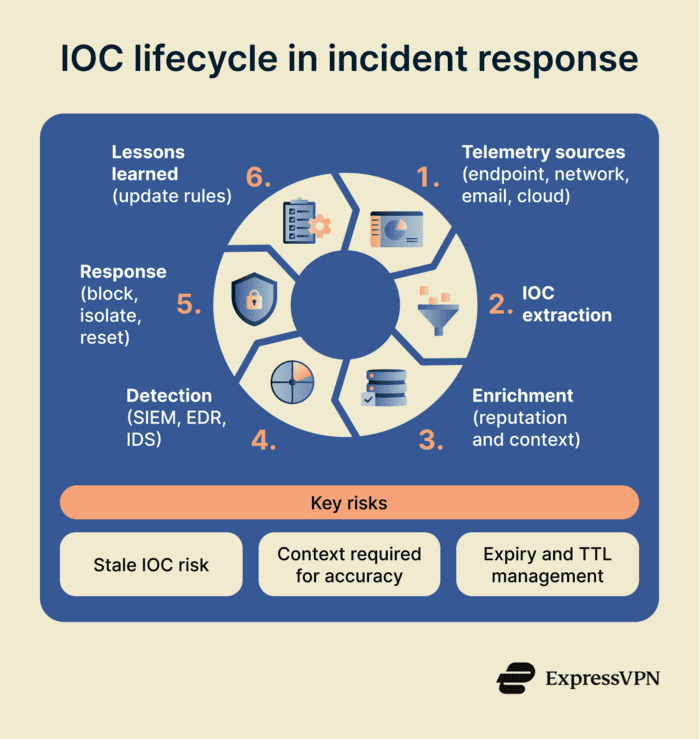
IOCs are collected from logs, endpoints, network monitoring tools, and cloud platforms. Security teams or automated systems analyze incidents and generate indicators that can be shared and monitored.
Security tools compare activity against known IOCs using signature matching, correlation rules, or threat intelligence platforms. Matches may trigger alerts, block traffic, isolate devices, or start investigations. Attackers frequently change infrastructure, so IOCs must be updated regularly.
IOCs are most effective when combined with other signals, such as user activity and system behavior, to confirm whether a threat is real.
Types of IOCs
IOCs appear across different parts of an IT environment, including:
- Network IOCs: Malicious IP addresses, domains, URLs, unusual traffic patterns, or unexpected outbound connections.
- Host IOCs: Suspicious file hashes, unauthorized files, modified registry keys, or unexpected system processes.
- Email IOCs: Malicious sender addresses, unusual headers, deceptive subject lines, or known phishing patterns.
- Behavioral IOCs: Abnormal login attempts, privilege escalation, lateral movement, or unusual account activity. These are sometimes categorized as indicators of attack (IOAs) rather than traditional IOCs.
- Cloud IOCs: API misuse, unexpected configuration changes, or access attempts from unusual locations.
Why are IOCs important?
IOCs can help organizations detect security threats more quickly by matching activity against threat data.
Security tools such as endpoint detection and response (EDR), security information and event management (SIEM), and firewalls use IOCs to detect and flag suspicious activity and may automatically block connections or isolate devices.
IOCs primarily support detection and response rather than prevention. They are also used in threat hunting to identify hidden threats, assess exposure, and track recurring activity across systems.
IOCs vs. indicators of attack (IOA)
IOCs point to evidence that an intrusion has already occurred. IOAs focus on behaviors that suggest an attack is in progress, even if no known threat indicator exists.
| IOCs | IOAs |
| Show signs that malicious activity has already occurred | Show signs that an attack may be in progress |
| Based on known threat data | Based on behavioral patterns |
| Often rely on matching known IPs, domains, or file hashes | Focus on actions such as unusual privilege escalation or lateral movement |
| Help investigate and confirm incidents | Help detect new or unknown attacks earlier |
Risks and privacy concerns of IOCs
IOCs can introduce operational and privacy risks if they’re outdated or poorly managed. These can include:
- Stale indicators: Outdated IOCs may block legitimate activity, miss new threats, or lead to increased false positives.
- Exposure through sharing: Sharing IOCs between organizations may unintentionally reveal details about affected systems or victims.
- Telemetry collection: Monitoring systems that gather indicators may collect user data, raising privacy and data retention concerns.
- Poisoned feeds: Attackers can attempt to insert false indicators into threat intelligence feeds, particularly in open or automated ingestion systems, thereby reducing trust and effectiveness.
Further reading
- What is cyber threat hunting, and how does it work?
- XDR in cybersecurity: What it is and why it matters
- Understanding MTTR in cybersecurity: A complete guide
- Emotet malware: How it spreads and how to stop it
- What is a honeypot in cybersecurity, and how does it work?