
Expressvpn Glossary
FCIP

What is FCIP?
Fibre Channel over IP (FCIP) is a tunneling protocol that allows Fibre Channel storage traffic to be transmitted over IP networks, including wide area networks (WANs) and private enterprise networks.
How does FCIP work?
FCIP works by wrapping Fibre Channel frames into IP packets so they can be transmitted across IP networks. To do this, a device called an FCIP gateway is placed at each end of the connection.
When data leaves a storage network, the local gateway encapsulates the Fibre Channel frames into Transmission Control Protocol (TCP) / Internet Protocol (IP) packets and sends them across the IP network. When the packets arrive at the destination, the gateway there strips the IP wrapper and delivers the original Fibre Channel frames to the receiving storage network. From the perspective of both storage networks, the connection behaves as if they are directly linked.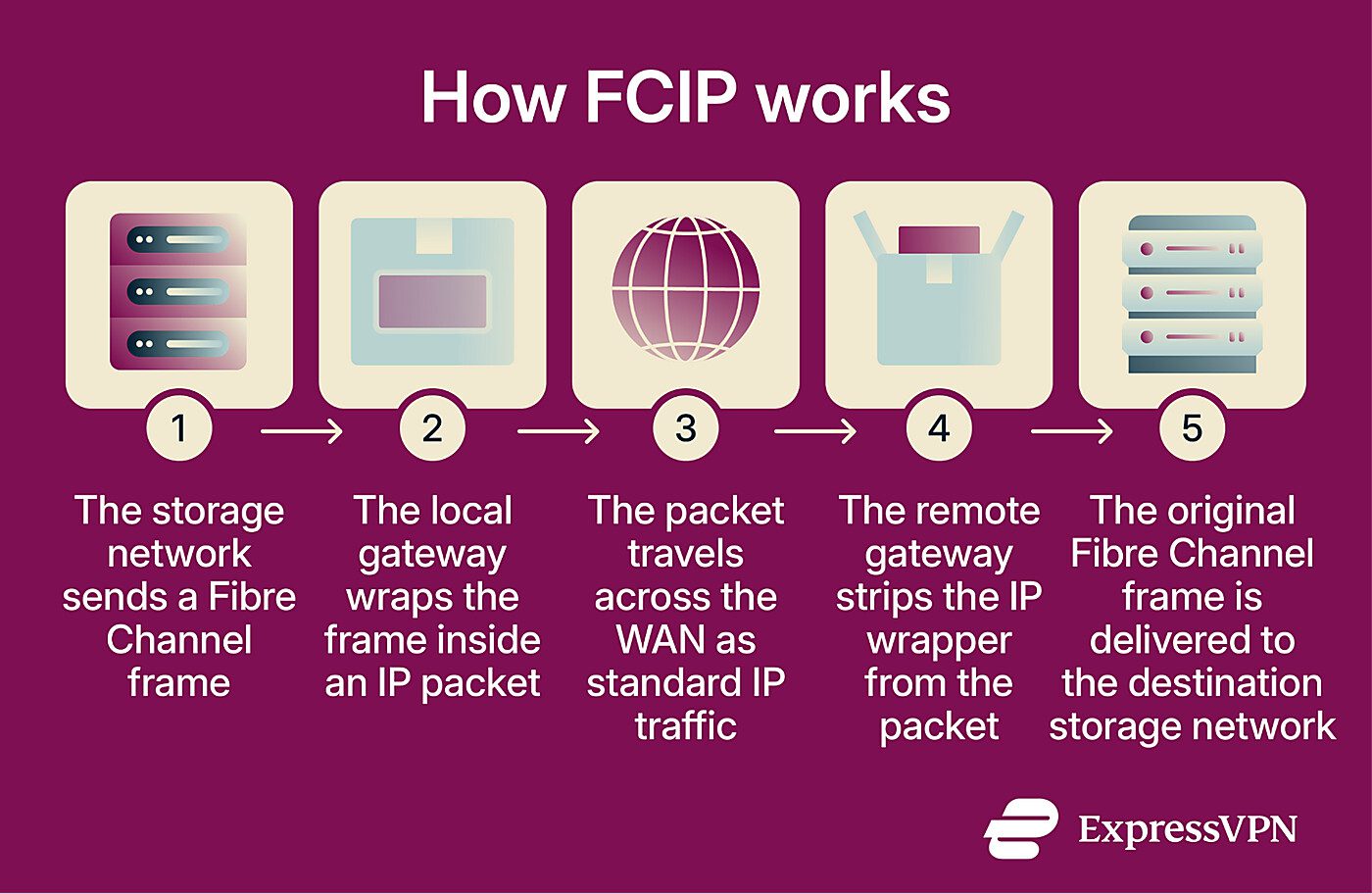
When is FCIP useful?
FCIP is useful when organizations need to extend their Fibre Channel networks across geographically separate locations. Because Fibre Channel operates on dedicated infrastructure, it is typically limited to relatively short-distance dedicated infrastructure.
With FCIP, organizations can replicate data between data centers and support disaster recovery strategies, all while using existing WAN infrastructure rather than investing in dedicated long-distance Fibre Channel connections.
FCIP limitations
FCIP introduces several limitations:
- Latency: Because it relies on TCP/IP, FCIP inherits the latency and reliability characteristics of the underlying IP network, which can affect storage performance compared to native Fibre Channel connections.
- Network sensitivity: Packet loss and congestion on the WAN can disrupt storage traffic, which is particularly problematic for latency-sensitive applications.
- Complexity: FCIP requires gateways at each end of the connection and depends on proper network configuration to function reliably.
- No default encryption: FCIP doesn’t encrypt traffic by default, meaning data transmitted over public networks requires additional security measures, such as Internet Protocol Security (IPSec).
Further reading
- Types of VPNs: Complete guide to VPN categories and protocols
- VPN protocols explained and compared
- Security concerns in cloud computing and how to address them
- Network File System (NFS): A secure guide for remote access