
Expressvpn Glossary
Edge security
What is edge security?
Edge security is a cybersecurity approach that protects data, users, and applications at the network’s edge, closer to where internet traffic enters and exits.
Instead of relying solely on a centralized system, edge security places inspection, control, and protective functions nearer to the source of the connection. This approach is essential for cloud and distributed environments.
How does edge security work?
Edge security works by monitoring and managing traffic at or near entry and exit points.
It typically includes:
- Traffic inspection and filtering: Analyzes inbound and outbound data packets at the edge, blocking suspicious or non-compliant traffic before it reaches internal resources.
- Identity and access verification: Authenticates users and devices and enforces policy-based access decisions.
- Threat detection and mitigation: Uses signatures, behavioral analytics, and sandboxing to identify and stop malicious activity at entry points.
- Encryption of data in transit: Protects data as it moves between users, devices, and services.
These controls are often delivered through distributed infrastructure, such as cloud-based security services or edge nodes located close to users.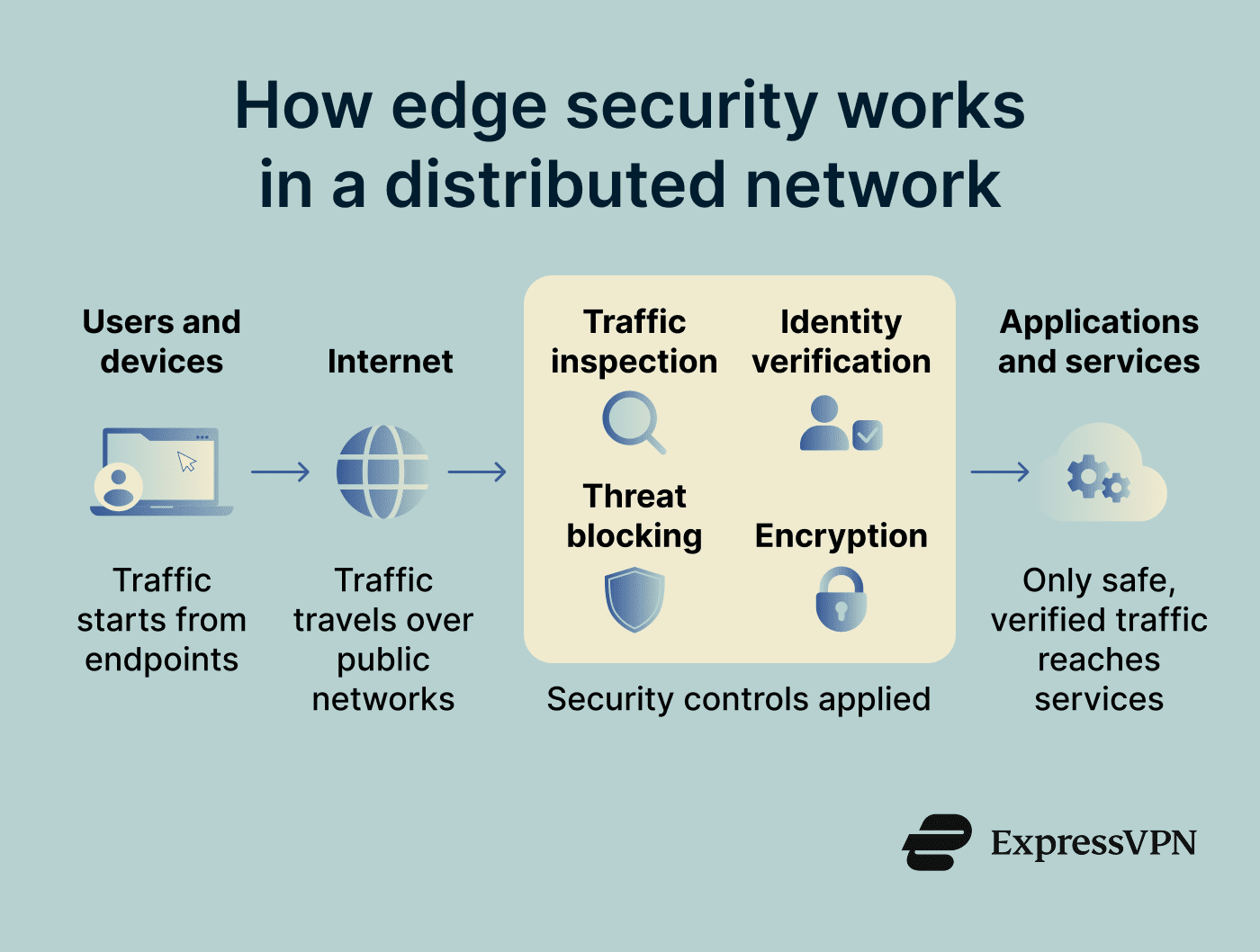
Key components of edge security
Edge security often integrates with Secure Access Service Edge (SASE), which combines networking and security functions in cloud-based systems.
| Component | Function |
| Secure web gateway (SWG) | Filters web traffic; enforces URL and content policies |
| Zero-trust network access (ZTNA) | Grants access to applications only after verifying identity and context |
| Firewall-as-a-Service (FWaaS) | Applies firewall rules at the network edge without relying on on-premise hardware |
| Cloud access security broker (CASB) | Monitors and controls cloud service use from the edge |
| Distributed denial-of-service (DDoS) mitigation | Detects and absorbs attacks before they reach core infrastructure |
Why is edge security important?
As organizations adopt cloud services, remote work, and distributed infrastructure, the traditional network perimeter becomes less defined. Edge security addresses this by applying consistent controls across distributed environments, reducing reliance on centralized inspection points.
Benefits include earlier threat detection, reduced latency from local traffic inspection, and more consistent policy enforcement across locations and user types.
Where is it used?
Edge security is used in environments where users, devices, or services operate outside a single central network.
Common use cases include:
- Branch offices and distributed sites: Local inspection prevents malicious traffic from entering the corporate network.
- Remote or mobile access: Workers accessing applications, with ZTNA enforcing identity‑based access.
- Internet of Things (IoT) and edge-connected devices: Where lightweight, localized security controls are required.
- Multi-cloud enterprise networks: Traffic between clouds is inspected at each interconnect point.
Risks and limitations
Deploying edge security across distributed environments introduces operational and governance complexity.
Common challenges include:
- Misconfigured policies: Can create security gaps if rules are not applied correctly.
- Inconsistent enforcement: Security controls may vary across locations or deployment models.
- Privacy considerations: Deep traffic inspection can raise concerns about the collection and handling of user activity data.
- Third-party dependency: Reliance on external providers can introduce operational and security risks.
- Limited visibility: Centralized monitoring may be harder to achieve across diverse or hybrid deployments.
Further reading
- What is Secure Access Service Edge (SASE)?
- Zero-trust architecture: What it is, how it works, and why it matters
- Zero-trust cloud security explained
- The ultimate guide to remote access VPN solutions
- Cloud VPN services explained