Expressvpn Glossary
Directory services

What are directory services?
Directory services are systems that store, organize, and provide access to information about users, devices, and resources within a network.
How do directory services work?
Directory services map entities, such as a user, a computer, or a group, to their associated attributes, permissions, and locations.
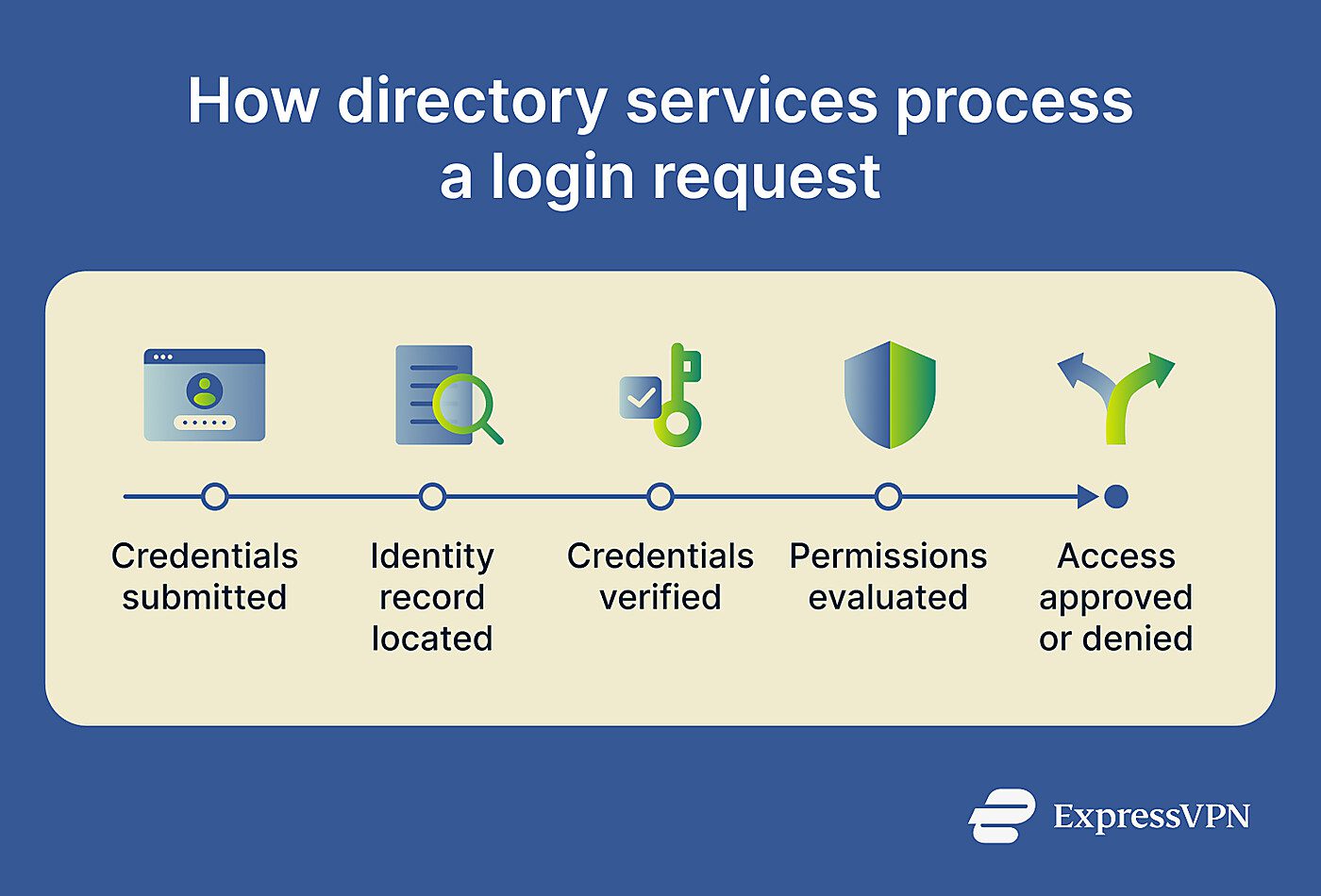
When a user or device requests access to a resource, the directory handles it in three steps:
- Authentication: The directory checks the user-submitted credentials against the stored identity record and, if confirmed, allows access.
- Authorization: The directory looks at the user's group memberships and access control lists (ACLs) to determine which systems, files, or applications are available.
- Replication: Directory data is synced across servers, so all parts of the network reference the same current information.
Directory services rely on standardized protocols to carry out these functions, including Lightweight Directory Access Protocol (LDAP), Kerberos, and Remote Authentication Dial-In User Service (RADIUS).
Where are directory services used?
Organizations rely on directory services in many systems that need a consistent way to identify users and manage access.
- Corporate networks and domains: Businesses use directories to maintain employee accounts and device records across internal domains, workstations, and shared network resources.
- Cloud identity platforms: Many cloud platforms use directories to manage workforce identities and control access to hosted apps, dashboards, and infrastructure services.
- Virtual private networks (VPNs) and remote access systems: Remote access tools rely on centralized account data so off-site workers can connect through the same account structure used internally.
- Email and collaboration platforms: Messaging platforms use centralized account information to manage mailboxes, address books, calendars, and team membership lists.
- Zero-trust access environments: Zero-trust platforms reference centralized account information when enforcing app access and device-based security policies.
Why are directory services important?
Directory services give administrators clear visibility of users and resources in one place and ensure consistency by applying the same rules across systems. They also support growth by scaling across many users and devices, and make security investigations easier by allowing activity and changes to be tracked efficiently.
Directory service risks and privacy concerns
Directory services hold identity and access data for systems, so security weaknesses can expose sensitive network information through:
- Misconfigurations: Misconfigured permissions or insecure LDAP exposure can reveal directory entries or metadata to unauthorized parties.
- Weak passwords: Attackers can guess or brute-force simple passwords and sign in as legitimate users stored in the directory.
- Overprivileged accounts: Accounts with unnecessary privileges can give attackers broad control if those credentials become compromised.
- Centralization: Because directories contain identity data for many systems, attackers often target them to map users, devices, and relationships.
- Poor logging: Without proper event logging, admins may miss unusual sign-ins, privilege changes, or other signs of compromise.
Further reading
- What is OIDC (OpenID Connect)?
- What is access control? How it works and why it matters
- Authentication vs. authorization: What’s the difference?
- How just-in-time access enhances cybersecurity
- How to implement zero trust
- Zero-trust network access (ZTNA) explained
- The ultimate guide to remote access VPN solutions
- Zero-trust cloud security explained