Expressvpn Glossary
Data center storage
What is data center storage?
Data center storage refers to the hardware and software used to store and manage data in a data center environment. It typically includes storage devices and storage management software, and it operates within a broader data center environment that provides compute, networking, power, cooling, and security.
How does data center storage work?
Data center storage infrastructure works by connecting servers and applications to shared or dedicated storage systems through high-speed networks. Redundancy is built into most setups, so data is often written across multiple drives or systems so that if one fails, operations can continue with minimal disruption.
Storage administrators use management software that controls access, monitors capacity, and sets policies for how data is tiered or replicated. Scalability is enabled through scale-up and scale-out approaches that allow capacity to be adjusted as needed.
Data center storage also has backup and disaster recovery mechanisms, ensuring up-to-date or recent copies of data are available during outages.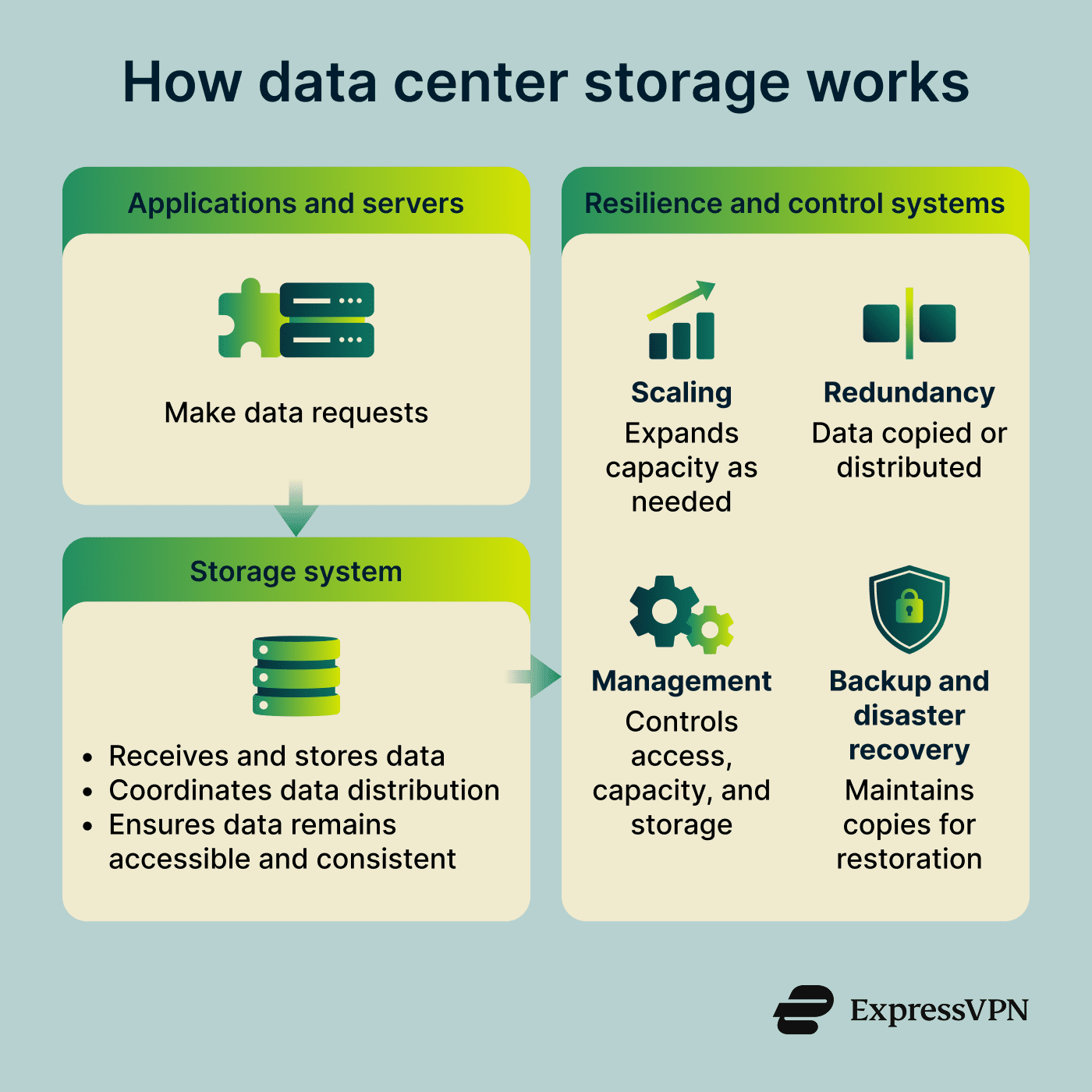
Types of data center storage
There are several kinds of data center storage, including:
- Direct-attached storage (DAS): Storage physically connected to a host device (often used for performance and latency-sensitive workloads).
- Network-attached storage (NAS): Scalable storage that’s accessible in a local network by multiple servers simultaneously and is relatively simple to manage.
- Storage area network (SAN): Dedicated high-speed network providing storage access to multiple servers, typically offering higher performance and more granular control than NAS.
- Block, file, and object storage: Ways of organizing data within storage systems. File storage uses a hierarchical folder structure, block storage stores data as raw blocks that can be individually addressed and retrieved, and object storage stores data as self-contained objects with metadata and a unique identifier.
The mechanisms used in data center storage can be on-premises or in the cloud, and organizations can also opt for hybrid solutions combining both.
Why is data center storage important?
Data center storage is critical for modern business operations. Applications and transaction logs, for example, depend on reliable, accessible data, meaning operations can be disrupted or stop entirely when storage fails.
Storage is also critical for data backups and disaster recovery, since organizations rely on backups and replicated data to recover quickly from failures or attacks.
Finally, storage plays a key role in supporting compliance and protecting sensitive data, as it determines how data is stored, accessed, retained, and secured in line with regulatory requirements.
Where is data center storage used?
Common use cases of data center storage include:
- Enterprise IT infrastructure: Supporting day-to-day business systems and internal operations.
- Cloud and hybrid environments: Enabling scalable, flexible storage across on-premises and cloud systems.
- Disaster recovery: Storing backups and replicated data for fast recovery after failures or attacks.
- Virtualized environments: Supporting virtual machines managed by hypervisors that dynamically allocate resources.
Risks and privacy concerns
There are various risks associated with data center storage that require active management. Misconfiguration is a common security concern, particularly in cloud and enterprise storage environments, where incorrectly configured access controls or exposed storage buckets can unintentionally expose sensitive data. Unauthorized access is another significant concern that arises from factors like weak credentials and insufficient authentication.
Ransomware is another significant threat, as a single attack can potentially encrypt large volumes of stored data.
Further reading
- What is network-attached storage (NAS)?
- Network File System (NFS): A secure guide for remote access
- What is a cross connect in a data center?
- Security concerns in cloud computing and how to address them
- What is big data security and privacy?