Expressvpn Glossary
Data audit
What is a data audit?
A data audit is a review of an organization’s data to understand what information it holds, where it’s stored, how it’s used, and who can access it.
It helps identify sensitive or high-risk data, check whether records are accurate and properly managed, and improve oversight of data across systems. Data audits support security, privacy, governance, and compliance efforts.
How does a data audit work?
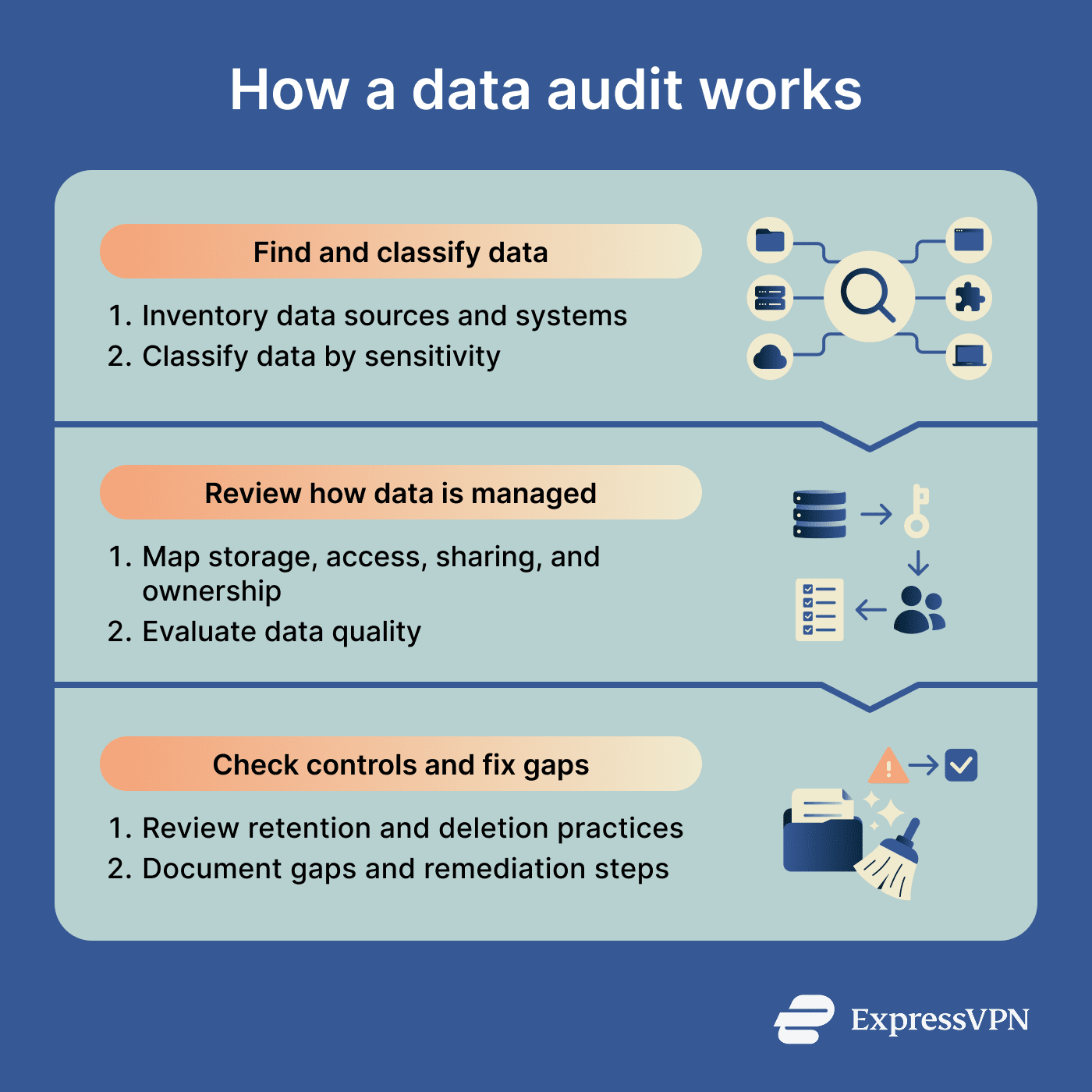
A data audit follows a structured process to show what data an organization holds and how it’s managed. This process is typically broken down into the following steps:
- Inventory data sources and systems: Identify where data is stored across internal servers, cloud platforms, Software-as-a-Service (SaaS) tools, shared drives, employee devices, and third-party services.
- Classify data by sensitivity: Group data based on sensitivity and importance, such as public information, internal business records, customer data, or other sensitive data.
- Map storage, access, sharing, and ownership: Review where data is stored, who can access it, how it’s shared, and who is responsible for managing it.
- Evaluate data quality: Check whether data is accurate, complete, up to date, and consistent across systems.
- Review retention and deletion practices: Confirm whether data is kept according to policy and whether outdated records are deleted or archived appropriately.
- Document gaps and remediation steps: Record any issues that are found and outline corrective actions, such as tightening access controls, assigning ownership, improving data quality, or removing unnecessary data.
Why is a data audit important?
A data audit is important for several reasons, including:
- Reduced security and privacy risks: A data audit can uncover exposed, outdated, duplicated, or unnecessary information that could increase the impact of a breach or misuse incident.
- Better data minimization: It can help identify data that no longer serves a business purpose and shouldn’t be stored.
- Improved governance and accountability: A data audit makes it clearer who owns specific datasets and who should have access to them, helping strengthen internal controls.
- Stronger compliance support: It can show where sensitive or regulated data exists and whether it’s being handled in line with policy and legal requirements.
Where are data audits used?
Data audits are used in many different environments. In enterprise IT, they help organizations understand how data is distributed across systems and departments. In cloud and SaaS environments, they’re useful for reviewing storage locations, permissions, integrations, and external sharing.
They’re especially important in industries such as healthcare and financial services, where sensitive records need to be managed carefully. Marketing and analytics teams also use data audits to better understand how customer and campaign data is collected and stored.
Risks and privacy concerns
Although data audits are designed to reduce risk, they often uncover serious privacy and governance concerns that need attention. Common issues include:
- Overcollection of personal data that’s no longer necessary.
- Unclear ownership of important or sensitive datasets.
- Excessive access permissions that expose information to too many users.
- Shadow data spread across unmanaged tools, folders, or unofficial systems.
- Weak retention and disposal controls that allow data to persist longer than intended.
Further reading
- Why software security audits matter
- What is big data security and privacy?
- Data sovereignty: What it is and compliance considerations