Expressvpn Glossary
Application firewall
What is an application firewall?
An application firewall is a security tool that monitors and controls traffic for specific applications or services. It’s commonly used to block suspicious connections, limit unwanted data flows, and reduce the risk of exploits targeting application-level functionality.
How does an application firewall work?
An application firewall operates primarily at the seventh (application) layer of the Open Systems Interconnection (OSI) model, where it can analyze application-specific protocols and behavior and apply rule-based filters.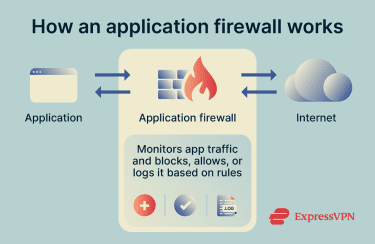
Depending on its configuration, an application firewall may also track active connections and evaluate traffic in context. Some implementations use stateful protocol analysis to examine traffic patterns and detect anomalous behavior by comparing activity against expected application behavior.
Why is an application firewall important?
Application firewalls are primarily used for the following purposes:
- Monitoring: Observes how applications communicate over the network and enforces rules based on expected behavior, such as restricting unauthorized connections or unexpected data flows.
- Security: Helps prevent misuse of applications by identifying abnormal or unauthorized activity, such as unexpected requests, protocol misuse, or attempts to exploit application functionality.
- Compliance: Supports enforcement of security policies by controlling how applications send and receive data, helping organizations meet data protection and regulatory requirements.
Types of application firewalls
There are two primary types of application firewalls: network-based and host-based application firewalls.
Network-based application firewalls analyze traffic for specific application protocols, such as HTTP or Domain Name System (DNS). They enforce rules based on how these protocols are used, detecting and blocking abnormal or unauthorized behavior across multiple systems.
Host-based application firewalls run on individual devices. They control which applications can send or receive traffic and define how and when those communications occur.
Risks and privacy concerns
Misconfigured application firewalls can block legitimate traffic, reducing productivity, or introduce security gaps that increase the risk of unauthorized access or unintended data exposure.
Privacy concerns may also arise when firewalls inspect traffic at a deeper level, as this can involve processing sensitive data. Without proper safeguards, this may create compliance and data protection challenges.
Further reading
- What is a firewall and why it matters for security
- VPN vs. firewall: Key differences and when to use each
- Deep packet inspection (DPI): How it works and why it matters