
Expressvpn Glossary
Web security gateway
What is a web security gateway?
A web security gateway is an on-premises or cloud-based tool that monitors and filters internet traffic to protect users from online threats. It can block unsafe content, such as phishing sites or malicious downloads, and enforce rules on what users can and can’t access online.
How does a web security gateway work?
A web security gateway sits between users and the internet and evaluates each web request before it connects. The gateway checks URLs against threat databases, scans content for malicious behavior, and applies organization-defined rules. If the request meets security and policy requirements, it’s allowed. If not, it’s blocked.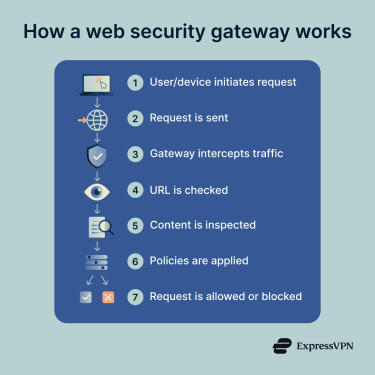
Why is a web security gateway important?
A web security gateway is important for several key reasons. It can:
- Block phishing attempts before users interact with them.
- Prevent malware downloads from compromised sites.
- Provide visibility into user activity and potential risks.
- Support safer browsing for remote teams.
Where is it used?
You’ll typically find web security gateways anywhere users need controlled and secure internet access:
- Enterprise environments with large user bases.
- Remote and hybrid work setups.
- Schools and public networks.
- Managed security services and cloud security platforms.
They’re often part of broader architectures like Secure Access Service Edge (SASE) or zero trust, where security follows the user instead of the network.
Benefits of using a web security gateway
A web security gateway gives organizations stronger protection against malicious websites by blocking threats before users can access them. It also provides better control over web access, allowing teams to define what users can and cannot access online.
With centralized policy enforcement, organizations can apply consistent rules across all users and devices, regardless of location. At the same time, it improves monitoring and reporting by giving security teams clear visibility into web activity. This level of oversight also supports compliance requirements by helping enforce acceptable use and data protection policies.
Risks and privacy concerns
While web security gateways improve protection, they can also introduce risks and privacy concerns if not properly configured or managed:
- Misconfigurations can block legitimate sites: Poorly defined rules may prevent access to safe or necessary websites.
- Encrypted traffic inspection raises privacy concerns: Transport Layer Security (TLS) inspection improves threat detection but involves analyzing secure user data.
- Logs may contain sensitive data: Browsing activity records must be stored and managed securely to prevent leaks.
- Effectiveness depends on policy quality: Weak or outdated policies reduce protection, while overly aggressive ones cause unnecessary restrictions.
Further reading
- What is Secure Access Service Edge (SASE)?
- What is SSL inspection in network security?
- What is unified threat management (UTM)?
- Zero-trust network access (ZTNA) explained
- What is a firewall and why it matters for security
- DNS security: How to protect your network from DNS threats