Expressvpn Glossary
Web mining

What is web mining?
Web mining is a subset of data mining that focuses on discovering patterns and insights from web data using techniques such as machine learning (ML) and statistics. It works with raw and scattered web information, such as text, images, videos, links, and user activity data.
See also: Data mining, data scraping, digital footprint
How does web mining work?
Web mining follows several stages that turn raw web data into useful insights.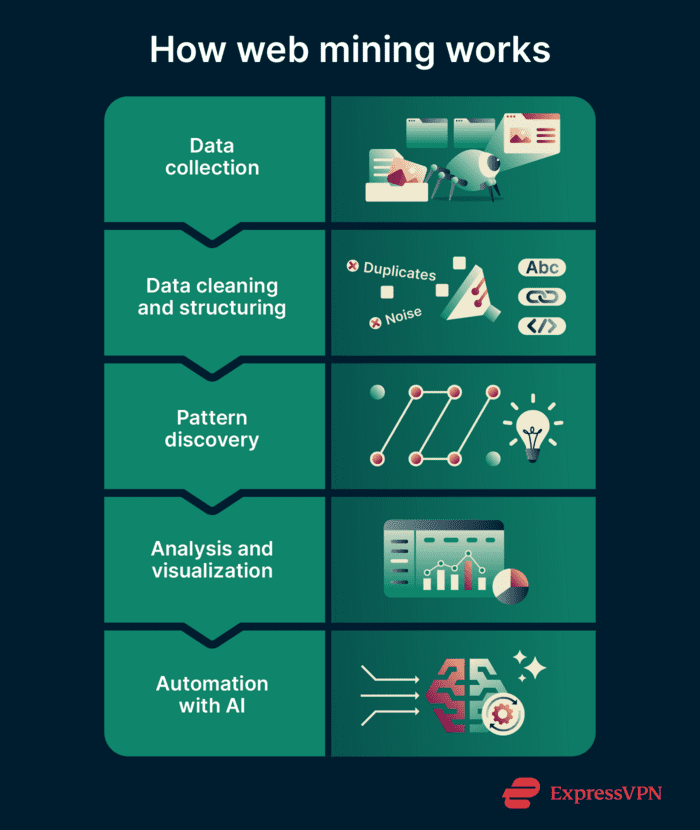
- Data collection: Automated tools called web crawlers scan websites and gather data, often by following links between pages.
- Data cleaning: Unnecessary or irrelevant information is removed from the collected web data to ensure accuracy and consistency.
- Data structuring: Parsing tools extract elements such as text, links, metadata, and usage information and organize them for analysis.
- Pattern discovery: Algorithms analyze the structured data to identify patterns, relationships, and trends.
- Analysis and visualization: The results are interpreted and presented through dashboards, analytics platforms, or automated applications.
Web mining data is typically automated using ML, natural language processing (NLP), and other AI techniques.
Types of web mining
Web mining can be divided into several categories:
- Web content mining: Extracts information from the content of web pages.
- Web structure mining: Examines how web pages are connected through links to reveal relationships between websites and identify influential pages.
- Web usage mining: Studies how users interact with websites and social media by analyzing click patterns, browsing sessions, and server logs to help understand navigation behavior.
Why is web mining important?
Web mining powers many everyday online tools and services by analyzing large volumes of web data to show how information spreads and how people interact with it. It also helps detect suspicious activity. By identifying patterns in web traffic, it may reveal bot networks, fraud, or attempts to manipulate online services. It also supports threat research by uncovering malicious websites, leaked data, and emerging attack techniques.
Where is web mining used?
Web mining is used across many industries that rely on online data and user behavior:
- Search engines and advertising platforms: Index websites, rank results, and deliver targeted ads by analyzing page content and user activity.
- E-commerce and market research: Personalize shopping experiences, recommend products, and track consumer sentiment through reviews, blogs, and social media discussions.
- Security, threat intelligence, and compliance: Scan websites, forums, and underground marketplaces to help identify cyber threats, detect fraudulent sites, and monitor potential reputation risks.
- Financial services: Monitor transactions, detect fraud, analyze market trends, and optimize investment strategies.
- Dark web mining: Collects information from hidden online environments not indexed by traditional search engines.
Web mining risks and privacy concerns
Analyzing browsing behavior across websites can enable large-scale tracking, allowing organizations to build detailed profiles of users and their interests. Collecting personal data carries additional risks, especially when combined from multiple sources, which can reveal sensitive information if leaked or poorly protected.
Additionally, web mining techniques can be misused by attackers to identify phishing targets, gather organizational intelligence, or find weaknesses in publicly accessible systems.
Further reading
- What is a digital footprint and how can I manage it?
- Data harvesting: What it is and how to stay protected
- What are trackers? Understanding how they affect privacy