Expressvpn Glossary
VoIP gateway
What is a VoIP gateway?
A Voice over Internet Protocol (VoIP) gateway is a network device that connects IP-based voice systems with traditional telephony infrastructure or legacy voice equipment.
It bridges VoIP networks and systems, such as the public switched telephone network (PSTN), older private branch exchange (PBX) equipment, and analog devices, converting signaling and voice media between packet-based IP networks and the formats used by traditional phone systems.
VoIP gateways can also support interworking between different telephony environments during network upgrades or hybrid deployments.
How does a VoIP gateway work?
When an IP phone or softphone initiates a call, the gateway receives the signaling and translates it and voice media as needed between the two environments.
It converts traditional telephony traffic into IP packets for transport across a data network and may also transcode the audio codec when neither endpoint supports the same encoding format.
The gateway then routes the call to its destination using configured call-routing logic and forwards it through telephony trunks when the call must reach the PSTN.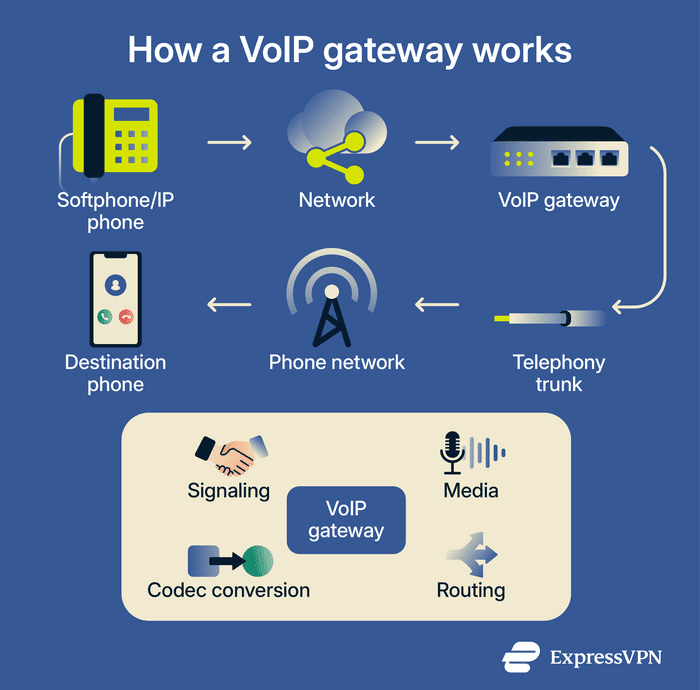
Types of VoIP gateways
VoIP gateways come in several forms, depending on the types of networks they connect to and the interfaces they support.
- Analog gateways: These gateways connect VoIP systems to traditional analog devices, such as desk phones, fax machines, and analog phone lines, via foreign exchange station (FXS) and foreign exchange office (FXO) ports.
- Digital gateways: These gateways connect IP telephony networks to digital trunk lines used by telecom providers or PBX systems, commonly through Primary Rate Interface (PRI) or digital circuits such as T1 and E1.
- Session Initiation Protocol (SIP) trunk gateways: Many VoIP gateways also connect enterprise voice systems to service provider networks via SIP trunks, routing calls over IP rather than traditional telephone circuits. This is usually a capability of a gateway or IP telephony platform, rather than a completely separate gateway class.
- Virtual or cloud-integrated gateways: In cloud-based communications systems, vendors may deliver gateway functions as virtual appliances or hybrid services that connect on-premises devices and trunks with hosted VoIP platforms.
- Session border controller (SBC) hybrids: Some modern gateways incorporate SBC capabilities, adding signaling control, security, and interconnection features for links between enterprise VoIP networks and service providers.
Why are VoIP gateways important?
VoIP gateways help organizations modernize voice infrastructure incrementally rather than all at once. They keep legacy devices such as analog phones, fax machines, and older PBX-connected equipment usable with modern VoIP systems, which can reduce migration costs and disruption by avoiding immediate hardware replacement.
They also improve routing flexibility by allowing calls to be directed through different trunks, networks, or carriers based on configured call-routing logic. In some deployments, gateways can support call continuity by providing alternate paths between IP networks and traditional telephony networks, but this depends on the overall resiliency design and failover configuration rather than on the gateway alone.
In addition, VoIP gateways help organizations integrate PSTN connections, legacy PBX equipment, and IP communications systems into a more connected voice environment.
Where are VoIP gateways used?
Organizations deploy VoIP gateways wherever legacy and modern voice systems need to coexist, for example:
- Offices with PBX modernization: Companies connecting legacy PBX systems to modern VoIP platforms during telephony upgrades.
- Call centers and interactive voice response (IVR) systems: Environments linking IP-based call handling systems with traditional telephony infrastructure for customer calls.
- Telecom carriers and service providers: Providers routing calls between IP networks and the PSTN.
- Hotels, campuses, hospitals: Large facilities integrating VoIP systems with existing PBX infrastructure, analog devices, or telephony connections across multiple buildings or departments.
- Remote sites with local trunks: Branch offices connecting local PSTN trunks with centralized VoIP networks.
Risks and privacy concerns
VoIP gateways connect voice systems to IP networks, which means they inherit many of the security risks associated with internet-based services. The most noteworthy vulnerabilities include:
- Weak authentication and call fraud: Attackers may exploit weak passwords or default credentials or poorly restricted call permissions to place unauthorized calls, sometimes resulting in toll fraud such as international revenue share fraud (IRSF), in which calls are routed to premium-rate numbers controlled by the attacker.
- Exposed SIP services: Automated tools can scan internet-exposed SIP services on gateways, trunks, or telephony systems to identify extensions and attempt credential brute-force attacks or other abuse.
- Unencrypted signaling and media: Without Transport Layer Security (TLS) for signaling and Secure Real-time Transport Protocol (SRTP) for media, attackers with access to the network path may be able to intercept or monitor call data.
- Insecure firewall or Network Address Translation (NAT) configuration: Incorrect NAT, firewall, or port-forwarding settings can expose SIP ports, management interfaces, or gateway services to the public internet.
- Unprotected signaling infrastructure: Unprotected SIP servers and gateways are vulnerable to denial-of-service (DoS) attacks, in which attackers flood them with signaling requests, preventing legitimate calls from being processed.
Further reading
- VoIP VPN: Complete guide to securing your internet calls
- What is network jitter, and how does it impact internet performance?
- NAT “firewall”: Everything you need to know about network security
- Types of IP addresses explained: Complete guide
- The ultimate guide to phone security: Protect your mobile device