Expressvpn Glossary
Risk monitoring
What is risk monitoring?
Risk monitoring is an ongoing process of tracking risks, changes in the business environment, and the effectiveness of risk responses. It helps organizations identify when risk levels change and decide whether additional action is needed.
The goal is to help organizations make informed decisions that reduce disruptions, limit financial loss, and keep risk within acceptable levels. Risk monitoring can be applied to various aspects of a business, including cybersecurity, physical security, business strategy, and daily operations.
How does risk monitoring work?
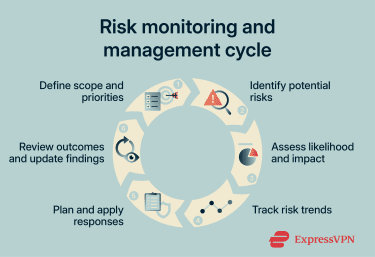
Risk monitoring usually sits within a broader risk management process. A typical process may include:
- Establishing context: Determine the goals and scope of the assessment, map the environment in which the organization operates, and identify its most critical or vulnerable assets.
- Identifying risks: Uncover potential risks by reviewing internal or external trends, past incidents, and stakeholder feedback, then record concerns in risk registers.
- Analyzing risks: Assess risks according to their likelihood and potential impact, then prioritize specific threats for remediation or closer monitoring.
- Tracking key risk indicators (KRIs): Use indicators to detect changes in risk exposure, emerging trends, and warning signs that risk may exceed tolerance levels.
- Implementing risk response: Choose which risks to accept, and develop actionable plans and countermeasures for the rest.
- Reporting and communication: Share risk findings with relevant stakeholders to ensure decisions, escalations, and accountability are clear.
- Monitoring and reviewing: Continue to monitor risks according to KRIs, environmental changes, employee feedback, and the effectiveness of response strategies.
Why is risk monitoring important?
Effective and continuous risk monitoring helps organizations stay ahead of emerging threats and changing risk conditions. As a continuous process, it helps organizations identify changes early and respond more quickly.
Businesses use risk monitoring to:
- Uncover gaps in security controls, policies, or procedures, especially in new or recently changed systems.
- Detect threats early, before disruptions spread to adjacent systems or escalate in severity.
- Make informed decisions about security and operational strategies based on up-to-date data.
- Support compliance by helping organizations track regulatory changes and adjust controls, policies, or procedures as needed.
- Improve incident readiness to reduce the operational, financial, and reputational impact of security breaches.
- Optimize resource allocation by focusing on the most critical risks and dynamically adjusting efforts.
Where is risk monitoring used?
Risk monitoring is used in virtually all contexts where organizations need continuous visibility into potential threats, vulnerabilities, and changing risk conditions. It supports many enterprise security operations centers (SOCs) by helping teams maintain visibility into threats, vulnerabilities, and the effectiveness of controls.
In cloud and hybrid environments, it helps identify misconfigurations and emerging risks across distributed systems. Organizations also apply risk monitoring to third-party vendors and supply chains to manage external dependencies and cyber risk exposure. Across different industries, financial and compliance teams rely on risk monitoring to track and mitigate operational threats.
It's especially valuable for protecting critical infrastructure, including energy, healthcare, and transportation systems, where disruption can affect essential services.
Risks and privacy concerns
One key risk of risk monitoring is that the process itself can create new security and privacy risks. Organizations may collect and analyze sensitive information about assets, controls, vulnerabilities, and business operations. If this data is exposed, it could help attackers identify weaknesses or plan an attack.
Risk assessors should therefore limit unnecessary data collection and enforce secure logging practices. Risk data, findings, and supporting evidence should be accessible only on a need-to-know basis and transmitted and stored securely via encryption.
If the risk monitoring process itself is flawed, it may also result in poor visibility, false positives, or false negatives. False positives can waste resources and cause alert fatigue, while false negatives can leave serious risks undetected. Similarly, infrequent monitoring or skipped assessments may lead organizations to rely on outdated risk profiles.
Further reading
- What is a cybersecurity risk assessment and how does it work?
- Your cybersecurity guide to attack surface management (ASM)
- What is security posture? A complete guide for organizations
- What is cyber threat hunting, and how does it work?
- Understanding critical infrastructure security