Expressvpn Glossary
Remote monitoring and management (RMM)
What is remote monitoring and management?
Remote monitoring and management (RMM) provides centralized oversight and control of computers, servers, and other endpoints across distributed environments.
Legitimate users of RMM software commonly include internal IT teams and managed service providers (MSPs). Because it combines monitoring with remote administration, RMM supports maintenance, security oversight, and faster troubleshooting.
How does remote monitoring and management work?
RMM platforms collect device and system data and send it to a central management platform. In many environments, software agents installed on endpoints handle this collection. In others, the platform pulls information from servers, cloud services, or APIs.
Administrators review system status across multiple devices and locations from the dashboard. The platform automatically generates alerts when failures, unusual activity, or threshold breaches occur. Administrators can then troubleshoot issues, apply updates, adjust configurations, or deploy fixes remotely.
Many RMM platforms also support automation through scripts or policies that handle routine tasks such as patching, system checks, and maintenance.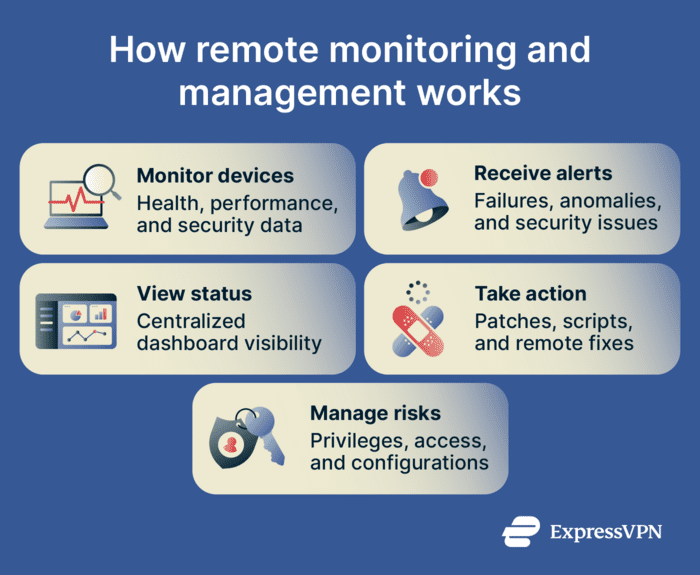
Why is remote monitoring and management important?
RMM helps organizations detect issues early and address them before they cause major disruptions or downtime.
It also improves operational consistency. Centralized management makes it easier to deploy patches, updates, and configuration changes across many systems simultaneously, helping reduce gaps in maintenance and security coverage.
Faster remote access to devices also allows administrators to investigate incidents and apply fixes without being on-site, which is especially valuable when infrastructure and teams are spread across multiple locations.
Where is it used?
- MSPs: They use RMM platforms to monitor and maintain devices for multiple client organizations from a single management system.
- Remote and hybrid workplaces: RMM helps IT teams support devices used by employees working from home or across distributed locations. Cloud-based RMM is commonly positioned for this kind of environment.
- Small-business device fleets: Smaller organizations rely on RMM tools to maintain systems without a large IT team, especially where automation and centralized management reduce manual workload.
- Enterprise endpoint environments: Large organizations use RMM platforms to maintain visibility across large numbers of endpoints, servers, and, in some products, additional infrastructure components.
Risks and privacy concerns
- Wide attack surface: RMM platforms provide centralized, often privileged access to many endpoints from a single console. If an attacker compromises that access, they may be able to control or affect multiple devices at once.
- Misconfiguration: Incorrect settings, exposed remote access paths, weak authentication, shared credentials, or excessive privileges can increase the risk of unauthorized access or misuse.
- Lateral movement: If a malicious actor gains control of an RMM platform, account, or agent, they may be able to pivot between managed systems, execute commands remotely, and expand their access within the environment.
- Sensitive data collection: RMM tools can gather system activity, logs, and device information. Depending on the configuration, this monitoring may include sensitive operational or user-related data.
Further reading
- What is remote access? A complete beginner-to-pro guide
- The ultimate guide to remote access VPN solutions
- RDP vs. VPN: The complete guide to remote access
- What is access control? How it works and why it matters
- VPNs, firewalls, endpoint security: What your team really needs