
Expressvpn Glossary
Public switched telephone network
What is the public switched telephone network?
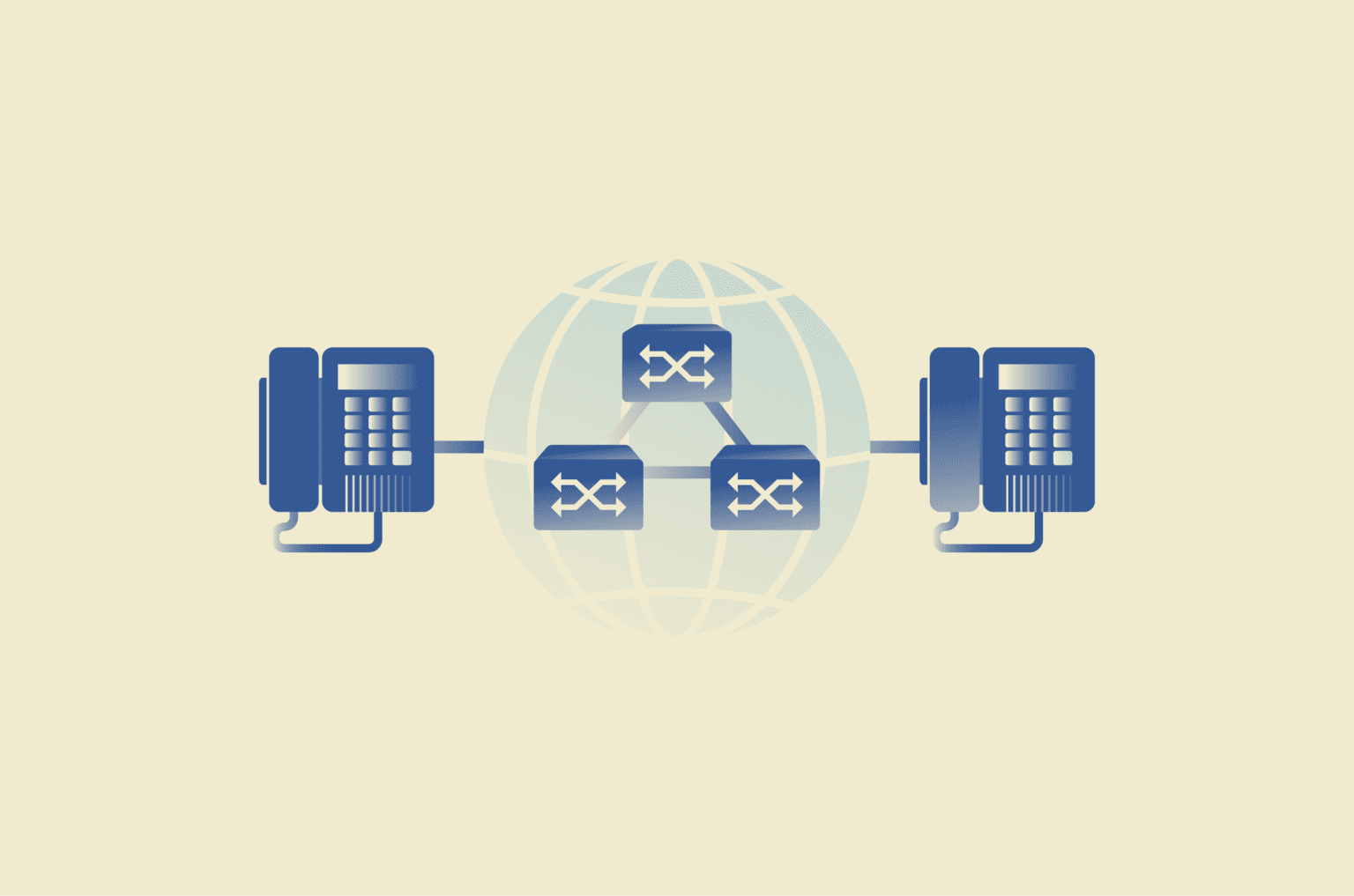
The public switched telephone network (PSTN) is the global collection of interconnected public telephone networks traditionally built around circuit switching and operated by local, national, and international carriers.
Its operation is guided by international standards from the International Telecommunication Union–Telecommunication Standardization Sector (ITU-T), along with national numbering rules, carrier interconnection agreements, and local regulations.
The core purpose of the PSTN is to provide reliable voice communication, connecting landline telephones across local, long-distance, and international boundaries.
How does the public switched telephone network work?
The PSTN operates as a circuit-switched network, creating a dedicated communication path between a caller and receiver for the duration of a call. The process follows these steps:
- Number identification: International telephone numbers follow the E.164 numbering plan, while local and service numbers may use national formats before being translated for routing.
- Call initiation: The caller dials a number, which the network uses to determine the destination.
- Local routing: In a traditional landline setup, the call travels through the local loop to a local exchange or switching center.
- Signaling: The network uses signaling protocols, such as Signalling System No. 7 (SS7), to set up, manage, and release the call.
- Path determination: Switching systems select a route toward the destination.
- Intermediate routing: Tandem exchanges forward the call via trunk lines as needed.
- Circuit establishment: The network reserves a dedicated channel, such as a circuit or digital time slot, for the duration of the call.
- Signal transmission: The conversation is carried as electrical or digital signals along the reserved path.
- Circuit release: When the call ends, the channel is freed for other calls.
For long-distance calls, the network routes through additional exchanges: regional centers for national calls and international gateways for overseas connections.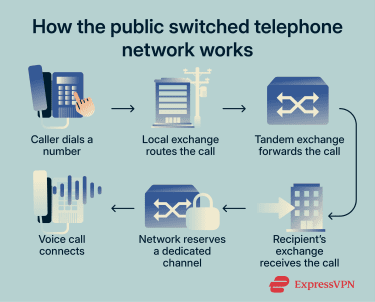
Why is the public switched telephone network important?
The PSTN is a major foundation of modern telecommunications. It helped standardize how public telephone calls are identified and routed using phone numbers, allowing networks across regions and countries to interoperate through shared standards and interconnection agreements.
Today, it supports essential communication at scale and is known for reliability. Because traditional PSTN networks are designed with redundancy and can route calls through alternative paths, they can help maintain service during some outages, making them important for emergency and critical communications.
Where is the public switched telephone network used?
The PSTN is used in services that rely on traditional landline telephone networks or need to connect with conventional telephone numbers, including everyday calling and systems connected through telephone lines:
- Residential and business telephony: Supports traditional landline phones, fax machines, and legacy or hybrid office phone systems.
- Emergency and safety systems: Connect some alarm systems, elevator phones, telecare devices, door-entry systems, and other safety equipment to monitoring centers.
- Payment terminals: Supports some legacy point-of-sale (POS) systems that process transactions over phone lines.
- Voice over Internet Protocol (VoIP) interoperability: Uses gateways to connect internet-based calling services with traditional phone numbers.
This technology is still used in many places, although telecom providers are increasingly replacing legacy PSTN and copper-line services with IP-based voice infrastructure.
Risks and privacy concerns
Despite its reliability, the PSTN still faces operational risks, such as network overload, power issues, signaling failure, and hardware faults, that can disrupt services. When they occur, disruptions can spread to large numbers of users because exchanges aggregate traffic from thousands of connections into shared nodes. Aging legacy PSTN and copper-line infrastructure can also increase maintenance costs and reliability risks.
The system also has limited built-in security. Traditional PSTN calls generally lack end-to-end encryption (E2EE), which can make interception possible if network infrastructure, signaling systems, or physical lines are accessed or compromised. Signaling systems can also be abused if attackers gain access to carrier-level networks, potentially enabling interception, tracking, fraud, or service disruption.
The PSTN is also susceptible to fraud, including toll abuse, in which unauthorized calls generate charges, and caller ID spoofing, in which the displayed caller number is falsified to impersonate another caller.
The shift to digital networks can mitigate some of these issues, but it introduces different risks. Some legacy systems still rely on PSTN connections, and omitting these dependencies during migration can break services such as alarm monitoring, telecare devices, elevator phones, emergency lines, or payment terminals.
Further reading
- What is neighbor spoofing, and how can you stop it?
- What is vishing? How to detect and prevent vishing attacks
- What is spam risk, and how can you stop these calls?
- What is a “scam likely” call, and how to block it?
- VoIP VPN: Complete guide to securing your internet calls