Expressvpn Glossary
Perimeter firewall
What is a perimeter firewall?
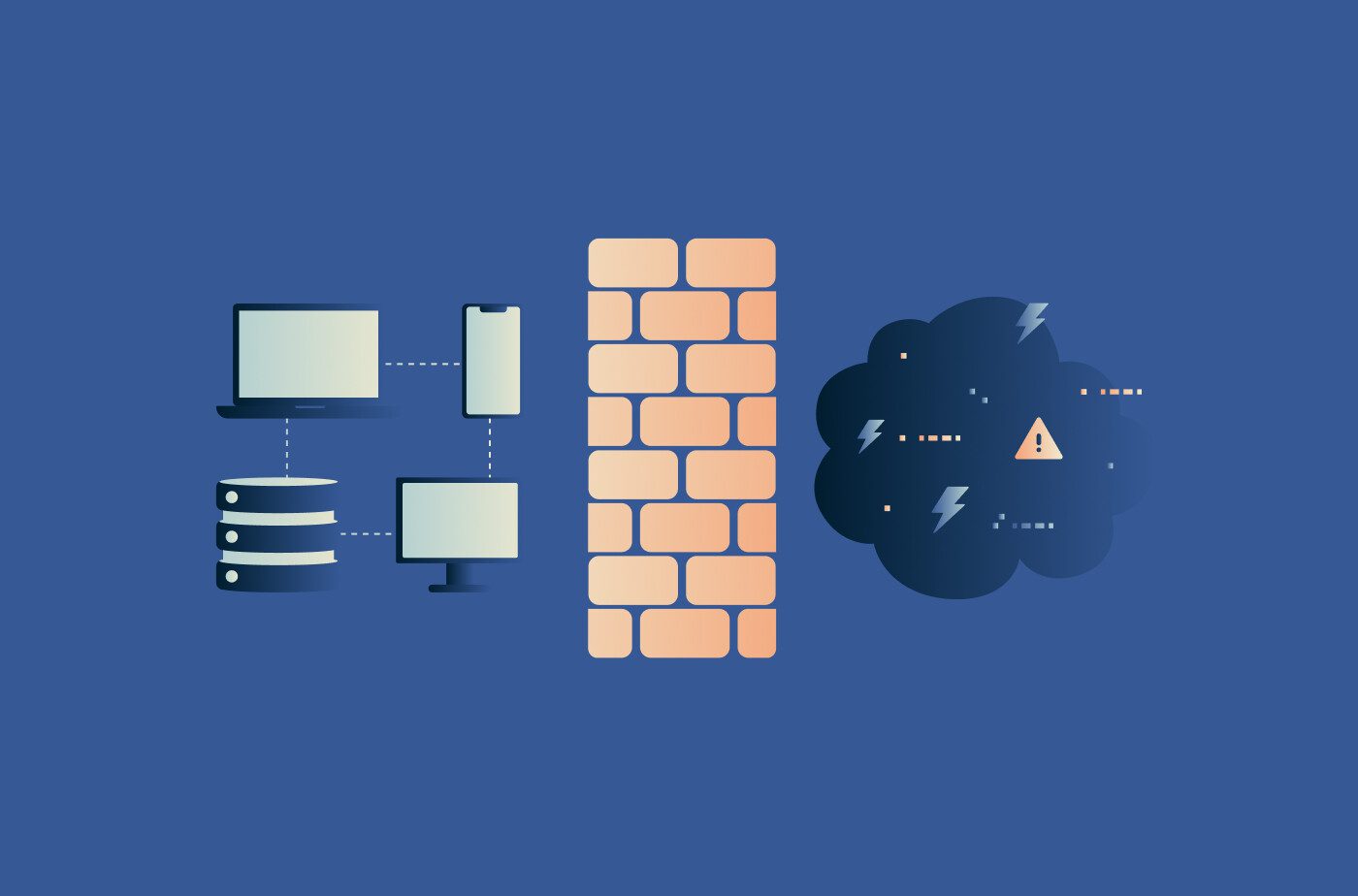
A perimeter firewall is a firewall placed at the boundary between a private network and the internet or other external networks, acting as a key traffic control point. It typically runs on a firewall appliance, integrated router, or a virtual or software-based firewall at the network edge.
How does a perimeter firewall work?
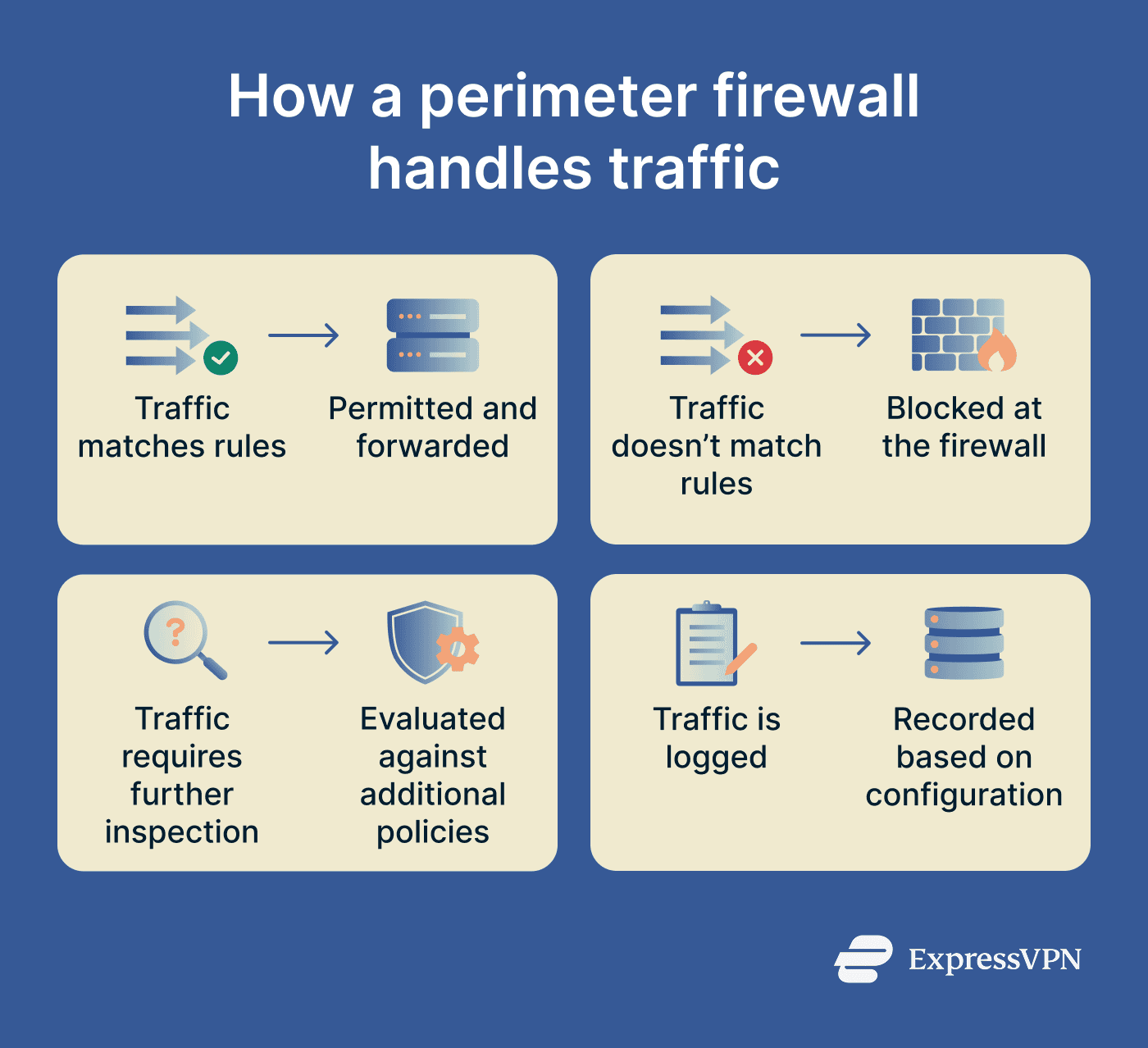
A perimeter firewall processes traffic in defined steps. The steps can vary, depending on firewall type and deployment, but are commonly:
- Routes inbound and outbound traffic through the firewall for inspection.
- Examines source and destination IP addresses, ports, and protocols.
- Compares traffic against predefined security rules.
- Performs deep packet inspection (DPI) in some next-generation firewalls (NGFWs).
- Permits, blocks, or logs traffic based on those rules.
Types of firewalls commonly used at the perimeter
- Packet-filtering firewalls: Evaluate only header information, without tracking session state or examining payload content.
- Stateful inspection firewalls: Track connection state and allow traffic consistent with valid sessions.
- Proxy firewalls (application-level gateways): Terminate connections and inspect traffic at the application layer.
- Next-generation firewalls (NGFWs): Add application awareness and threat-prevention features.
Where is it used?
Perimeter firewalls are used in several common network environments:
- Enterprise network perimeters: Positioned at the internet-facing edge of corporate environments, connecting employees and business systems to outside services.
- Data centers: Deployed at ingress and egress points to protect traffic entering and leaving these environments.
- Branch office networks: Used in remote sites that connect to headquarters, shared applications, or centralized security systems.
- On-premises and hybrid environments: Used where applications and services are split across local infrastructure and cloud platforms.
Why is a perimeter firewall important?
A perimeter firewall helps to:
- Limit what public-facing services are reachable, reducing the attack surface.
- Apply access rules consistently across network traffic.
- Generate logs to support investigations and compliance efforts.
- Reveal connection patterns and unusual activity for investigation.
Risks and privacy concerns
Perimeter firewalls have limitations that can introduce risk if not addressed within a broader security strategy:
- Malicious activity originating within the network may go undetected.
- Misconfiguration may expose services or create unintended access paths into systems.
- Encrypted traffic reduces inspection visibility unless Transport Layer Security (TLS) inspection is enabled.
- Logs may expose sensitive metadata, such as IP addresses.
Further reading
- What is a firewall?
- VPN vs. firewall: Key differences and when to use each
- NAT firewall: Everything you need to know about network security
- VPN passthrough: Do you need it, and how does it actually work?
- Zero-trust architecture explained
FAQ
What is the difference between a perimeter firewall and an internal firewall?
A perimeter firewall filters inbound and outbound traffic between internal and external networks, while an internal firewall filters traffic within the network.
Is a perimeter firewall enough on its own?
No, a perimeter firewall isn’t sufficient on its own. Attacks can bypass the perimeter or originate within the network, so a layered approach is recommended.
How is a perimeter firewall different from a VPN?
A perimeter firewall filters and controls traffic between networks, while a VPN creates an encrypted connection between a device and a network for secure remote access.
What threats can a perimeter firewall block?
A perimeter firewall blocks traffic based on defined rules, including known malicious IP addresses, suspicious traffic patterns, and restricted domains. Advanced firewalls can also detect threats such as command-and-control traffic and malicious URLs.
Are perimeter firewalls still relevant in cloud environments?
Yes, perimeter firewalls are used in cloud environments to filter traffic at boundaries such as virtual networks. However, modern architectures may not have a single fixed perimeter, so additional security layers are often used alongside them.