
Expressvpn Glossary
Network intelligence

What is network intelligence?
Network intelligence is the practice of collecting, analyzing, and using network data to understand a network’s operational, performance, and security status. It typically combines visibility, telemetry, traffic analysis, and monitoring to provide insights into network health and behavior.
In many contexts, network intelligence is a foundational part of cybersecurity. It supports activities like network threat hunting, detection and response, incident investigation, and forensics.
How does network intelligence work?
Network intelligence can be understood through three broad stages: data gathering, analysis, and actionable or predictive intelligence. Together, these help administrators understand their network’s current status, identify major gaps or threats, and implement proactive solutions.
Data collection involves gathering information about network topology, packets, telemetry, logs, and traffic patterns. To do this thoroughly, organizations need an accurate and current inventory of networked devices and how they connect, including routers, firewalls, endpoints, and other infrastructure.
Systematically analyzing this data may reveal trends, anomalies, threats, and patterns. Administrators increasingly rely on AI and machine learning (ML) systems to help process and interpret large, complex datasets.
Network intelligence systems collect telemetry from devices, which often includes real-time data. Inspecting packets, flow data, and traffic metadata can provide context about network activity. However, encrypted traffic may limit visibility into packet contents unless decryption or inspection controls are in place. Traffic analysis can still reveal how data moves through the network, including metrics such as volume, packet loss, and latency.
Based on these findings, organizations conduct risk assessments and develop strategies to improve network health and cybersecurity posture.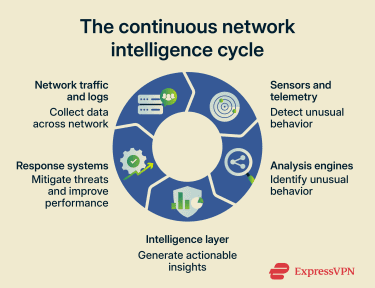
Why is network intelligence important?
Effective network intelligence accelerates decision-making, helps optimize resources, and strengthens security. As a continuous practice, it enables organizations to address critical issues as they arise and act proactively to prevent disruptions and major security incidents.
In a fast-changing landscape, relying solely on intermittent audits and assessments can leave organizations vulnerable to emerging threats. With constant visibility into critical areas, network intelligence accelerates threat detection.
Network intelligence also allows organizations to identify and address potential security blind spots and misconfigured controls more quickly. By rapidly flagging suspicious activity, security teams can respond faster, limit potential damage, and begin remediation.
Furthermore, network intelligence helps prioritize and guide activities like proactive maintenance and strategic network upgrades. By planning their work around busy periods, informed admins can minimize disruptions and avoid outages.
Where is it used?
Many organizations rely on network intelligence in some capacity, including:
- Enterprise security operations centers (SOCs): Monitoring network activity and internal systems for threats.
- Managed security service providers (MSSPs): Delivering outsourced services, such as monitoring, analysis, and incident response for clients.
- Cloud and hybrid environments: Maintaining visibility across distributed infrastructure, including on-premises and cloud workloads.
- Threat detection and network forensics: Investigating incidents, tracing attacks, and providing for remediation.
Internet service providers (ISPs), mobile network operators (MNOs), and other communications service providers (CSPs) are also active users of network intelligence. The term has strong roots in telecommunications, where related concepts such as the Intelligent Network (IN) have long been used to describe service and network management capabilities.
Compared with most businesses, CSPs use network intelligence at a much larger scale. In these environments, it often emphasizes traffic management, service quality, congestion control, reliability, and customer experience, as well as security use cases.
Risks and privacy concerns
Network intelligence practices can create additional security and privacy risks if not handled correctly.
Sensitive user, network, and asset metadata gathered during the data collection phase might be exposed if safeguards are not in place. Organizations should avoid overcollection to minimize the risk. It’s also important to protect potentially sensitive information in transit and at rest; de-identify, mask, aggregate, or anonymize it where practical; limit retention periods; and restrict access to authorized teams.
Incomplete visibility, poor data quality, or flawed analytics can also lead to incorrect insights that distort decision-making. This may amplify security risks, introduce new flaws, or obscure critical vulnerabilities.
Further reading
- NDR vs. XDR: Key differences and how to choose
- Deep packet inspection (DPI): How it works and why it matters
- What is network mapping? Complete guide to security best practices
- What is cyber threat hunting, and how does it work?
- What is eavesdropping in cybersecurity, and how do you prevent it?