Expressvpn Glossary
Network function virtualization (NFV)
What is network function virtualization?
Network function virtualization (NFV) is an architecture that moves network functions from dedicated hardware to software running on standard servers in data centers or cloud environments. These functions have traditionally run as virtual machines (VMs), and modern NFV environments may also use containerized network functions.
NFV enables organizations to lower costs and scale network services more quickly without relying on specialized hardware for each function. A hypervisor (software that creates and manages VMs) allows multiple VMs to share the same physical server.
How does network function virtualization work?
NFV runs network services as software rather than on dedicated hardware. Each service is packaged as a virtualized network function (VNF): software that performs a specific networking task, such as firewall protection, routing, load balancing, or encryption.
VNFs run on standard servers within an NFV infrastructure (NFVI), which includes computing resources, storage, networking, and a virtualization layer such as a hypervisor.
A framework called management and orchestration (MANO), defined by the European Telecommunications Standards Institute (ETSI), coordinates the deployment, connection, and maintenance of VNFs. MANO has three main components:
- NFV orchestrator (NFVO): Manages complete network services and defines how VNFs connect.
- VNF manager (VNFM): Handles the lifecycle of VNFs, including deployment, scaling, updates, and removal.
- Virtualized infrastructure manager (VIM): Controls the infrastructure resources on which VNFs run.
Operators define a network service and the VNFs it requires. The system then allocates resources, deploys VNFs, and connects them via virtual networks. This approach allows operators to scale and update services without changing physical hardware.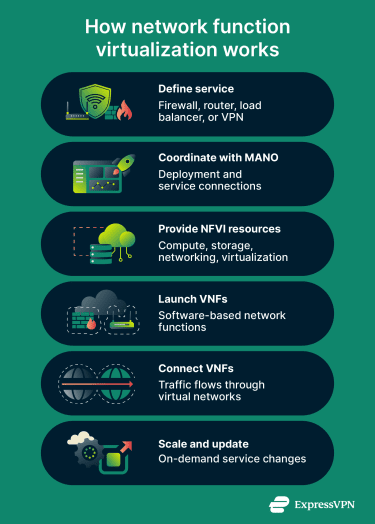
Why is network function virtualization important?
- Cuts equipment costs: NFV runs functions on standard servers instead of expensive dedicated hardware.
- Can lower operations costs: Automation and resource sharing can reduce hardware needs and improve infrastructure efficiency.
- Speeds up deployment: Service providers can deploy changes much faster than hardware upgrades allow.
- Scales on demand: Operators upsize or downsize functions to handle traffic spikes efficiently.
- Increases flexibility: NFV can make networks more agile and reduce reliance on specialized hardware.
- Supports 5G and telco cloud: NFV helps underpin many modern 5G networks and telco cloud systems.
- Enables faster go-to-market: Communication service providers (CSPs) can launch, update, or retire services quickly to meet market and business needs.
Where is it used?
Telecom, enterprise, and cloud networks rely on NFV to run network services as software rather than on dedicated hardware. Telecom companies and internet service providers (ISPs) use it for tasks like traffic routing, firewall protection, and gateway services.
Businesses use NFV in data centers to run tools such as load balancers and intrusion detection or prevention systems (IDPS) without dedicated hardware. Software-defined wide area network (SD-WAN) services may also use VNFs, depending on the deployment. NFV can also support services across private, hybrid, and cloud-based infrastructure.
Risks and privacy concerns
- Misconfiguration: Incorrect settings can expose services, leak sensitive data, or allow unauthorized access.
- Weak provisioning controls: Rapid provisioning can create risk if identity, access, and change controls are weak.
- Inefficient deployment review: Fast software-based rollouts can bypass proper security review if checks are not built into the deployment process.
- Hypervisor vulnerability: A flaw in the virtualization layer can expose multiple hosted workloads on the same machine.
- APIs exposure: Poorly secured management or orchestration APIs can allow unauthorized control or access to sensitive service data.
- Denial-of-service (DoS): Resource-exhaustion attacks can reduce availability by overwhelming shared infrastructure or hosted services.
Further reading
- What is cloud networking? A comprehensive overview
- What is IaaS? Infrastructure-as-a-Service explained
- Virtual server vs. physical server: Key differences explained
- Network architecture: Building secure and modern networks
- What is a virtual private cloud (VPC)?