Expressvpn Glossary
Mobile virtual network operator (MVNO)

What is a mobile virtual network operator?
A mobile virtual network operator (MVNO) is a mobile service provider that leases access to cellular infrastructure from a mobile network operator (MNO) while selling services, such as mobile plans, under its own brand name.
MVNOs don’t own the radio access network, which includes spectrum and cell towers, but may operate some core network functions, such as subscriber management or traffic routing. MVNOs often operate their own billing and support services and can use both physical SIM cards and eSIMs to serve their customers.
Types of mobile virtual network operators
- Thin MVNO (also called "light" or "skinny" MVNO): Owns no core infrastructure and has limited control. They rely on their MNO host for most core network functions, such as authentication and routing.
- Thick MVNO: Owns some core infrastructure, such as policy controls, enabling greater customization. It still depends on a host MNO for certain operations.
- Full MVNO: Owns and operates most core network elements, enabling MNO-like control over services, routing, and roaming. Leases access to the radio access network (RAN) from the MNO.
How does a mobile virtual network operator work?
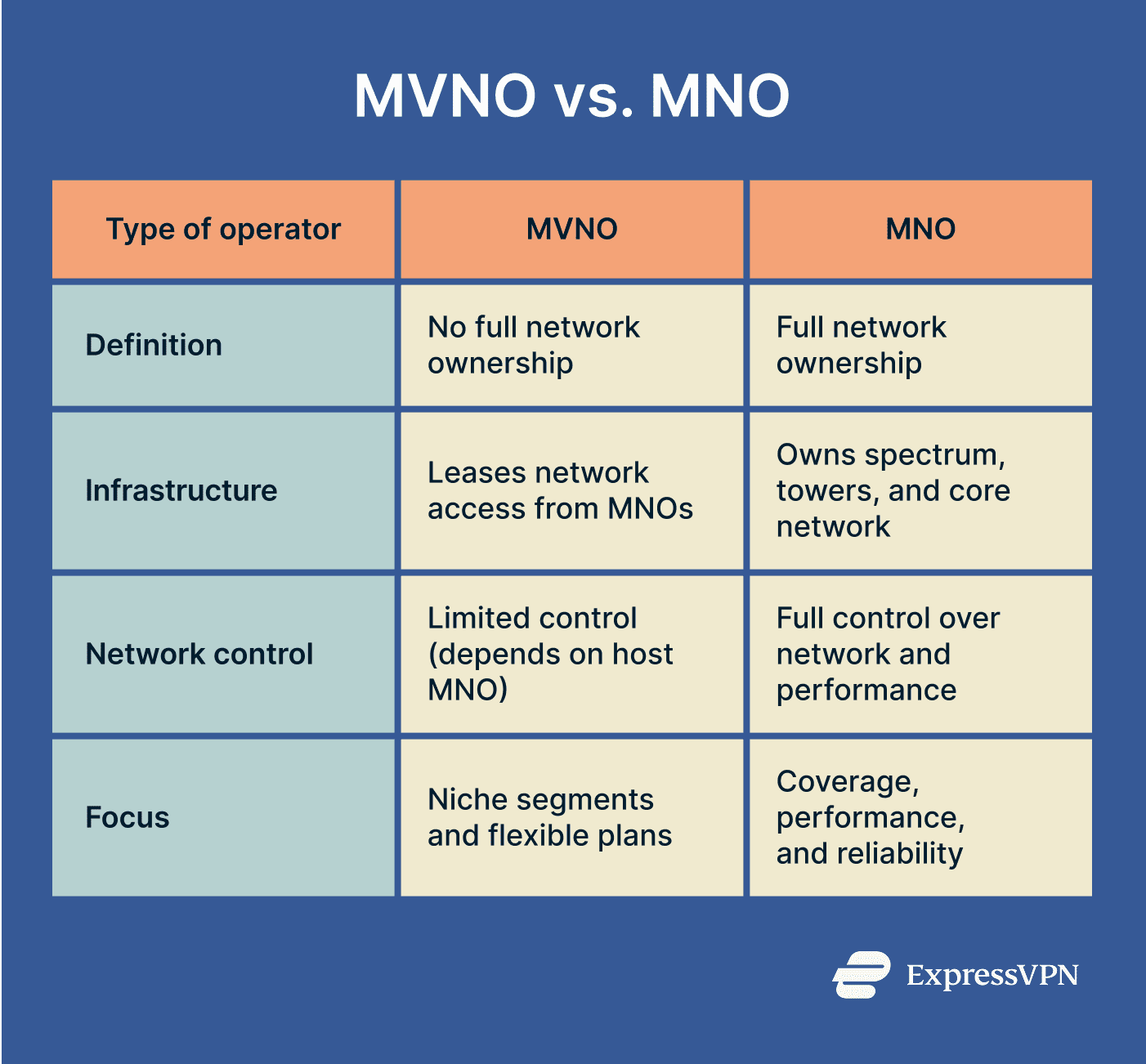
Traffic may be routed through either the host MNO’s core network or the MVNO’s own core infrastructure, depending on the MVNO type.
Some MVNOs may also partner with mobile virtual network enablers (MVNEs), which provide technical infrastructure (such as billing and core network functions) needed to launch and operate services. MVNEs act as intermediaries between MNOs and MVNOs.
Where is it used?
- Consumer mobile plans.
- Travel SIMs and eSIMs.
- Internet of Things (IoT) connectivity.
- Enterprise mobility.
- Rural or underserved markets.
Why mobile virtual network operators matter
MVNOs increase competition and add options to the mobile service market. Their services are often marketed as lower-cost alternatives to traditional operators.
Some offer niche plans, like pay-as-you-go or prepaid options, and features not provided by larger brands, leveraging host networks to expand coverage and encourage industry innovation.
Risks and privacy concerns
Many of the same risks that apply to MNOs also apply to MVNOs, though specific security policies and account protection practices can vary between providers. Potential risks include:
- Security controls: Protections vary by provider.
- Data retention: Metadata may be stored for legal and operational purposes.
- Third-party apps: May collect user data independently of the carrier.
Further reading
- Who can see my mobile data history?
- What is an eSIM? Everything you need to know
- Are eSIMs safe for travel and everyday use?
- SIM swapping: What you need to know to stay protected
- The threat of SIM swaps starts with your personal data