Expressvpn Glossary
Master password
What is a master password?
A master password is a single password used to protect a database of saved passwords, passkeys, and other sensitive data. It’s commonly used in password managers and Basic Input/Output System (BIOS) firmware. It acts as a master key, so users only need to remember one password instead of many.
How does a master password work?
A master password controls access to a protected system or encrypted data. When entered, the system verifies it and either unlocks access directly, such as in BIOS firmware, or uses it to generate a cryptographic key that decrypts stored data, such as in a password manager.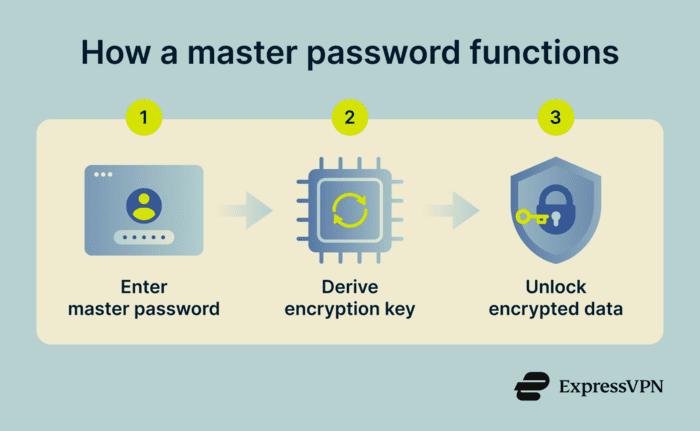
Whenever a user enters their master password, it runs through a key derivation function (KDF), such as Password-Based Key Derivation Function 2 (PBKDF2), which processes it through many rounds of hashing.
These repeated computations make it significantly harder for attackers to guess the password using brute force methods.
Some services add an extra verification step, like a code or device check, to confirm a user’s identity before granting access to the password vault, even after they enter their master password.
Why is a master password important?
A master password is important because it:
- Protects sensitive data and systems: A master password controls access to protected data or system settings, helping prevent unauthorized access.
- Supports encrypted, zero-knowledge storage: A master password enables systems that encrypt data in a way that prevents even service providers from accessing it.
- Acts as the foundation of vault security: In password managers, the master password controls access to the entire vault, making it the core of how stored data is protected.
Where are master passwords used?
A master password serves as a core security feature across many tools that store or protect sensitive data, including:
- Password managers: Password managers rely on a master password to unlock and decrypt stored login credentials and other data.
- Encrypted file vaults: Encrypted vaults use a master password to control access to files, ensuring that only authorized users can open and read protected documents.
- Device or disk encryption: Full-disk encryption systems use a master password to protect all data on a device, preventing access if the device gets lost or stolen.
- Enterprise credential management tools: Organizations use master passwords to secure access to shared accounts, administrative tools, and sensitive business systems.
Risks and privacy concerns
One compromised master password can expose all stored accounts and sensitive data within the system through:
- Phishing attacks: Fake login pages or malicious prompts can trick users into entering their master password, leading to full account compromise.
- Weak password choices: Short or simple master passwords can allow attackers to guess or crack them using automated tools and brute-force attacks.
- Malware and keyloggers: Malicious software can record keystrokes or screen activity and capture the master password during entry.
Strict zero-knowledge designs can also prevent providers from recovering access if the master password gets lost.
Further reading
- What is a password manager and why should you use one
- Tech Friend: What makes password managers safe?
- The best way to store your passwords securely
- Meet ExpressKeys, a new home for your passwords
- Password security: What changed from 2015 to 2025
- Passphrase examples and how they work