
Expressvpn Glossary
Internet of Everything

What is the Internet of Everything (IoE)?
The Internet of Everything (IoE) is a concept that expands on the Internet of Things (IoT) by connecting people, devices, data, and processes. Instead of focusing only on connected devices, IoE emphasizes how these elements work together.
How does the Internet of Everything (IoE) work?
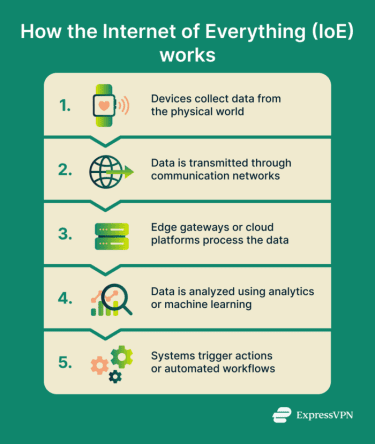
IoE works by connecting devices, people, and systems so that data can be collected, shared, and used to trigger actions. In a typical flow:
- Connected devices and applications generate data through sensors, user input, or system activity.
- That data is transmitted across networks between devices, systems, and users.
- Processing systems analyze the data to identify patterns, generate insights, or trigger automated responses based on predefined rules or workflows.
- The results are delivered to users or systems, enabling decisions, actions, or further automation.
IoE use cases
- Smart cities: Sensors and data systems help manage traffic, energy use, and public safety.
- Healthcare: Connected devices monitor patient health and support remote care.
- Manufacturing: Smart machines and predictive maintenance reduce downtime.
- Smart homes: Connected appliances, lighting, and security systems automate household tasks.
- Retail: Businesses analyze customer data to personalize services and improve supply chains.
IoE benefits
IoE improves efficiency, decision-making, and service delivery. Automated workflows reduce downtime and human error, while data collected from connected devices helps organizations identify patterns and make better decisions.
At the same time, IoE supports more personalized services that improve customer experiences and help organizations manage energy, resources, and waste more efficiently.
Risks and privacy concerns
While the IoE facilitates many modern devices, it can also create problems, such as:
- Expanded attack surface: More connected devices create more potential entry points that attackers can exploit.
- Privacy and profiling risks: IoE systems collect large amounts of personal data, which can enable user tracking or profiling.
- Data exposure through insecure APIs: Weak authentication or missing encryption can allow attackers to access or intercept sensitive data.
- Weak device security: Default passwords and poor configurations make IoE devices easier to compromise or use in botnets.
Further reading
- IoT cybersecurity: What it is and why it’s critical for modern networks
- Ultimate guide to IoT device security
- What are IoT networks? A complete guide
- IoT device management: Complete guide
- What is IIoT and why its security matters more than ever