
Expressvpn Glossary
Internet exchange point (IXP)
What is an internet exchange point?
An internet exchange point (IXP) is a physical location where different networks, like internet service providers (ISPs) or content platforms, connect and exchange internet traffic (peering). By routing traffic through an IXP, networks can often avoid sending data through multiple third-party transit providers, improving efficiency.
How does an internet exchange point work?
An IXP works by allowing multiple networks to connect in one place and exchange traffic more directly. At an IXP, content delivery networks (CDNs), cloud platforms, and ISPs connect their routers to a shared switching system, called the switching fabric. The switching fabric is the core network infrastructure of the IXP.
The networks use the Border Gateway Protocol (BGP) to exchange routing information and implement peering agreements, which define how traffic flows between them. Once connected, data can travel directly between participating networks through the IXP’s switching fabric, reducing the need to route traffic through third-party transit providers.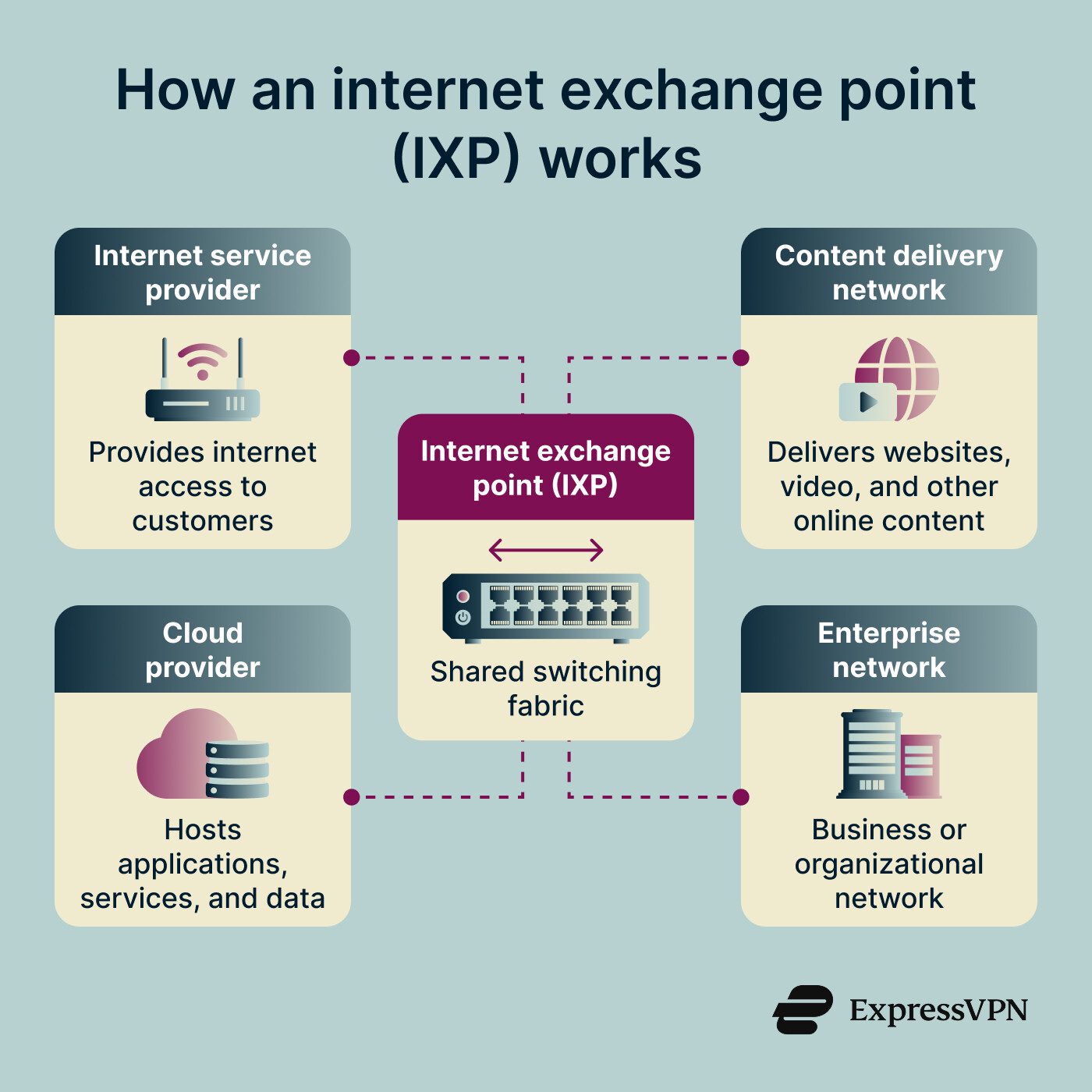
Why is an internet exchange point important?
IXPs play a vital role in helping the internet to function at scale. By enabling direct interconnection between networks, they help reduce reliance on third-party transit providers and support a more distributed and resilient internet infrastructure. IXPs also make it easier for regional networks to keep local traffic local, which contributes to a more efficient and balanced global network.
Where are IXPs used?
IXPs are typically found in:
- Carrier-neutral data centers: Facilities not owned by a single network provider that host multiple networks, making them ideal locations for IXPs to interconnect participants.
- National internet infrastructure: Strategic locations in a country that serve as key hubs for routing internet traffic efficiently at the national level.
- Regional network ecosystems: IXPs supporting regional networks, keeping local traffic local and reducing the need for long-distance routing.
- ISP interconnection: Networks like ISPs connect at IXPs to exchange traffic directly with other networks, improving performance and reducing reliance on third-party transit.
- CDN and cloud interconnection: CDNs and cloud providers connect to IXPs to deliver content more efficiently to users and optimize their traffic paths.
Benefits and limitations
Benefits of IXPs include:
- Lower latency: Data travels shorter routes between networks, improving speed.
- Reduced bandwidth costs: Networks avoid paying third-party transit providers, although transit fees may still apply in IXPs.
- Better local routing: Regional traffic can stay within the area instead of being routed over long distances.
- Improved resilience: Direct interconnections reduce reliance on single upstream providers.
However, they also come with several limitations:
- No built-in encryption: IXPs only exchange traffic; they don’t secure it. Encryption is handled by protocols like HTTPS.
- Depends on peering policies: Networks choose who to connect with, which determines which routes they can access and how they exchange traffic.
- Limited geographic coverage: Not all regions have well-developed IXPs, so traffic may still rely on longer routes.
- Requires technical resources: Networks need infrastructure and expertise to connect and manage peering effectively.
Further reading
- Internet infrastructure: What it is and how it works
- What is routing, and why does it matter in networking?
- How does the internet work?
- Anycast DNS guide: Everything you need to know
- What is computer networking and how VPNs fit in