Expressvpn Glossary
Internet backbone
What is the internet backbone?
The internet backbone is the core infrastructure of the global internet. It carries large volumes of internet traffic and forms the central pathways that allow networks around the world to communicate.
Internet backbone infrastructure
The internet backbone relies on several key infrastructure components that enable global data transport:
- Fiber-optic cables: Long-distance terrestrial and submarine fiber links carry internet traffic between regions and continents.
- Backbone routers: High-capacity routers forward data between networks and maintain large routing tables.
- Points of presence (PoPs): Facilities in major cities where backbone providers house networking equipment and connect their infrastructure to local networks.
- Internet exchange points (IXPs): Neutral locations where different networks interconnect and exchange traffic directly.
How does the internet backbone work?
Once traffic reaches the backbone, backbone routers determine the best available path to its destination. These routers communicate using Border Gateway Protocol (BGP), which maintains a continuously updated map of reachable networks and the routes used to reach them.
Based on this information, each router forwards the data packet to the next network along the selected path. Networks typically interconnect at PoPs or IXPs, where providers exchange traffic.
If a route becomes unavailable or congested, routers can select alternative paths, allowing traffic to continue moving across the backbone.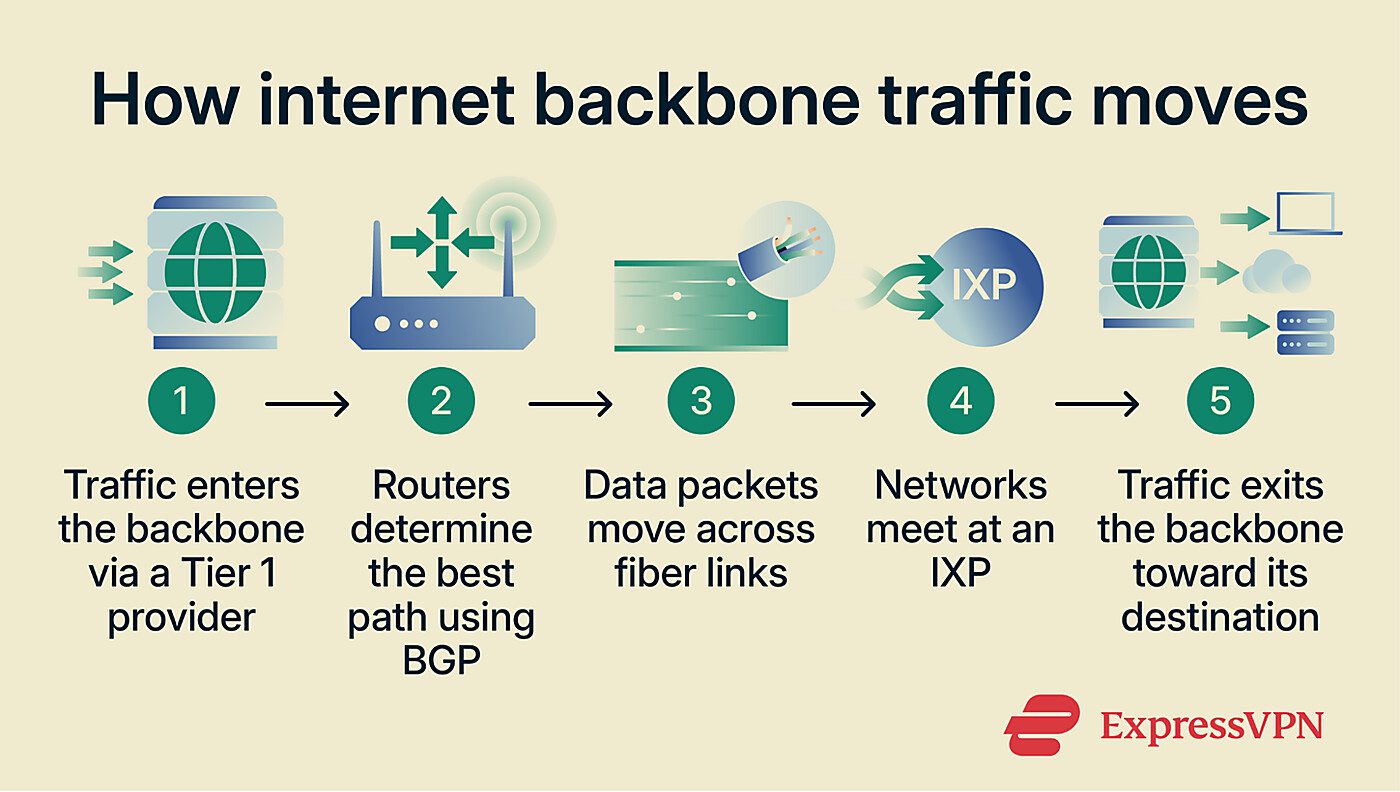
Who owns the internet backbone?
No single entity owns the internet backbone. It is operated collectively by a small number of large carriers, known as Tier 1 providers, which maintain peering agreements that allow them to exchange traffic with one another. Smaller regional and local providers pay Tier 1 carriers for access to this broader network, a cost that is eventually passed down to end users.
Architecture and constraints
The internet backbone is designed to carry large volumes of traffic across interconnected global networks. Its architecture introduces certain constraints that shape how traffic is routed and how disruptions are handled:
- Physical disruptions: Submarine and terrestrial fiber cables can be damaged by natural events or human activity, which may interrupt connectivity until traffic is rerouted.
- Routing trust model: BGP relies on trust between networks when exchanging routing information. In some cases, incorrect or unauthorized route announcements can affect how traffic is directed, though such issues are typically limited in scope and resolved by network operators.
- Network concentration: A relatively small number of major carriers and interconnection points handle significant global traffic, which can increase the impact of outages or disruptions in key areas.
Further reading
- How does the internet work?
- Network connections: Everything you need to know
- Internet infrastructure: What it is and how it works