Expressvpn Glossary
Internet Assigned Numbers Authority (IANA)

What is IANA?
The Internet Assigned Numbers Authority (IANA) is a set of functions that maintain protocol parameter registries, allocate IP address blocks, and maintain the Domain Name System (DNS) root zone, where top-level domains (TLDs) like ".com" are recorded and delegated.
IANA’s functions are carried out by Public Technical Identifiers (PTI), which is an affiliate of the Internet Corporation for Assigned Names and Numbers (ICANN).
What does IANA do?
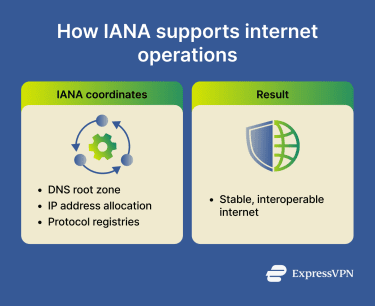 IANA’s four core responsibilities include:
- IP address allocation: Allocates IP address blocks to Regional Internet Registries (RIRs), which distribute them to internet service providers (ISPs) and other organizations.
- DNS root zone management: Maintains the DNS root zone file by adding, modifying, or removing TLD entries and ensuring each TLD is correctly linked to its authoritative nameservers so domain queries can be routed properly.
- Protocol registries: Maintains registries of protocol parameters, such as port numbers and protocol identifiers, ensuring they’re uniquely assigned and consistently defined in coordination with the Internet Engineering Task Force (IETF).
- Autonomous System Number (ASN) allocation: Allocates ASN ranges to RIRs, which assign them to ISPs and other organizations as unique identifiers for their networks.
Why is IANA important?
By coordinating unique identifiers, IANA helps maintain the internet's overall stability and global interoperability. It supports DNS operations and enables communication between devices and networks.
It also enables global routing by allocating IP address blocks and other network identifiers, helping prevent duplication and reduce the risk of IP conflicts and routing errors.
Further reading
- How does the internet work?
- What is DNS, and how does it work?
- Nameserver: The complete guide to setup and management
- DNS record types explained: A complete guide for privacy
- Types of DNS servers: Everything you need to know