Expressvpn Glossary
Host-based firewall

What is a host-based firewall?
A host-based firewall is a security control that runs on an individual device, such as a laptop, server, or desktop system, and regulates its network connections.
Its main role is to enforce local network policy for a single system, unlike a network firewall, which filters traffic for multiple devices.
How does a host-based firewall work?
A host-based firewall evaluates traffic, compares it against a set of rules, and then takes action. It typically follows this process: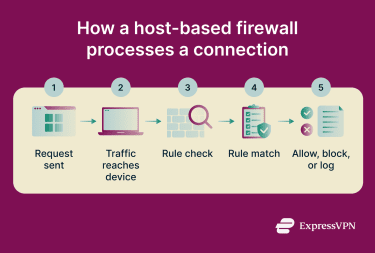
- Inspect packets: Examine data to determine its source and destination.
- Match against rules: Compare traffic to rules based on ports, protocols, IP addresses, or the applications sending or receiving data.
- Allow, block, or log activity: Permit safe connections, block unauthorized ones, or record activity.
- Generate alerts: Trigger alerts when activity appears unusual or violates rules, depending on configuration.
Where is it used?
Deployment depends on the system function, location, and sensitivity:
- End-user devices: Control which apps and services can send or receive traffic.
- Servers (on-premises and cloud): Restrict traffic to required services, reducing exposure to critical systems.
- Remote and hybrid environments: Enforce security rules on devices outside the office network.
- High-risk or regulated endpoints: Apply stricter controls to systems handling sensitive data.
Why is a host-based firewall important?
A host-based firewall helps contain threats by limiting what a system can access and what can access it. It:
- Prevents lateral movement: Helps restrict connections between devices, stopping attackers from moving deeper into a network.
- Limits command-and-control traffic: May block suspicious outbound connections used by malware to contact external servers.
- Protects beyond perimeter defenses: Filters traffic on the endpoint even when a device leaves the network or a threat bypasses a gateway firewall.
- Strengthens endpoint defense: Adds an independent layer of control on the device, reducing reliance on a single security measure.
- Supports compliance: Enforces traffic restrictions and policies for audit and regulatory requirements.
Risks and privacy concerns
- Misconfigurations can block legitimate traffic.
- Weak or overly broad rules can allow unwanted connections.
- Frequent prompts can cause users to allow connections without proper review.
- Logs may include sensitive metadata, such as IP addresses.
Further reading
- What is a firewall and why it matters for security
- VPN vs. firewall: Key differences and when to use each
- NAT "firewall": Everything you need to know about network security
- VPNs, firewalls, and endpoint security: What does your team need?
- XDR in cybersecurity: What it is and why it matters
FAQ
What is the difference between a host-based firewall and a network firewall?
A host-based firewall runs on an individual device and controls traffic for that system. A network firewall sits between networks and filters traffic for multiple devices.
Does a host-based firewall protect against malware?
No, a host-based firewall filters network traffic and can block suspicious connections. While this may limit how malware is delivered or communicates, it doesn’t replace anti-malware protection.
Can a host-based firewall block apps from accessing the internet?
It can block or allow access based on specific applications. Firewall rules can be tied to programs, ports, and protocols, allowing control over which apps send or receive traffic.
Is a host-based firewall enough on its own?
No, while it adds a layer of protection by filtering traffic on the device, effective security requires other controls, such as updates, access management, and additional protections.
Do Windows and macOS include host-based firewalls?
Yes, Windows includes a host-based firewall enabled by default, and macOS provides a built-in firewall that can be enabled to control incoming connections.