Expressvpn Glossary
Digital watermarking

What is digital watermarking?
Digital watermarking is the embedding of identifying data into digital media like images, audio, video, or documents. This data may include information such as the file’s origin, ownership details, timestamps, unique IDs, or licensing information.
Watermarking can be visible, such as a logo overlaid on an image, or hidden using techniques related to steganography. Hidden watermarks are designed to be machine-readable and difficult to notice without a detector.
How does digital watermarking work?
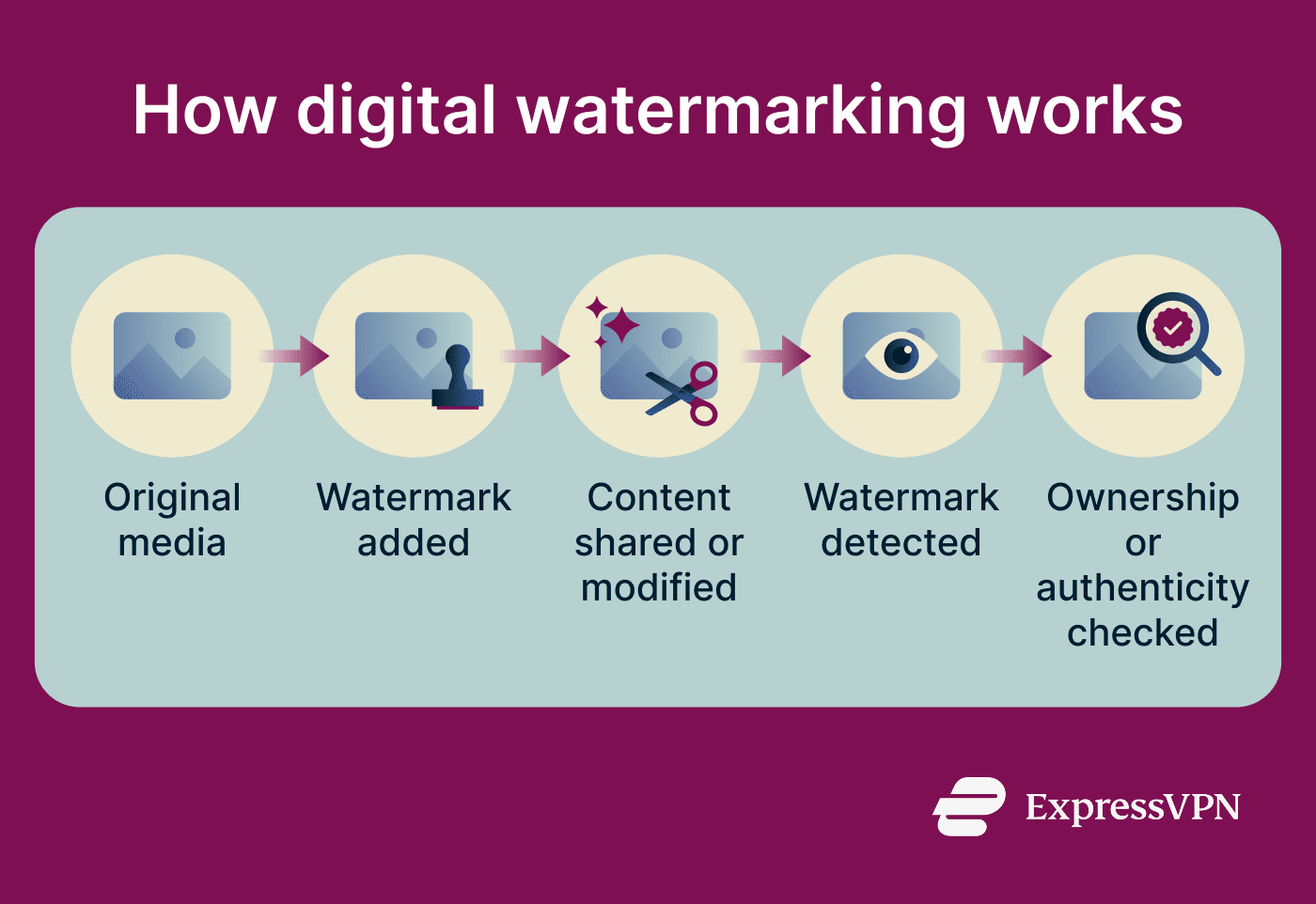
Digital watermarking and rights-management workflows may follow a few steps:
- Embedding: A watermarking tool adds an identifier to the file, such as small changes to pixels in images, audio/video signals, or text and layout patterns in documents.
- Distribution: Users share, copy, upload, or modify the file, such as by compressing, resizing, or converting it to another format.
- Detection and extraction: A detector scans the file for watermark patterns. Depending on the system, it may only confirm that a watermark is present or extract a readable label, ID, or other embedded data.
- Response: A platform or rights-management system may compare the detected watermark or identifier with a known record to support ownership, provenance, licensing, or reuse checks. Depending on the system and policy, this may lead to review, tracking, changes to monetization, removal, or blocking.
Types of digital watermarking
Digital watermarking methods vary by embedding technique, visibility, and purpose:
- Visible vs. invisible watermarks: Visible watermarks overlay text or logos directly on the content. Invisible watermarks embed signals that aren't noticeable to users but can be detected by software.
- Robust vs. fragile watermarks: Robust watermarks are designed to remain detectable even after common changes such as compression or resizing. Fragile watermarks are designed to break when changes occur, helping detect tampering.
- Spatial domain watermarks: This method embeds data by adjusting pixel values in specific regions of an image, making small changes that typically don’t affect how the content appears.
- Frequency-domain watermarks: Methods such as the discrete cosine transform (DCT) and the discrete wavelet transform (DWT) decompose a file into frequency components and embed watermark data in selected coefficients or sub-bands to balance visibility, robustness, and file quality.
- Fingerprinting vs. ownership marks: Fingerprinting assigns a unique identifier to each copy of a file to trace its source. Ownership marks embed a fixed identifier that links the content to its creator or rights holder.
Why is digital watermarking important?
Digital watermarking is key to protecting intellectual property, supporting copyright enforcement, securing documents, and enabling digital forensics.
Because watermarking embeds data into the content itself, robust watermarks can remain tied to the file after copying, sharing, or some modifications. This can provide evidence of ownership, attribution, or provenance, supporting legal protection against piracy and intellectual property infringement. It can also mark the origin of AI media, helping identify whether content was AI-generated, human-made, or edited with AI tools.
For security and forensics, watermarking enables tracking, leak detection, and tamper detection without visibly altering content.
Where is it used?
Digital watermarking appears across various platforms and use cases, including:
- Streaming services and online video platforms.
- Social media platforms and image-sharing sites.
- Stock photo websites and content marketplaces.
- Corporate documents shared between employees or clients.
- Broadcasting and streaming, where visible logos identify a channel or invisible forensic watermarks help trace leaks.
Risks and privacy concerns
Digital watermarking might involve trade-offs between reliability, quality, and privacy depending on its implementation.
Without the right protection measures or watermarking methods, compression, cropping, or added noise can weaken or remove some watermarks. Transform domain methods, such as DCT or DWT, improve robustness, but their effectiveness depends on the algorithm, embedding strength, and the extent of content alteration. Embedding more data, increasing embedding strength, or repeating the watermark across a file can improve detectability, but may also increase the risk of artifacts or slight quality loss.
Detection accuracy also affects reliability. Systems aim to minimize false positives and negatives, but results vary depending on the technique, detector settings, and how the content is altered. Heavy editing can reduce detectability, while overly sensitive detection can flag incorrect matches.
Additionally, forensic or transaction watermarks can help trace a specific distributed copy to a source, account, device, or transaction. This may raise privacy concerns if watermark identifiers are persistent, hidden, or linked to individual users without clear notice or safeguards.
Further reading
- How to stop AI from stealing your art
- What is steganography? A complete guide to hidden data techniques
- What is AI art? A beginner-friendly guide to how it works