Expressvpn Glossary
Data retrieval

What is data retrieval?
Data retrieval is the process of fetching stored data from a database, system, or storage environment. It allows users, applications, or systems to obtain specific information when needed.
How does data retrieval work?
Data retrieval begins with a request for specific information that may come from a user search, an application query, or an automated system process.
If required, the system authenticates the user, then identifies the data source and processes the query by applying filters, keywords, or search conditions to locate the correct records. Once that’s done, it returns the requested data in a usable format.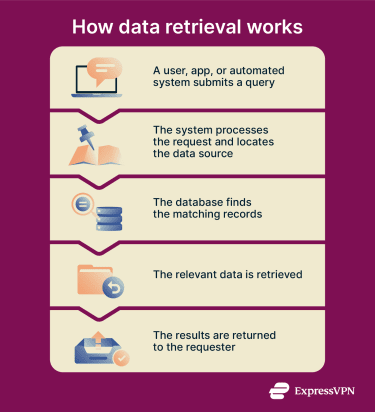
Data retrieval methods
Data retrieval methods vary depending on how data is stored, what it contains, and how quickly results are needed:
- Structured Query Language (SQL) queries: Use standardized commands to retrieve data from relational databases that store information in structured tables.
- NoSQL queries: Retrieve data stored in non-relational models such as document, key-value, column-family, or graph structures. This method is common in big data platforms, Internet of Things (IoT) systems, and social media services.
- Application programming interfaces (APIs): Serve as intermediaries that let applications request and receive data from other software systems, including web and cloud services.
- Web scrapers: Collect publicly accessible web data automatically. That data is then converted into structured, user-friendly formats.
Where is it used?
Data retrieval is used across various sectors and industries, with common use cases including:
- Search and recommendation systems: Platforms retrieve and rank indexed data in response to user queries or behavior, such as web search engines returning pages or online stores surfacing relevant products.
- Transactional systems: Operational systems retrieve records in real time to process transactions and support decisions, such as verifying account balances, retrieving user profiles, or accessing medical records.
- AI knowledge systems: AI applications retrieve relevant information from knowledge bases or document stores before generating responses, a pattern commonly used in Retrieval-Augmented Generation (RAG).
Why is data retrieval important?
Data has no practical value if it cannot be found and used when needed. Effective data retrieval can enable systems to locate and return stored information efficiently. It also enables app features like user profiles and personalized recommendations.
Challenges and security concerns
While data retrieval is essential and provides many benefits, it can also introduce certain challenges and security risks:
- Performance and accuracy issues: Large datasets, poor indexing, or outdated caches can slow systems or return outdated results.
- Unauthorized access and injection attacks: Weak authentication or unsecured query interfaces can expose sensitive data or allow manipulation through query injection attacks.
- Privacy and compliance risks: Systems retrieving personal or regulated data must enforce strict access controls and maintain proper logging and auditing.
Further reading
- What is SQL injection? How it works and how to prevent it
- What is big data security and privacy?
- What is access control? How it works and why it matters
- What is TLS encryption, and how does it protect your data?