
Expressvpn Glossary
Data center virtualization
What is data center virtualization?
Data center virtualization is the use of software to create virtual versions of physical resources such as servers, storage, and networking. Instead of running applications on dedicated hardware, it allows multiple workloads to share the same physical infrastructure while remaining logically isolated from one another.
How does data center virtualization work?
Data center virtualization adds a software layer called a hypervisor between physical hardware and the workloads running on it. The hypervisor divides hardware resources such as CPU, memory, storage, and networking into multiple virtual machines (VMs), each running its own operating system and applications.
Additional software tools sit above the hypervisor to manage virtual networks, storage, and compute resources without needing direct control of the physical hardware.
A central management system monitors the virtual data center and allocates resources as needed to keep workloads running efficiently. Virtualization also supports live migration, allowing VMs to move between servers without downtime, and automation tools that speed up provisioning and scaling. This makes systems easier to manage, helps deploy applications faster, and improves hardware utilization.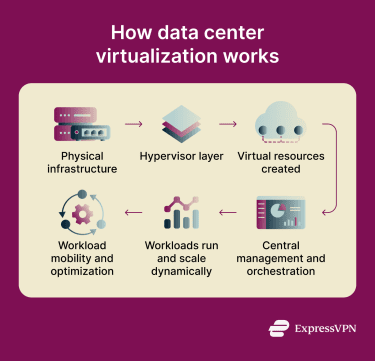
Why is data center virtualization important?
Data center virtualization allows organizations to use their hardware more efficiently while making systems easier to manage and scale. This leads to:
- Better hardware utilization: Multiple workloads share the same physical infrastructure, reducing wasted resources.
- Improved scalability and flexibility: VMs can be created, resized, or moved quickly to handle changing demand without new hardware.
- Stronger resilience and disaster recovery: Virtualized workloads can be backed up, replicated, and restarted on another server if hardware fails.
- Better workload portability: Workloads can move between hosts or environments with minimal disruption.
- Easier management and automation: Centralized tools simplify monitoring, updates, and provisioning.
- Lower hardware and operational costs: Fewer physical servers reduce power consumption, cooling requirements, and data center space, thereby lowering overall operating expenses.
- Consistent security and segmentation: Policies can be applied at the software level, and workloads can be isolated to limit the impact of issues.
Where is data center virtualization used?
Data center virtualization is used in private data centers, public cloud environments, and hybrid setups. Organizations use it to run applications without dedicated hardware, while hybrid environments rely on it to move workloads between on-premises systems and cloud infrastructure.
Virtualization also powers virtual desktop infrastructure, which lets users access their desktops from different devices. Additionally, it’s used to host disaster recovery and backup environments, where workloads can be quickly restored to alternate hardware, and for isolated development and testing environments, where engineers can test changes without risking production systems.
Risks and security concerns
Virtualized data centers can introduce security risks because multiple systems share the same physical infrastructure. Vulnerabilities in the hypervisor could allow attackers to move between VMs, while misconfigured network rules or permissions can weaken isolation and expose data.
Internal traffic between virtual systems may go unmonitored, making it easier for threats to spread without detection. Backup copies and snapshots can also create risk if they store sensitive data longer than intended.
Further reading
- Virtual server vs. physical server: Key differences explained
- What is IaaS? Infrastructure-as-a-Service explained
- What is cloud networking? A comprehensive overview
- How to set up a virtual machine safely and avoid common mistakes
- Desktop virtualization: The complete guide
- What is a cross connect in a data center?