
Expressvpn Glossary
Data center tiers
What are data center tiers?
Data center tiers classify the design and infrastructure of facilities based on redundancy and fault tolerance. Defined by the Uptime Institute, the tiers range from Tier I to Tier IV and provide a clear way to assess reliability and availability during maintenance or in the event of failures.
How do data center tiers work?
Data center tiers define four levels (Tier I–IV), with each tier adding greater redundancy, maintainability, and resilience across critical infrastructure systems. Higher tiers include independent infrastructure paths and backup capacity, allowing systems to continue operating during maintenance or failures.
Types of data center tiers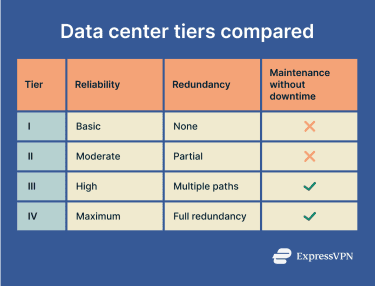
- Tier I: Single power and cooling distribution path with no redundant capacity components. Maintenance or infrastructure failures may require shutting down operations.
- Tier II: Single power and cooling distribution path with redundant capacity components, such as backup cooling or power systems. Maintenance still typically requires shutdowns, and distribution path failures can interrupt operations.
- Tier III: Multiple distribution paths and redundant capacity components that allow planned maintenance without shutting down IT operations. However, the facility is not fully fault-tolerant, so unplanned failures may still affect services.
- Tier IV: Multiple independent and physically isolated distribution paths with fault-tolerant infrastructure. Individual equipment failures or distribution interruptions should not impact IT operations.
Why are data center tiers important?
Data center tiers help organizations evaluate infrastructure by:
- Providing a standard way to assess availability.
- Establishing expectations for uptime and resilience.
- Supporting decisions about cost, compliance, and system design.
Where are data center tiers used?
Enterprises, colocation providers, and IT professionals use data center tiers to evaluate data center facilities, colocation services, and infrastructure supporting cloud or hybrid environments.
The tiers help organizations match availability requirements with appropriate services. Lower-tier facilities are often used for less critical workloads, while higher-tier facilities support high-availability services.
Further reading
- What is a cross connect in a data center?
- What is a cloud server? Everything you need to know
- What is IaaS? Infrastructure-as-a-Service explained
- What is cloud networking? A comprehensive overview
- Network architecture: Building secure and modern networks