
Expressvpn Glossary
Data availability
What is data availability?
Data availability refers to authorized users’ ability to access data in a timely and reliable manner whenever it’s needed. It’s one of the three pillars of the CIA triad, a foundational cybersecurity model that also includes confidentiality and integrity.
How does data availability work?
Data availability involves maintaining infrastructure that’s capable of storing and serving data with minimal disruption. This can include direct-attached storage (DAS), network-attached storage (NAS), and storage area networks (SAN), all connected through networking hardware that enables reliable access. Software systems then act as the interface between users and this infrastructure, ensuring data can be retrieved efficiently.
A key component is data redundancy: storing multiple copies of data across various sources in case one source fails. This is supported by failover mechanisms, which automatically switch to a standby system if the primary one goes down, helping maintain continuous access. Data backups complement all this through point-in-time copies, which are backups that capture the entire state of data at a specific moment.
All this is underpinned by continuous monitoring, where health checks track system performance and automatically route traffic to functioning systems if issues are detected.
Why is data availability important?
Data availability is vital because it keeps services operational. Even brief downtime can lead to lost revenue, operational disruption, and reduced user trust. What’s more, in critical systems like those used in healthcare, an outage can disrupt access to vital patient information during emergencies.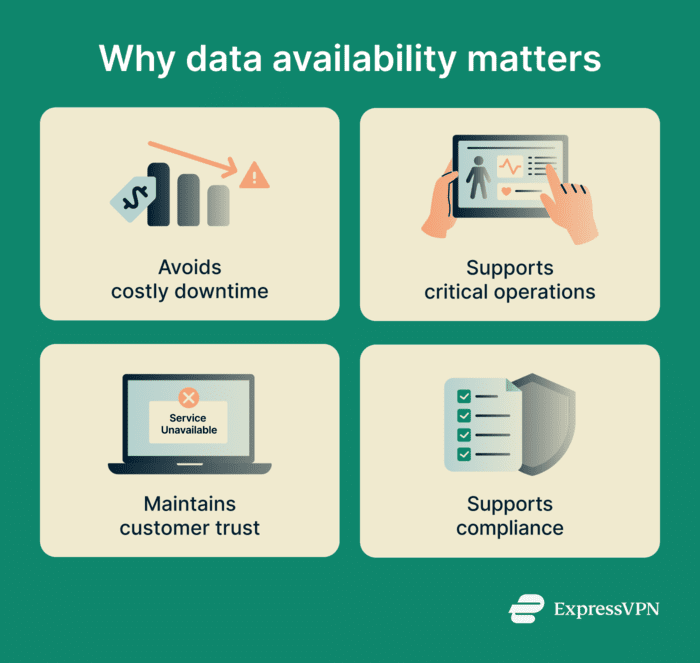
Finally, data availability is a key component in building customer trust and meeting compliance requirements in regulated industries like finance and healthcare.
Where is it used?
Data availability is especially important in sectors where downtime can disrupt essential services, delay operations, or put safety and continuity at risk.
- Cloud platforms: Cloud providers maintain availability through redundancy across multiple availability zones. If one zone experiences an outage, traffic is redirected to another with minimal disruption.
- Healthcare systems: Since patient records and treatment data must be accessible at all times, healthcare organizations use replication across systems or regions to ensure continuous access and reliable recovery.
- Financial services: Banks and payment providers rely on continuous access to transaction data to operate.
- Critical infrastructure: Availability disruptions can hinder power grids, water systems, or transportation networks, making data availability vital for critical infrastructure.
- Enterprise networks: Networks in large organizations require data availability to keep internal systems, applications, and business operations running.
Further reading
- What is big data security and privacy?
- Security concerns in cloud computing and how to address them
- What is IaaS? Infrastructure-as-a-Service explained
- What is a virtual private cloud (VPC)?