Expressvpn Glossary
Class C IP address
What is a Class C IP address?
A Class C IP address is a legacy category from the original classful IPv4 addressing system, which divided IP addresses into classes based on network size. In this system, Class C addresses have a first octet from 192 to 223.
Public and private IP ranges of Class C
Within the Class C space, 192.168.0.0 to 192.168.255.255 are non-routable addresses reserved for private networks, such as those used in homes and offices. The remaining addresses within the Class C range are mostly public, though several other blocks are reserved for specific purposes. For example, 203.0.113.0 to 203.0.113.255 is reserved for documentation and example code.
How does a Class C IP address work?
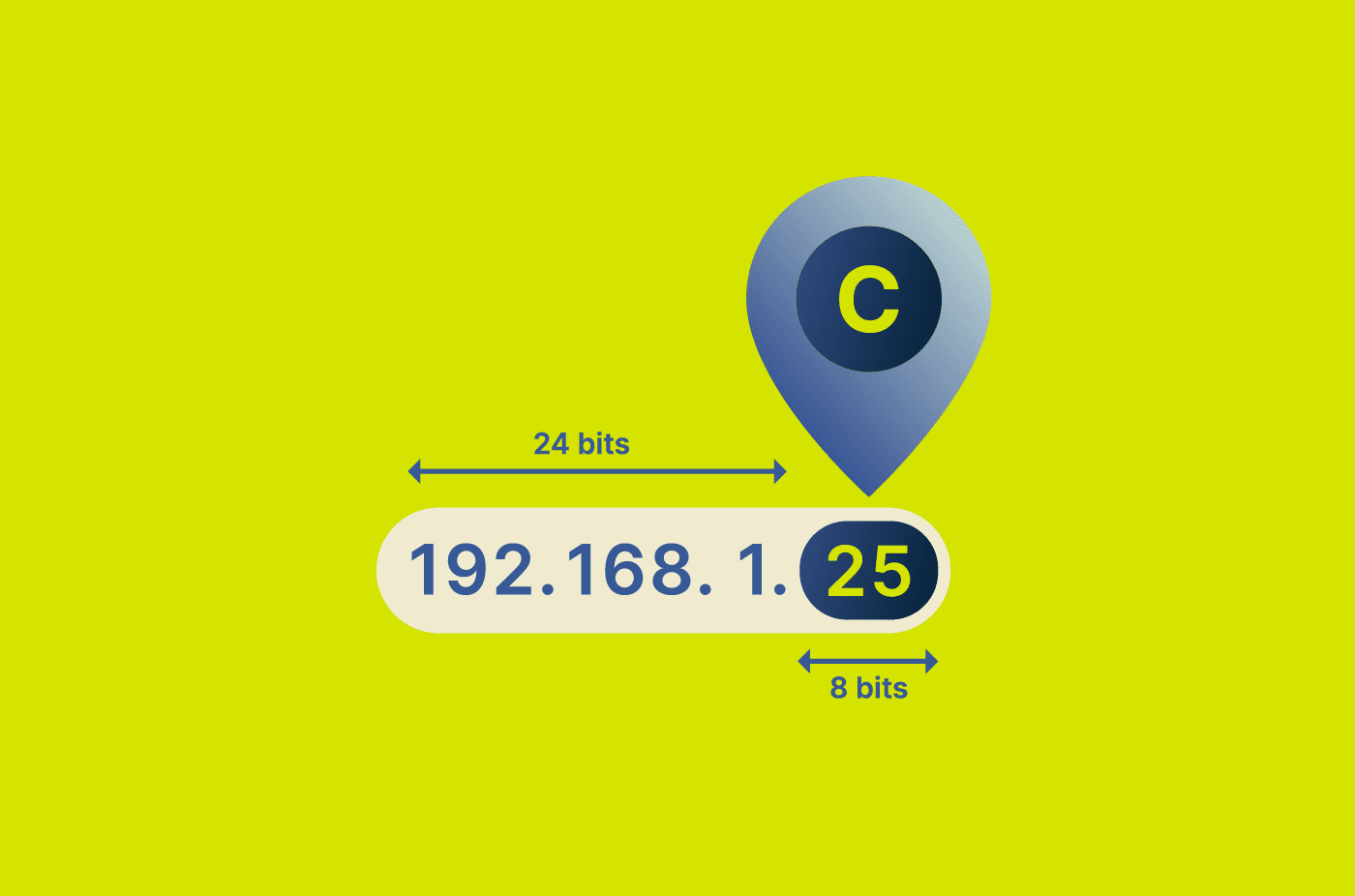
A Class C address uses the first three octets (24 bits) to identify the network and the last octet (8 bits) to identify the host. Because the host portion contains 8 bits, a Class C network can create 256 total addresses, with 254 usable host addresses after reserving the network and broadcast addresses.
In the classful system, the subnet mask was implied by the IP address class. Any address beginning with 192–223 was defined as a Class C network with a /24 subnet mask.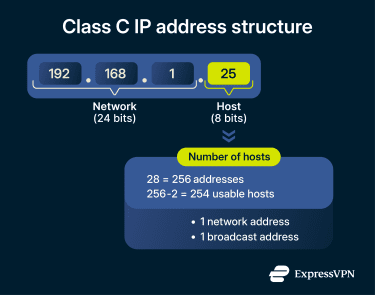
Class C IP address use cases
Class C IP addresses were designed for small networks that need a limited number of devices, such as home networks, small business networks, and small office local area networks (LANs). Today, Class C addressing is primarily used for educational purposes, such as teaching the basics of IPv4 addressing and subnetting.
Why is Class C addressing no longer widely used?
Class C addressing, along with the rest of the classful system, was replaced by Classless Inter-Domain Routing (CIDR). The main reason is that the class-based model divided networks into fixed sizes, which often led to inefficient use of IP addresses.
For example, a Class C network could support only 254 hosts, which could be either too small or larger than needed. CIDR introduced flexible prefix lengths (such as /26, /27, or /28) that allow IP address blocks to be allocated more efficiently.
Some network practitioners use “Class C” as shorthand for any /24 subnet. However, this is technically incorrect, as class is determined by the leading bits of the address, not the prefix length.
Further reading
- What are IP address classes? Importance for VPNs and cybersecurity
- What is a subnet? A complete guide to subnetting
- Types of IP addresses explained: Complete guide
- What is my local IP address?
- IPv4 vs. IPv6: Which one is better?