Expressvpn Glossary
Class B IP address
What is a Class B IP address?
A Class B IP address is an IPv4 address that falls within a particular range. Though seldom used as a meaningful distinction today, the concept remains relevant to understanding how IPv4 addressing was originally structured. The Class B range was created for medium-sized networks that needed more devices than a Class C network could support. By default, a Class B network supports 65,534 usable host addresses.
In a Class B system, the first number in the IP address is between 128 and 191. Each number in an IPv4 address is called an octet, and there are four octets in total. It uses the default subnet mask 255.255.0.0, which means the address is split between a network part and a host part.
How does a Class B IP address work?
In 172.16.10.25, the 172.16 part identifies the network, while 10.25 points to a specific device on that network. This example also falls within the private IPv4 range reserved for internal networks.
Class B addressing was designed for organizations that needed more host addresses than a Class C network could provide. Today, this classful system has largely been replaced by Classless Inter-Domain Routing (CIDR), which describes networks using prefix lengths such as /16, /20, or /24 rather than Class A, B, or C labels.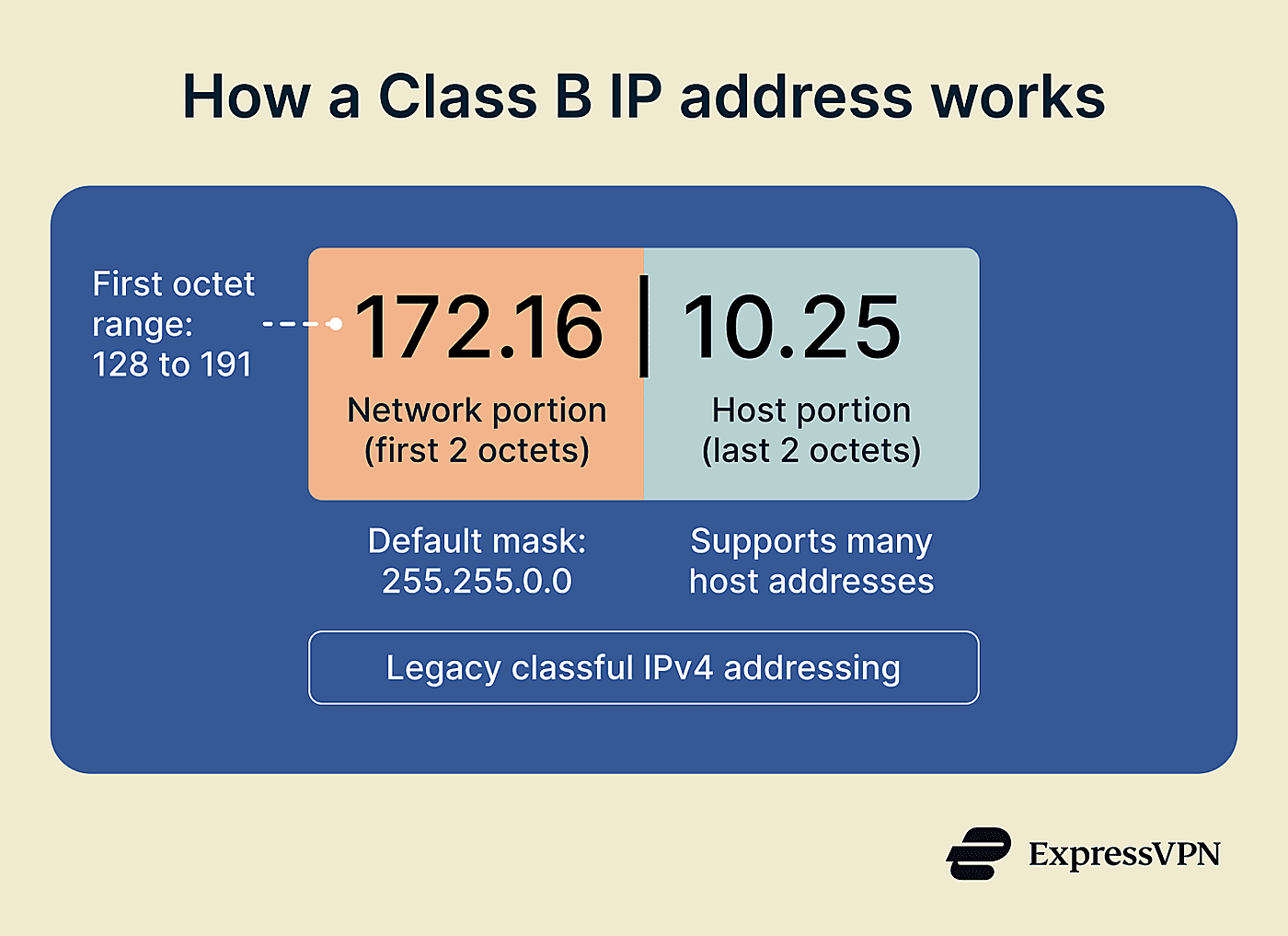
Why is a Class B IP address important?
A Class B IP address is important mainly as a legacy networking concept. It helps explain how older IPv4 networks were structured and gives useful background for subnetting, network design, and the shift to the modern CIDR system.
Where is it referenced today?
Today, Class B addressing is mostly referenced in:
- Legacy enterprise environments.
- Older networking textbooks.
- Subnetting and routing exercises.
- Historical discussions of IPv4 allocation.
- Certification study guides that explain classful addressing.
In modern practice, networks are usually described with CIDR prefixes such as /16, /20, or /24 instead of Class A, B, or C labels.
Risks and privacy concerns
A Class B IP address is not a privacy risk by itself. The real issues come from how a network using a large address range is designed, documented, and exposed.
In older or poorly segmented networks, large address ranges can encourage overly broad subnets or security zones. That can make traffic harder to monitor, expand the attack surface, and make it easier for an attacker or malware to move across connected systems once inside.
Confusion between older class-based labels and modern CIDR-based network design can also lead to mistakes. A team may assume a network is broader or narrower than it really is, which can affect firewall rules, access controls, and subnet planning.
There’s also a common source of confusion around private addressing. The private range often associated with Class B is 172.16.0.0/12, covering 172.16.0.0 through 172.31.255.255. This range is private, but it represents only a portion of the broader historical Class B address space.
Another reserved block within the historical Class B range is 169.254.0.0/16, used for IPv4 link-local addressing. Devices may self-assign addresses in this range when no other address configuration, such as Dynamic Host Configuration Protocol (DHCP), is available.
In any case, uncertainty about the nature of a particular block can lead to errors in addressing or incorrect assumptions about whether traffic is public, private, or link-local.
Further reading
- What are IP address classes? Importance for VPNs and cybersecurity
- What is a subnet mask? Why it matters for your network
- What is a subnet? A complete guide to subnetting
- What are non-routable IP addresses?
- Types of IP addresses explained: Complete guide
FAQ
What is a Class B IP address range?
What is the default subnet mask for Class B?
Is Class B addressing still used today?
How many hosts can a Class B network support?
What is a Class B IP address example?
Is a Class B IP address private?
What is the difference between Class A, B, and C?
- Class A used the first octet for the network and the remaining three for hosts.
- Class B used the first two octets for the network and the remaining two for hosts.
- Class C used the first three octets for the network and the final octet for hosts.