
Expressvpn Glossary
Certificate-based authentication

What is certificate-based authentication?
Certificate-based authentication (CBA) is a cryptographic method of verifying identity using digital certificates instead of passwords. A digital certificate is an electronic credential issued by a trusted certificate authority (CA) that binds an identity to a public key.
The certificate holder holds the corresponding private key, which is used to prove ownership of that certificate (and hence, identity) during authentication.
CBA operates within public key infrastructure (PKI), a system that manages the issuance, validation, renewal, and revocation of certificates.
How does certificate-based authentication work?
CBA typically occurs during a Transport Layer Security (TLS) handshake, which establishes a secure connection between a client and a server.
During this handshake, the client's identity is verified through the following steps:
- Certificate presented: The client (a user or device) sends its digital certificate to the server.
- Certificate validation: The server verifies that the certificate was issued by a trusted CA and has not expired or been revoked.
- Challenge issued: The server sends a cryptographic challenge.
- Challenge signed: The client signs the challenge using its private key.
- Ownership verified: The server validates the signature using the public key in the certificate, confirming the client holds the corresponding private key.
- Access granted: If validation succeeds, access is granted.
When both parties (client and server) authenticate each other in the same handshake, the process is called mutual TLS (mTLS).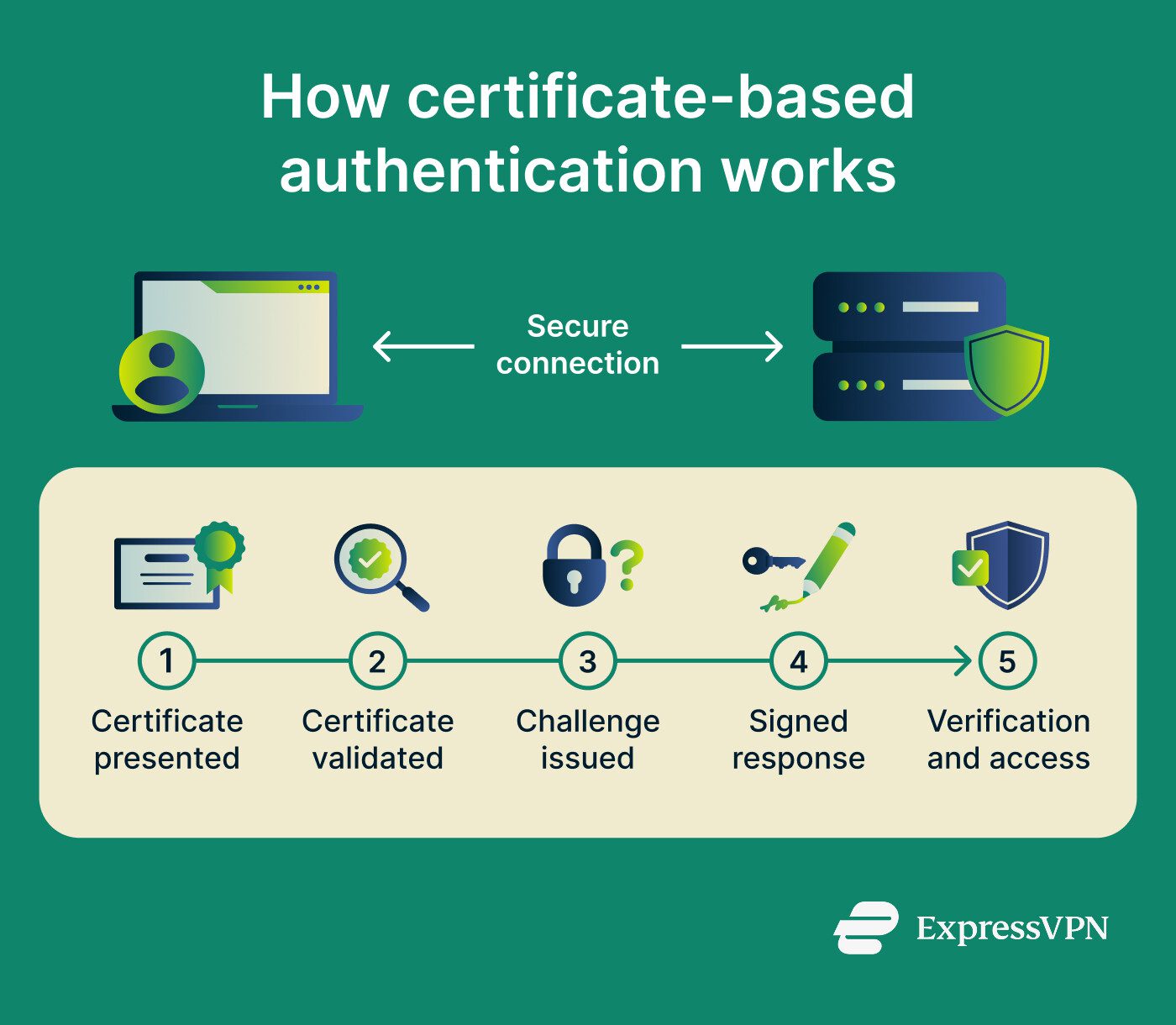
Why is certificate-based authentication important?
CBA strengthens identity verification by removing reliance on passwords and using cryptographic proof instead.
Key advantages include:
- Phishing resistance: No credentials are entered or transmitted, reducing exposure to credential-harvesting phishing attacks.
- Strong device identity: Authentication can be tied to a specific device through its private key.
- Passwordless access: Eliminates password storage, management, rotation, and reuse risks.
- Scalability: Centralized PKI-based credential management enables consistent authentication policies across large numbers of users and devices.
Where is certificate-based authentication used?
CBA is widely used in environments that require strong cryptographic identity assurance:
- Enterprise networks: Controls access to internal systems and services.
- Virtual private network (VPN) access: Authenticates devices or users before allowing connection to private networks.
- Wi-Fi security: Uses certificates to authenticate connections to wireless networks.
- Web security: Provides mutual authentication between client and server in secure communications.
- Internet of Things (IoT) environments: Enables secure, automated device-to-device authentication.
Limitations and privacy concerns
While CBA improves security, it introduces operational challenges:
- PKI complexity: Deploying and maintaining PKI infrastructure requires significant operational resources.
- Certificate lifecycle management: Certificates must be issued, renewed, and revoked correctly. Expired or unrevoked compromised certificates create security gaps.
- Private key risks: A lost private key prevents authentication until a new certificate is issued. A compromised key allows an attacker to impersonate the legitimate owner.
- Misconfiguration: Incorrect trust settings, such as accepting certificates from untrusted CAs or failing to validate certificate chains, can undermine security.
Further reading
- What is PKI, and why does it matter for online security?
- What is a certificate authority, and how does it work?
- Why we’d never install a Trusted Root CA on your device
- Authentication vs. authorization: What’s the difference?
- What is phishing-resistant MFA, and why does it matter?