
Expressvpn Glossary
Anycast DNS

What is anycast DNS?
Anycast Domain Name System (DNS) is a routing method where multiple servers share the same IP address. When a DNS query is sent, the network routes it to the nearest or most efficient server, rather than to a single fixed destination, as in a more traditional unicast DNS setup.
This approach reduces latency and improves reliability by distributing traffic across multiple servers. If one server becomes unavailable, queries are automatically routed to another without requiring changes at the user or application level.
How does anycast DNS work?
Anycast DNS works by having multiple servers in different geographic locations advertise the same IP address to the internet using the Border Gateway Protocol (BGP). BGP determines how traffic moves across networks.
When a DNS query is made, BGP selects a route based on factors such as routing policies and path attributes. The query is usually handled by the most efficient server, which may not always be the physically nearest one.
Because many servers share the same IP, traffic is distributed across a global network rather than concentrated at a single point. If a server fails or becomes overloaded, BGP automatically reroutes the queries to the next-closest healthy node. This built-in failover improves uptime and keeps performance stable during outages or traffic spikes.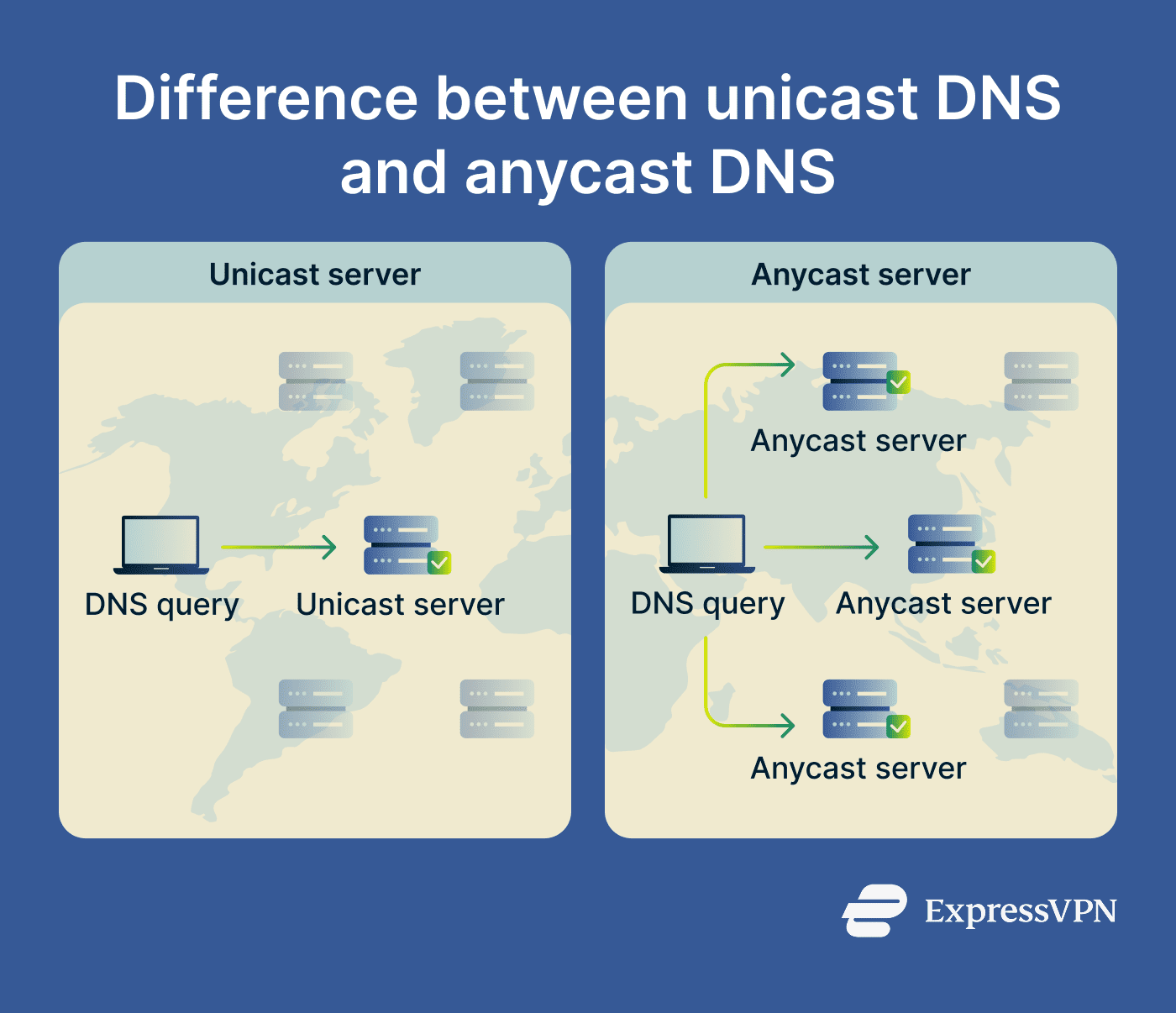
Why is anycast DNS important?
Anycast DNS creates a self-adjusting system where routing changes dynamically as network conditions change.
Key advantages include:
- Lower latency: Queries travel a shorter network path, resulting in faster DNS responses.
- Improved uptime: Automatic rerouting around failed or overloaded nodes keeps services available.
- Distributed denial-of-service (DDoS) resilience: Attack traffic is spread across many servers, lowering the impact on any single point.
- Global consistency: Users in different regions receive similar response times.
- Scalability: Infrastructure can expand by adding more servers without changing the IP address.
Where is anycast DNS used?
Anycast DNS is widely used in public DNS resolvers, such as Google Public DNS and Cloudflare DNS, where fast, reliable resolution is required at a global scale. Content delivery networks (CDNs) use it to route users to nearby infrastructure for better performance. High-availability web services rely on it to maintain uptime across regions, and DDoS mitigation systems use it to absorb large volumes of malicious traffic.
Benefits and limitations
Anycast DNS comes with various advantages and disadvantages worth considering:
| Benefits | Limitations |
| Faster responses by routing queries to nearby servers | Routing paths can shift due to BGP updates |
| Automatic failover improves redundancy | Distributed servers make troubleshooting more complex |
| Scales traffic across many global servers | Users may reach different servers depending on network conditions |
Further reading
- Anycast DNS: A detailed guide
- What is DNS, and how does it work?
- What is routing, and why does it matter in networking?
- Types of IP addresses explained: Complete guide
- Types of DNS servers: Everything you need to know