What is PKI, and why does it matter for online security?


Trust plays a central role in how modern digital systems operate. They require dependable methods to verify identities and ensure that there’s no tampering during transmission across networks.
Public key infrastructure, or PKI, is the backbone for many of these security protections. It provides the technical framework to support secure communication, authentication, and controlled access across most online ecosystems.
In this guide, we’ll take a deeper look at how PKI works, the components that support it, and why it continues to play a critical role in modern online security.
What is public key infrastructure (PKI)?
PKI is a security framework that links a public cryptographic key with the device or user that owns it. A key in this context is a piece of cryptographic data used to encrypt or decrypt information, prove identity, or establish a secure connection. PKI works with key pairs, which consist of a public key (shared openly) and a private key (kept secret by the owner).
PKI protects communication between users and servers, such as when you visit a website and see a secure HTTPS connection. It does this by ensuring two things at the same time:
- That you’re connected to the correct server, which it does by authenticating the connection.
- That the data exchanged between you and that server is protected by encryption, which PKI enables by securely exchanging encryption keys so the data can be safely transmitted.
For businesses, PKI helps secure internal systems, emails, devices, and applications. It facilitates secure communication by ensuring that messages are only readable by the intended sender and recipient and that the information hasn’t been changed while moving across the network.
Key components of PKI
PKI provides the framework for secure communication, identity verification, and controlled access online. While cryptography protects data from unauthorized access, PKI ensures that each cryptographic key is correctly linked to its rightful owner.
When a system sees a cryptographic key, it has no built-in way to know who owns it. A digital certificate solves that problem by attaching the key to a verified identity, such as a website, device, service, or organization. The certificate is issued and signed by a trusted authority, which allows other systems to rely on it as proof of ownership.
PKI involves these main components.
Public and private keys
PKI is designed to work with asymmetric encryption. As mentioned above, this type of encryption uses a pair of cryptographic keys, which are long strings of bits used by encryption algorithms to secure data.
- Public key: This key is shared openly and is typically distributed through a digital certificate issued by a trusted certificate authority (CA). In confidentiality scenarios (such as Transport Layer Security or TLS), it’s used to encrypt data so that only the holder of the corresponding private key can decrypt it. In authentication scenarios, the public key is used for decryption, namely, to verify data or digital signatures created with the private key.
- Private key: The owner of this key keeps it secret, and it’s used to decrypt data or create digital signatures.
PKI depends on careful private key management. Private keys must be generated securely, stored safely, and protected from unauthorized access throughout their lifecycle. The trust that PKI builds up breaks down if a private key is exposed or mishandled, even if the certificate itself looks valid.
While PKI is built on asymmetric (public-key) cryptography, it isn’t usually used to encrypt large amounts of data directly. Its main role is to make it safe to use symmetric encryption.
Symmetric encryption uses a single shared secret key to lock and unlock data. This method is very fast and efficient, which makes it ideal for encrypting ongoing communication. The problem is sharing that secret key safely: if an attacker intercepts it, they can read everything.
PKI solves this problem by using public-key cryptography to securely exchange a temporary symmetric key (a session key) between two parties. Once that key is safely shared, symmetric encryption takes over.
In short, PKI establishes trust and securely shares keys, while symmetric encryption does the heavy lifting of protecting the data itself.
Digital certificates
Digital certificates link public keys to verified identities, allowing systems to establish trust. They’re a core part of PKI.
Server certificates and client certificates are two common types. A client certificate can be used to identify a user, device, or application to a web server. This allows the server to verify the requester’s identity before granting access. A server certificate identifies servers and services to clients. It’s typically a TLS (formerly Secure Sockets Layer or SSL) certificate issued to a domain name or hostname, such as a website or application server.
When you enter a URL in your browser, it checks the server’s certificate to confirm that the connection is encrypted and that the certificate is valid and trusted before proceeding.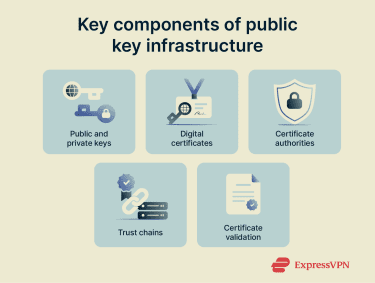
Certificate authorities
To prevent unauthorized certificate issuance, digital certificates must be issued and signed by a trusted CA. This is an organization that’s responsible for issuing, signing, and managing digital certificates and for establishing the trust rules that other systems rely on when verifying identities.
As part of this role, a CA defines and enforces policies that govern how certificates are issued, including:
- Methods used to verify the identity of certificate recipients.
- Certificate types that can be issued.
- Parameters associated with each certificate type, including validity periods and usage constraints.
- Certificate storage and status records, including accessible databases that track issued certificates, expiration dates, and revocation status.
- Operational security procedures and requirements for issuing, storing, and revoking certificates.
Once a certificate is issued, the CA signs it with its private key, creating a verifiable link between the public key and the verified identity.
In many PKI implementations, identity verification is handled by a registration authority (RA), which operates as a trusted intermediary between certificate requesters and the CA. The RA checks the identity of users, devices, or services before issuing a certificate. The CA, on the other hand, focuses on signing and managing the certificates.
In some cases, the same organization may perform both the CA and RA roles, while in others, the RA operates as a separate entity.
Trust chains
A trust chain (or chain of trust) shows how a certificate is connected to a trusted CA:
- End-entity certificate: The certificate of the website, device, or service.
- Intermediate certificates: Issued by the CA to create a hierarchy.
- Root certificate: Self-signed and trusted by operating systems and browsers.
Root certificates form the foundation of trust in PKI. Operating systems and browsers trust a limited set of root certificates by default, and all other CA certificates derive their authority from them.
Because they’re at the top of the hierarchy, root CAs must follow strict security practices. The root CA should usually be offline, with the private keys stored under highly controlled physical and operational security measures. This reduces the risk of key exposure, since a compromised root key could be used to issue fraudulent certificates that appear trustworthy across many systems.
Certificate validation
When validating a certificate, a system will check:
- That each certificate in the chain is correctly signed by the next one up to a trusted root.
- That the certificates aren’t expired or revoked.
- That revocation status is current.
If all checks pass, the certificate is considered trustworthy, allowing systems to establish secure communication, even with previously unknown parties.
Certificate revocation happens when a private key is compromised, credentials are misused, or access should no longer be trusted. Most systems use revocation lists or real-time status checks to see if a certificate is still valid. When these checks are delayed, ignored, or unavailable, revoked certificates may continue to be trusted longer than intended, weakening the trust model that PKI relies on.
What PKI is used for
Across different applications, PKI ensures that communications, software, and devices are authentic, unaltered, and accessible only to authorized parties.
Secure websites and SSL/TLS encryption
Website owners use PKI to secure their sites through SSL or TLS certificates. To get the certificate, the site owner must prove domain ownership to a trusted CA. Once the SSL/TLS certificate is installed on a web server, browsers can verify that they’re connecting to the intended domain and establish a trusted connection. This reduces the risk of users landing on a spoofed page, such as those used in phishing and typosquatting attacks.
Authentication and identity verification
PKI plays a key role in verifying the identity of users, devices, and services. Instead of relying solely on passwords or shared secrets, systems can use digital certificates to confirm that an entity is authorized to access a resource.
This approach is especially valuable in environments where strong identity assurance is required. By validating certificates against trusted authorities, organizations can reduce the risk of impersonation, unauthorized access, and credential misuse while maintaining a scalable authentication model.
PKI-based authentication plays an integral role in zero-trust security models. Instead of assuming trust based on network location or prior access, systems continuously verify identity using digital certificates before granting access to specific resources.
Secure email and data protection
Email and messaging platforms are among the most common channels for sharing sensitive information, which makes them frequent targets for abuse. Attackers posing as legitimate users or organizations can intercept, alter, or send messages without proper protections.
PKI helps online communication in two important ways.
- It can encrypt messages so that only intended recipients can read their contents. When end-to-end encryption (E2EE) is used, such as with the Secure/Multipurpose Internet Mail Extensions (S/MIME) email security standard, messages are protected even if they’re intercepted, because only recipients with the correct private keys can read them.
- It helps reduce email spoofing and phishing by enabling cryptographic verification of sender identities. Digitally signed emails allow receiving systems to confirm that a message genuinely originated from the claimed sender or domain and that it hasn’t been modified in transit.
While it doesn’t completely remove these threats, it makes it harder for attackers to convincingly impersonate trusted senders at scale.
Similar cryptographic principles are used to protect messages in secure messaging platforms that support E2EE, such as WhatsApp, where encryption keys are used to ensure that messages can only be read by intended recipients.
Digital signatures and software integrity
PKI is widely used to digitally sign software, updates, and code packages. Software publishers sign their code using private keys, allowing operating systems and devices to verify the signature against a trusted certificate before installation or execution.
This helps ensure that software hasn’t been altered in transit and that it originates from a verified source, reducing the risk of malware, tampered updates, or supply-chain attacks.
Connected devices and embedded systems
PKI is also used to establish trust between connected devices and systems that operate at scale. In Internet of Things (IoT) environments, digital certificates are used to authenticate devices, encrypt device-to-device communications, and support secure provisioning throughout a device’s lifecycle.
Similar PKI-based trust models are used in modern vehicles and medical devices, where certificates help verify software updates, authenticate components, and ensure that only authorized systems can communicate with critical hardware.
Enterprise and network security
Organizations rely on PKI to secure internal networks and services at scale. Instead of just checking each person's identity, PKI helps create secure communication throughout the entire organization, including apps, internal services, and remote access systems.
In enterprise environments, PKI supports secure remote access, internal service authentication, and encrypted communications between systems. Digital certificates allow organizations to protect traffic between applications, enforce trust between internal components, and reduce reliance on shared credentials across complex environments.
This approach enables organizations to maintain consistent security controls as networks become more distributed, supporting cloud services, remote work, and interconnected systems while preserving trust across the enterprise.
Security risks and limitations of PKI
Despite the benefits outlined above, PKI isn’t a perfect system, and bad actors can exploit its vulnerabilities. Rather than the cryptography itself, the main risk stems from the issuance, management, and trust of the certificates.
Certificates require ongoing management after issuance. They must be tracked, renewed, rotated, and revoked as systems change and credentials expire. Without lifecycle management, even a well-designed PKI system can fail.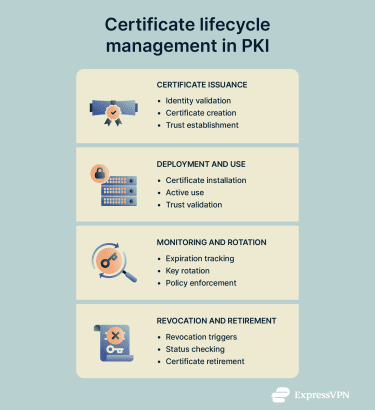
Certificate misuse and compromise
PKI is built on the premise that the certificates are valid, properly configured, and actively maintained. However, if any of these requirements are not met, the connection isn’t as secure as the user expects, even if it seems to work.
Ideally, in these scenarios, there will be a warning or blocked connection. But that’s not always the case. A system may continue operating under the assumption that a connection is secure, while data is actually exposed to interception or downgrade risks, where attackers force a connection to fall back to weaker or outdated security settings.
Trust and certificate authority risks
PKI relies on CAs to verify identities and issue trustworthy certificates. Mainstream browsers and operating systems have an updated list of approved CAs; if a certificate is issued by an untrusted CA or allowed to expire, browsers warn users that the connection is not secure or block access entirely. These warnings are designed to protect against threats such as man-in-the-middle (MITM) attacks, phishing, and malware distribution.
However, this trust model creates a single point of failure that malicious actors can exploit. If an attacker is able to insert or substitute a public key that’s improperly trusted (for example, by abusing a compromised or mis-issued certificate), they could perform a MITM attack without either party realizing it.
Management and scalability challenges
Many organizations use a mix of cloud platforms, containerized workloads, DevOps pipelines, and connected devices, all of which rely on certificates for secure communication. Traditional PKI systems were built for more static environments, and they can struggle to keep up with high certificate volumes, short-lived services, and automated workflows.
Without strong automation and centralized policy enforcement, organizations may face inconsistent certificate standards, integration gaps, and operational overhead. As environments scale, managing certificate issuance, rotation, and revocation becomes a security challenge in itself, rather than a background task.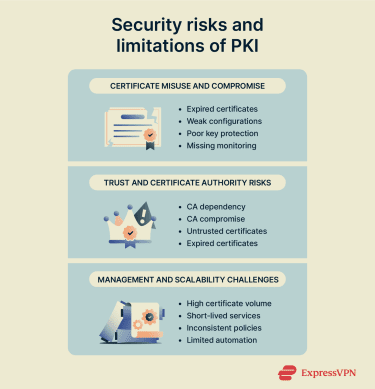
Why PKI still matters for online security
While traditional PKI systems can be difficult to manage at scale, modern PKI implementations incorporate automation, centralized policy enforcement, and tighter integration with dynamic environments. This allows organizations to issue and manage digital certificates while maintaining controlled access across complex infrastructures.
Post-quantum readiness
One of the biggest long-term challenges facing public key cryptography is the rise of quantum computing. Large-scale quantum computers could eventually break widely used public key algorithms, which rely on asymmetric encryption.
That’s why modern PKI systems are evolving to support post-quantum cryptography (PQC) and hybrid certificates, allowing organizations to introduce quantum-resistant algorithms alongside existing ones without replacing entire infrastructures. This flexibility makes PKI a critical component of preparing for future cryptographic threats.
Supply chain and IoT security
As organizations deploy more connected devices, PKI plays a central role in establishing trust between systems that operate at scale. In IoT environments, digital certificates are used to authenticate devices, secure device-to-device communications, and support trusted provisioning throughout a device’s lifecycle.
PKI also underpins secure firmware updates and software delivery by allowing systems to verify that updates come from authorized sources and haven’t been tampered with.
Zero-trust and adaptive security models
Modern zero-trust strategies rely on continuous verification rather than one-time authentication. PKI supports this approach by enabling identity verification throughout a session, rather than assuming trust based on network location.
In adaptive security models, PKI enables the use of short-lived certificates, automated rotation, and dynamic policy enforcement. These capabilities allow organizations to respond to changing risk conditions in real time while maintaining secure access to specific resources across distributed environments.
PKI as an audit and compliance tool
Beyond encryption and authentication, PKI supports governance, auditing, and compliance efforts. Certificate issuance, renewal, and revocation events can be logged and reviewed, helping organizations demonstrate adherence to security policies and regulatory requirements.
These records can support security audits, incident investigations, and forensic analysis by providing clear evidence of how identities and trust relationships were managed over time. In this way, PKI contributes not just to technical security but to broader organizational risk management.
How PKI supports secure network connections
PKI underpins many of the mechanisms used to secure network connections. Digital certificates enable systems to authenticate users and devices, encrypt data using public key cryptography, and verify the integrity of transmitted information through digital signatures.
These same mechanisms are used to secure virtual private network (VPN) connections. When you connect to a VPN, PKI helps ensure that the server you’re connecting to is legitimate and not an impostor and that the connection between your device and the VPN server is encrypted end-to-end. This prevents attackers from impersonating VPN servers and protects against MITM attacks, even on unsecured networks.
PKI also supports certificate revocation, allowing organizations to invalidate certificates when credentials are compromised or access should be removed.
FAQ: Common questions about PKI
What is PKI used for in everyday security?
Public key infrastructure (PKI) is commonly used to secure and authenticate connections between web browsers and web servers. It also helps protect access to internal systems, applications, and connected devices by verifying identities and encrypting data. Many routine online interactions rely on PKI working quietly in the background.
Is PKI the same as SSL or TLS?
No, public key infrastructure (PKI) is not the same as Secure Sockets Layer (SSL) or Transport Layer Security (TLS), but it enables them. PKI provides the framework for issuing and validating digital certificates, which SSL and TLS use to authenticate systems and establish encrypted connections. Without PKI, SSL and TLS couldn’t reliably verify identities or secure communications.
What happens if a certificate authority is compromised?
If a certificate authority (CA) is compromised, attackers may be able to issue forged certificates that appear legitimate. This can allow man-in-the-middle (MITM) attacks, where users believe they’re communicating with a trusted site while their data is intercepted or altered. Browsers may respond by displaying security warnings, blocking access, or removing trust in affected certificates.
How do I get my PKI certificate?
Obtaining a public key infrastructure (PKI) certificate typically involves working with a trusted certificate authority (CA). The process usually starts by generating and submitting a certificate signing request (CSR), which contains information about the system, service, or organization requesting the certificate. The CA then verifies the requester’s identity according to the certificate type and validation requirements. Once the identity check is complete, the CA issues the certificate.
Take the first step to protect yourself online. Try ExpressVPN risk-free.
Get ExpressVPN