What is ethical hacking, and how does it support cybersecurity?



Ethical hacking refers to authorized testing, where organizations permit specialists to probe systems using techniques similar to those used by malicious actors.
Data breaches, phishing scams, and ransomware attacks rarely occur at random. They typically begin when a flaw is discovered and exploited. Ethical hacking helps ensure those flaws are identified and addressed before attackers can take advantage of them.
This guide explains what ethical hackers can do, how people enter the field, and the certifications commonly required. It also discusses common ethical hacking techniques and the tools and technologies used.
What is ethical hacking?
Ethical hacking is the practice of testing computer systems, networks, and applications to uncover problems before they get abused. The defining factor is authorization. Ethical hackers are invited to test systems, given clear boundaries, and required to report what they discover.
Ethical hackers deliberately look for weak points. These might include outdated software, poor configurations, or design flaws. Instead of exploiting them, ethical hackers document them so they can be fixed. To do this, they try to reach areas that shouldn’t be accessible and observe how systems respond.
The difference is that this testing takes place within an agreed scope and rules of engagement, and all findings are reported back to the organization.
How ethical hackers work with security teams
Before a test starts, ethical hackers agree on what will be tested, when it will happen, and who to contact if something breaks. During or after testing, they share clear evidence of what was found so security teams can confirm the issue, understand the risk, and decide what to fix first.
Ethical hackers also support improvement over time. For example, test results can be used to adjust monitoring so similar activity is easier to spot or to update internal checks so the same type of weakness doesn’t keep reappearing.
Typical responsibilities in organizations
Ethical hackers' responsibilities usually involve a mix of planning, hands-on testing, analysis, and communication. This often includes:
- Planning safe tests: Defining what systems are in scope, what methods are allowed, and what “stop” conditions apply if something unexpected happens.
- Checking systems for weak points: Looking for security gaps in networks, apps, accounts, and configurations, using a mix of automated checks and hands-on validation.
- Confirming what really matters: Separating issues that only appear risky from issues that can actually be used to gain access or expose data.
- Reporting in a usable way: Documenting findings so technical teams can reproduce the problem and fix it, and so non-technical stakeholders understand the impact.
- Supporting fixes and retesting: Answering questions during remediation, verifying that changes work, and documenting what’s now resolved.
- Protecting sensitive information: Handling any data seen during testing carefully, sharing only what’s necessary, and following agreed rules for storage and cleanup.
How ethical hacking differs from malicious hacking
Ethical hacking and malicious hacking can involve similar techniques. The difference comes down to permission, intent, and what happens after a weakness is found.
| Ethical hackers | Malicious hackers |
| Have permission from the system owner | Have no permission from the system owner |
| Look for problems so they can be fixed, such as weak passwords, misconfigured access, or outdated software | Look for problems to exploit for gain, disruption, or access |
| Work within agreed rules and limits | Have no rules or limits to follow |
| Report what they find to the organization that authorized the testing, usually security or IT teams | Keep findings secret, reuse them, or share them publicly, including on underground forums |
Identifying security weaknesses before attackers do
Ethical hackers focus on finding security weaknesses before attackers do. This gives organizations time to fix underlying issues and reduces the likelihood of attackers discovering and exploiting them first.
These security weaknesses often stem from technical gaps that are easy to miss during day-to-day operations. Common examples include:
- Software bugs: They can appear in applications and supporting components, including custom code and external dependencies. Some bugs cause applications to process data incorrectly, while others allow actions that were never meant to be possible, such as bypassing authentication or accessing restricted functions.
- Poor configurations: These are often less visible but just as dangerous. Examples include overly permissive access controls, exposed administrative interfaces, or services running with more privileges than they actually need. These issues can quietly expand an attacker’s options without triggering obvious alarms.
- Outdated systems: Even if configured correctly, outdated systems can still contain known vulnerabilities that attackers may exploit. Without security updates, organizations often rely on mitigation or compensating controls to reduce risk.
Supporting risk management and incident prevention
Ethical hacking also supports broader risk management efforts. It helps organizations see whether their security rules actually hold up when systems are tested. For example, a company may require approval before accessing internal tools, but testing might show that some systems are open to more people than intended.
Teams use this information to make changes. Engineers can tighten access settings or fix vulnerable systems, while security teams can improve monitoring and response plans.
What ethical hackers are allowed to do
Ethical hackers are not free to test whatever they want, however they want. Their work is tightly controlled to make sure testing improves security without causing harm or crossing legal boundaries.
Before testing begins, ethical hackers agree on a scope and set of rules. This includes:
- Which systems, applications, or networks can be tested.
- Which areas are excluded (this may include third-party services or highly sensitive systems).
- What to do if testing accidentally reveals a related system or issue that falls outside the agreed boundaries.
If an ethical hacker comes across a system that wasn’t approved for testing, they must stop and request permission before continuing.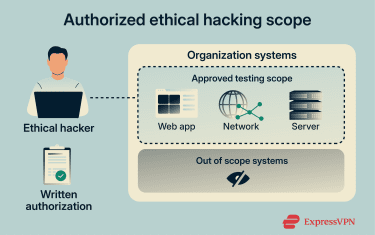
Rules of engagement and responsible disclosure
In addition to permission, ethical hacking follows specific rules that control how testing happens and how results are handled.
These rules can cover:
- When testing is allowed to take place to avoid disrupting normal operations.
- Which tools or techniques are permitted and which are not.
- Who to contact if testing causes an unexpected issue.
Ethical hackers are also expected to handle data carefully. Any sensitive information they encounter must be protected and not misused.
This is usually set out in writing before any testing starts. Companies hire ethical hackers under contracts that clearly say how data must be handled and who can see the results. These agreements often include confidentiality terms that prevent findings from being shared outside the organization.
When ethical hackers discover a security issue, they report it privately to the organization. This is usually done through a secure report or a private channel agreed upon in advance. If a hacker breaks these rules, there can be legal consequences.
Ethical hackers are also responsible for minimizing risk during testing. Some actions can affect system performance or availability, so testers are expected to use low-impact methods and coordinate disruptive tests with approved maintenance windows and technical contacts.
How to become an ethical hacker
Becoming an ethical hacker usually involves building a solid understanding of how digital systems operate, followed by focused training in security testing. There’s no single required background, but successful ethical hackers tend to combine technical knowledge, structured learning, and hands-on practice.
In some cases, people with a history of unauthorized hacking later move into ethical roles. This usually happens through formal programs, cooperation with authorities, or strict oversight.
Skills required for ethical hacking
Ethical hacking requires both technical understanding and practical judgment. These are some of the core skills involved:
- Understanding networks and systems: Knowing how networks communicate, how access and permissions work, and how different systems interact. Familiarity with operating systems, especially Linux, is important because many testing tools and environments rely on it.
- Web and application knowledge: Understanding how websites and applications handle data, user input, and authentication. Many security issues come from design or implementation mistakes in these areas.
- Basic scripting: Using simple scripts to automate routine tasks and to better understand what security tools are doing behind the scenes.
- Clear communication: Being able to explain findings in plain terms. Ethical hackers are expected to describe what they found, why it matters, and how it can be fixed so others can act on it.
Educational paths
There’s no single route into ethical hacking. The skills needed for the role can come from different paths.
Formal education in computer science, cybersecurity, or related fields helps explain how operating systems, networks, and applications are designed. This background makes it easier to recognize when something isn’t configured or behaving the way it should.
Practical IT work, such as managing systems, supporting networks, or maintaining applications, adds a different layer of understanding. Working with live systems exposes common configuration mistakes, access issues, and operational shortcuts that can later turn into security problems.
Practical development work is also important. Building software helps professionals understand how features are implemented and where mistakes can occur. When evaluating a unique function in an application, it helps to think through how it was likely built and what may have been overlooked. This can reveal flaws or unintended behaviors that create security risks.
There are also dedicated courses and training programs focused specifically on ethical hacking. These courses teach common testing methods, how to work within legal boundaries, and how to document findings responsibly. They’re often combined with hands-on labs, so people can practice in safe, controlled environments rather than real systems.
Recommended certifications
Common ethical hacking certifications include:
- Certified Ethical Hacker (CEH)
- Offensive Security Certified Professional (OSCP)
These certifications focus on different areas of ethical hacking. The sections below explain what each one covers and how they differ.
Certified Ethical Hacker (CEH)
The CEH certification introduces standard approaches to security testing. Someone with this certification understands how attackers commonly find and exploit weaknesses and how to test systems safely and legally.
CEH holders learn how to map systems and networks, identify common vulnerabilities, and assess basic security controls. They know how to run structured tests, interpret results, and separate real risks from low-impact issues. The certification also emphasizes working within scope, following rules of engagement, and documenting findings clearly so teams can act on them.
Overall, CEH shows that someone understands standard testing methods and the ethical and legal boundaries that come with security work, even if they’re still building hands-on experience.
Offensive Security Certified Professional (OSCP)
The OSCP certification focuses more heavily on hands-on testing. It’s designed to show whether someone can apply their skills in realistic scenarios, not just understand concepts on paper.
People who earn OSCP know how to plan and carry out controlled penetration tests, identify ways to move through a system once access is gained, and document their findings clearly. The certification places strong emphasis on problem-solving, persistence, and working through real technical challenges.
OSCP includes a practical exam. Candidates are given a set of systems to test and must demonstrate what they can do within a limited time, then submit a written report explaining their findings.
Many professionals hold both CEH and OSCP. CEH helps build a broad understanding of ethical hacking methods and boundaries, while OSCP shows the ability to apply those skills in real-world testing. One doesn’t replace the other, but OSCP is often seen as more advanced and hands-on.
Ethical hacking techniques
Ethical hacking mainly relies on two core techniques: penetration testing and vulnerability scanning. Penetration testing focuses on actively testing defenses under realistic conditions, while vulnerability scanning looks for known issues across systems and applications.
Penetration testing
Penetration testing simulates how an attacker might attempt to access a system under authorized conditions. The goal is to check whether existing security controls stop real intrusion attempts and to understand what would actually happen if someone tried to break in.
During a penetration test, testers examine how systems are exposed and how an attacker could realistically move through them. This can include testing network entry points, checking whether outdated software can be abused, or seeing if weak access controls allow someone to go further than they should.
They may also test how systems respond once an initial foothold is gained. For example, whether one compromised account can be used to access other systems, or whether security controls detect and stop suspicious activity along the way.
The results show which weaknesses pose real risk and which issues deserve priority attention. Rather than listing every possible flaw, penetration testing helps organizations see which problems could actually lead to unauthorized access or data exposure and how serious the impact would be.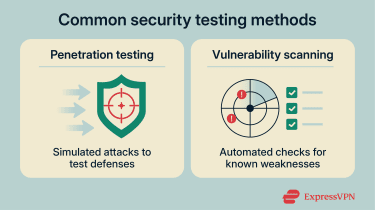
Vulnerability scanning
Vulnerability scanning checks systems and applications for known security issues. It looks for outdated software, missing updates, and unsafe configurations that attackers often target.
Organizations use vulnerability scanning as part of regular security maintenance. It helps catch common problems early and reduces exposure to well-known threats.
Ethical hackers document how these different issues connect and which ones can be abused. They can also review scan results, confirm which findings are real and which are false positives, and test whether multiple small issues can be combined into a serious risk.
They look for gaps that scanners often miss, too, such as logic flaws, unusual access paths, or situations where a system is technically “patched” but still exposed in practice.
Tools and technologies
To carry out security testing properly, ethical hackers rely on specialized tools that help them see what’s happening inside systems.
Each tool serves a different purpose, depending on what part of the system is being tested.
Burp Suite
Burp Suite is used to see how websites handle user activity. It allows ethical hackers to inspect the data moving between a browser and a server and check whether it’s being processed securely.
It’s especially useful for reviewing login flows, account settings, and other user-facing features where mistakes could lead to unauthorized access or exposed data.
Nmap
Nmap helps ethical hackers understand what a network looks like from the outside. It reveals which devices respond and which services are accessible.
Teams use it to make sure they’re only exposing what’s essential, such as approved services, required ports, or public-facing applications, and not leaving extra doors open by mistake.
Wireshark
Wireshark lets ethical hackers see what’s actually being sent across a network. This makes it easier to spot data that shouldn’t be exposed and to confirm that secure connections are working as intended.
Unlike tools such as Nmap, which show what systems and services are visible on a network, Wireshark focuses on the traffic itself. This allows ethical hackers to see whether sensitive information is being sent in clear text, whether encryption is applied correctly, and whether unexpected data is leaking during normal activity.
The future of ethical hacking
The role of ethical hackers is changing as technology evolves. What was once a periodic security check is becoming a more continuous and integrated part of how organizations protect their systems.
Automation and artificial intelligence
Automation and AI are increasingly used to support security testing, especially for tasks that involve large amounts of data. Ethical hackers now rely on these tools to speed up work that would otherwise take a long time to do manually.
AI tools can review large amounts of code, configurations, and network activity quickly, flagging patterns linked to common security issues. This allows ethical hackers to spend more time analyzing complex findings, exploring unusual behavior, and understanding how different weaknesses might combine into real risks.
At the same time, attackers are also using AI to improve phishing, automate attacks, or manipulate systems at scale. Ethical hackers are adapting by testing how these AI-driven threats work and by checking whether systems, including AI models themselves, can be misused, confused, or manipulated.
Security built in from the start
Ethical hacking is also moving earlier in the technology lifecycle. Organizations are increasingly involved in security testing during design and development.
This supports ongoing security programs or controlled live testing, where systems are reviewed more regularly. Problems are identified closer to when they’re introduced, which makes them easier and cheaper to fix.
As more infrastructure is defined through code, especially in cloud environments, ethical hackers are also reviewing configuration files and deployment scripts. This helps catch risky settings before systems go live, reducing the chance that simple setup errors turn into serious security issues later.
FAQ: Common questions about ethical hacking
Is ethical hacking legal?
Yes, ethical hacking is legal when it’s authorized. The system owner must give clear permission before any testing starts. Without that permission, the same actions would be illegal, even if the intention is good.
How is ethical hacking different from penetration testing?
Penetration testing is one type of ethical hacking. Ethical hacking is the broader practice of checking systems for weaknesses, while penetration testing focuses specifically on trying to break in to see how far an attacker could go. Not all ethical hacking is penetration testing, but penetration testing is part of ethical hacking.
Do ethical hackers work independently or within organizations?
Both. Some ethical hackers work as full-time employees inside companies. Others work independently as consultants or take part in approved testing programs. In all cases, they work with permission and clear rules.
Why is authorization required for ethical hacking?
Because ethical hacking involves accessing parts of systems that are normally restricted. Authorization makes it clear that testing is allowed, sets boundaries, and protects everyone involved from legal or operational problems.
Is ethical hacking still relevant as security tools improve?
Yes. Automated tools can find many known problems, but they can’t fully think like a human attacker. Ethical hackers help spot complex issues, unexpected behavior, and real-world risks that tools alone might miss.
Take the first step to protect yourself online. Try ExpressVPN risk-free.
Get ExpressVPN