How to identify and stop ad fraud



Ad fraud ranges from fake clicks and impressions to fraudulent affiliate activity, and it can cost companies a lot of money. It can also skew campaign data, making it hard to measure true performance or return on investment (ROI).
This guide aims to help you fight ad fraud by breaking down the tactics fraudsters use and providing practical tips on detection and prevention.
What is ad fraud?
Ad fraud occurs when someone in the ad supply chain fakes clicks, impressions, leads, or sales. This is done to make advertisers pay for traffic or results that aren’t real or valuable.
In simple terms, it’s when someone gets paid for ads that no real, interested human actually saw, clicked, or benefited from.
How ad fraud works
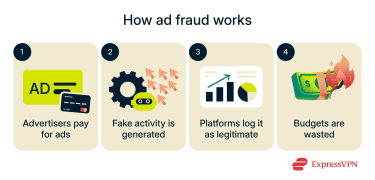
Most ad fraud follows this basic pattern:
- An advertiser pays for ads: The advertiser bids for impressions, clicks, installs, or conversions through an ad network or exchange.
- Fraudsters generate fake activity: Instead of real people seeing or interacting with ads, attackers use bots, scripts, or deception to simulate that activity.
- Ad platforms record the activity as “legitimate”: If the fake behavior looks “human enough,” it passes automated checks.
- Money changes hands: Publishers or intermediaries get paid, and the advertiser wastes budget on worthless traffic.
Tools fraudsters use
Below are some of the most common tools used to carry out various types of ad fraud.
Botnets (infected consumer devices)
Botnets are networks of real consumer devices, such as home computers, smartphones, or Internet of Things (IoT) devices, that have been infected with malware and remotely controlled without the owner’s knowledge. Because these devices belong to real people and use normal home or mobile internet connections, the traffic they generate often looks legitimate to advertising platforms.
In ad fraud, botnets are used to generate fake impressions, clicks, installs, or video views at scale. Since the activity comes from genuine devices with realistic behavior patterns, botnet traffic is much harder to block than traffic from obvious data centers or known automation tools.
Headless browsers that mimic real users
Headless browsers are automated browsers that run without a visible user interface. Fraudsters configure them to behave like real people by loading full web pages, executing JavaScript, scrolling, waiting between actions, and interacting with ads in human-like ways.
When combined with realistic fingerprints and IP addresses, headless browsers can generate fraudulent ad interactions that are difficult to distinguish from genuine user traffic.
Residential and mobile proxy IPs
Residential and mobile proxy IPs route traffic through real household or cellular internet connections rather than data centers. Fraudsters use these proxies to hide automation and bot activity behind IP addresses that look authentic.
Mobile IPs are particularly valuable in ad fraud because mobile traffic is harder to analyze and often receives less scrutiny, especially in app install and in-app advertising campaigns.
Emulators and virtual machines
Emulators and virtual machines allow attackers to simulate thousands of devices or operating systems from a single physical computer. In mobile ad fraud, emulators can imitate different phone models, operating system versions, and app environments to generate fake installs or engagement.
This setup enables large-scale fraud operations while keeping costs low. Although emulated devices are not real, they can be configured to pass many technical checks, especially when paired with realistic IP addresses and device fingerprints.
Stolen or aged user accounts
Stolen or aged user accounts are real accounts that already have a usage history, established trust signals, and normal behavior patterns. These accounts may be taken over through phishing, malware, or credential leaks, or acquired from underground markets after being left dormant.
Using real accounts allows fraudsters to bypass safeguards that target newly created or suspicious accounts. In ad fraud, compromised accounts can be used to click ads, generate installs, post affiliate links, or distribute scam traffic while appearing to come from legitimate users.
Common ad fraud types and methods
Ad fraud can take many forms, but it generally falls into a few broad categories:
- Click fraud: Fake or automated clicks are generated to drain advertising budgets or inflate publisher revenue, often using bots, click farms, or malware-infected devices that mimic normal user behavior. This is particularly damaging in pay‑per‑click (PPC) campaigns, where advertisers are billed for each click.
- Impression fraud: Ads are counted as “served” even though no human actually saw them, such as when ads load off-screen, behind other elements, or for too little time to be visible (a few milliseconds).
- Ad stacking: Multiple ads are layered on top of each other in the same placement so that only one is visible, but all generate impressions and revenue.
- Pixel stuffing: Ads are shrunk to extremely small sizes, sometimes as small as 1×1 pixel, making them invisible to users while still triggering impression counts.
- Domain spoofing: Fraudsters misrepresent low-quality or fake websites as premium publishers in programmatic ad auctions, causing advertisers to pay for placements they didn’t intend to buy.
- Mobile install fraud: Fake app installs or engagements are generated using bots, emulators, or click injection techniques to claim credit for installs that never happened or would have occurred anyway.
- Affiliate fraud: Fake leads, sign-ups, or purchases are created to trigger commissions, often using automated form submissions, disposable accounts, or incentivized traffic.
- Made-for-advertising (MFA) sites: Low-quality websites are created primarily to display ads rather than provide value to users, relying on high ad density and purchased traffic to generate revenue.
The financial impact of ad fraud
According to a market research firm, Juniper Research, and its analysis of 78,000 datasets of digital ad activity, an estimated 22% of digital ad spend was lost to ad fraud in 2023. That amounted to around $84 billion in wasted money.
In addition to these direct financial losses, ad fraud can also lead to:
- Distorted performance metrics: Fake clicks, impressions, and conversions lead to misguided decisions and wasted budget.
- Reduced growth potential: Campaigns optimized on fraudulent data underperform.
- Eroded trust: Stakeholders and partners may lose confidence in analytics, reporting, and marketing effectiveness.
- Brand reputation risks: Ads placed in low-quality or inappropriate environments can harm credibility with customers.
How to identify ad fraud
Modern ad fraud is sophisticated and often indistinguishable from real traffic at first glance. However, certain patterns and warning signs can help indicate when ad activity is not genuine.
Unusual traffic and engagement patterns
Ad fraud can often be detected by looking at traffic and engagement that doesn’t match expected user behavior:
- Sudden spikes in visits: Rapid, unexplained traffic surges may indicate bots or click farms, since normal growth is gradual and linked to marketing.
- High activity from a single IP or region: Artificial activity often comes from one server or location, while legitimate traffic generally comes from many regions and devices.
- Repeated or highly regular interactions: Bots interact with ads at consistent intervals or high frequency, sometimes immediately after display, regardless of time.
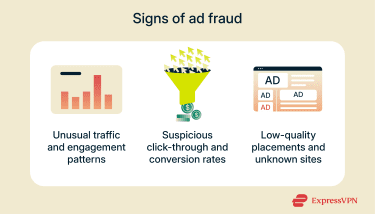
Suspicious click-through and conversion rates
Common signs of fraudulent metrics include:
- Conversions without expected interactions: Users convert immediately without viewing features, pricing, or other key content.
- High bounce rates: Many users leave right after clicking an ad; genuine visitors usually explore before exiting.
- Click-to-conversion mismatches: High click-through rate (CTR) paired with low conversions or very short sessions can indicate click fraud.
Low-quality placements and unknown sites
Ads on MFA sites often waste ad budgets, as these sites are built to generate impressions or clicks with little to no real audience.
When auditing your ad placement reports, watch out for these red flags:
- Sites with little or no real content: Pages with minimal text, auto-generated material, or copied content.
- Irrelevant or off-topic sites: Ads showing up on sites unrelated to your target audience or campaign focus.
- Excessive ads or pop-ups: Pages flooded with ads and lacking meaningful content.
- Suspicious domain names: Random, unusual, or non-descriptive URLs.
How to prevent ad fraud
These are the technical and operational measures that help prevent ad fraud.
How tools for detecting ad fraud work
Ad fraud prevention tools protect advertisers by:
- Analyzing traffic behavior: Use timing, click patterns, location, and device data to identify bots and click farms.
- Verifying ad inventory quality: Check domains and placements to detect spoofing, fake sites, and misleading inventory.
- Validating attribution: Confirm clicks, leads, and sales come from real users, not bots or fraudulent affiliate tactics.
Examples of ad fraud prevention tools
Here are some well-established tools used to detect invalid traffic, filter fraudulent activity, and protect media spend:
- DoubleVerify: Helps ensure ads appear in the right places and are actually viewable across devices. It also detects non-human and invalid traffic.
- HUMAN: Specializes in identifying sophisticated bots and other fake activity designed to look like real users.
- TrafficGuard: Focuses on fraud that impacts conversions and attribution, especially in mobile apps and paid search. It detects fake clicks, fraudulent installs, and manipulated attribution that can drive up costs.
Best practices for advertisers and agencies
Advertisers and agencies can reduce ad fraud by combining smart tools with consistent oversight:
- Verify inventory before spending: Check domains, publishers, and supply sources to ensure ads come from legitimate, authorized inventory.
- Use trusted third-party verification tools: Choose providers that validate traffic, placements, and conversions, ideally with industry accreditation and both automated and human review.
- Block fraud before buying ads (pre-bid filtering): Screen inventory in advance to prevent ads from appearing on fake or low-quality sites.
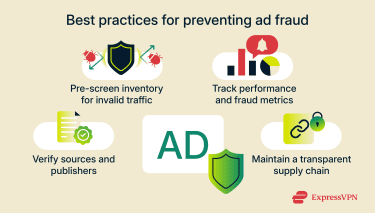
- Monitor campaigns continuously (post-bid analysis): Review traffic after ads run to spot unusual patterns in clicks, impressions, or conversions.
- Limit ad frequency: Restrict how often ads are shown to the same user to reduce repeated or invalid engagement.
- Avoid extremely cheap inventory: Unusually low cost per mille (CPM) can signal low-quality or fraudulent sources.
- Demand supply chain transparency: Know who is buying, selling, and reselling inventory.
FAQ: Common questions about ad fraud
What is an example of ad fraud?
A common example of ad fraud is click fraud, where the fraudster uses automated bots or coordinated human activity to generate fake clicks on ads. Another example is impression fraud, where bad actors make it appear as if ads were viewed when they weren’t.
What is the definition of ad fraud?
Ad fraud is when someone fakes clicks, impressions, or conversions so ads look more effective than they really are, making advertisers pay for activity that has no real value.
How do you detect ad fraud?
You can detect ad fraud by keeping an eye on unusual traffic patterns, abnormal engagement metrics, and suspicious ad placements. Signs include sudden spikes in visits, unusually high activity from a single IP or region, repeated interactions at regular intervals, and disparities between clicks and downstream conversions.
How can advertisers protect themselves from ad fraud?
Advertisers can reduce exposure to ad fraud by pre-screening ad inventory, using accredited verification tools, monitoring campaigns in real time, implementing targeting and frequency capping, and working with trusted partners that provide transparency in the supply chain.
What tools are available for detecting ad fraud?
There are numerous tools for detecting ad fraud. For example, DoubleVerify helps verify ad placement and viewability across diverse channels, and TrafficGuard detects performance- and conversion-related fraud such as fake clicks and installs.
How is ad fraud measured?
Ad fraud is measured by analyzing key traffic and engagement metrics, like click-through rate (CTR), bounce rate, time on site, and conversion rate, to identify suspicious patterns. For example, sudden spikes in visits, unusually high activity from a single IP or region, or repeated, highly regular interactions can indicate bot traffic.
Take the first step to protect yourself online. Try ExpressVPN risk-free.
Get ExpressVPN